Two telescopes already share one of the most sought-after regions of space, each on its own path. If future missions come to depend on conditions with few practical alternatives, access to it could become a point of leverage.
More than 3,000 years ago, Troy stood at the mouth of the Dardanelles, a narrow strait on the route between the Aegean and Black Seas. Its position put the city close to a passage that ships had few ways to bypass.
They were sitting at a chokepoint.
In The Foresight Brief: Chokepoints Past, Present and Future, the World Economic Forum and the Atlantic Council define chokepoints as “strategically important connectors through which goods, resources, services or information flow, often with limited alternatives”.
Today, the next chokepoint may not be on Earth at all.
For all its vastness, space has a geography of its own. At a handful of locations, known as Lagrange points, a spacecraft can keep pace with Earth as it travels around the Sun, using relatively little fuel to stay in position.
As space missions come to depend on places that offer advantages they would struggle to find elsewhere, access to those locations could soon become a source of competition.
Prime real estate: The James Webb Space Telescope
To pick up faint infrared light from some of the most distant objects in the universe, the James Webb Space Telescope needs to stay cold. Its orbit helps it do that. Roughly 1.5 million kilometres from Earth, Webb can keep the Sun, Earth and Moon on the same side of its sunshield, leaving its instruments facing cold, dark space.
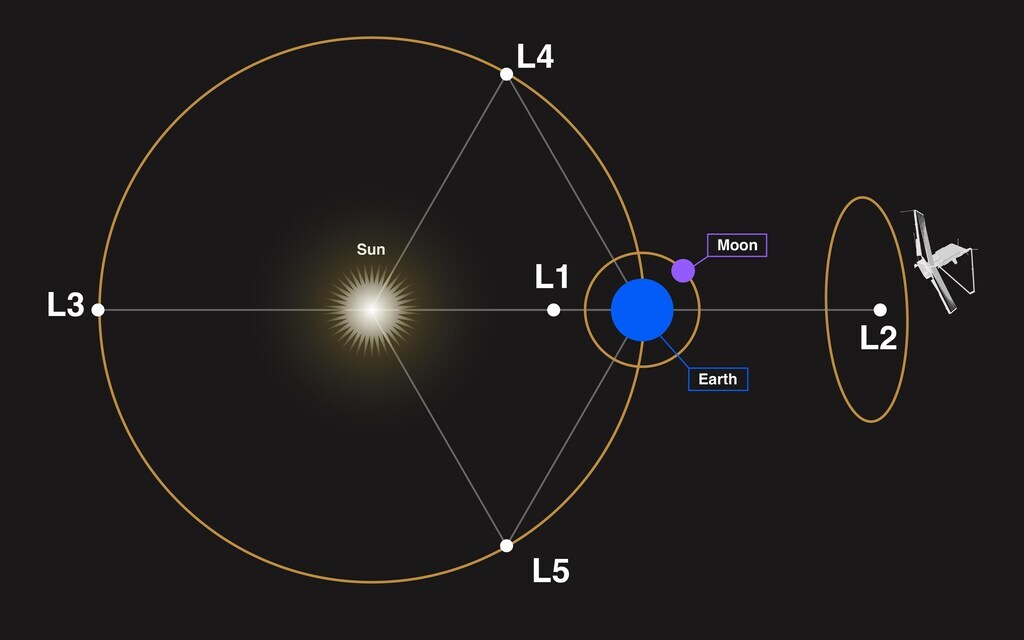
Webb loops around a location known as L2, one of five Lagrange points in the Sun-Earth system. L2 lies on the far side of Earth from the Sun. From this region, Webb can orbit the Sun at the same pace as Earth to ensure constant communication, completing a circuit in about a year.
Webb’s orbit shows what makes certain locations in space valuable, and there’s a growing lineup along the L2. Alongside Webb, the Lagrange point hosts the European Space Agency's Euclid mission and the joint Spektr-RG X-ray telescope.
NASA’s Nancy Grace Roman Space Telescope is currently in transit to its L2 orbit, roughly three months after its launch in August.
Could locations like these become strategically important as activity in space grows?
The strategic value of Lagrange points
On Earth, the importance of a chokepoint becomes clearest when the people who rely on it have to find another way.
At the Panama Canal, drought has forced ships to wait or take longer routes, and the Strait of Hormuz shocked the world earlier this year, when disruption at a single passage had consequences far beyond it.
The Panama Canal’s locks depend on freshwater. During the 2023-24 drought, falling water levels cut daily crossings from 38 to 22. The canal restricted crossings again in 2026. As climate change puts pressure on freshwater supplies, this long-established trade route could become less reliable.
The Strait of Hormuz is a major route for oil, natural gas, fertilizer and raw materials. When conflict disrupted traffic in 2026, the effects reached well beyond energy markets. At the Forum’s Annual Meeting of New Champions in Dalian, China, in June, experts discussed the global fallout from the supply shock, from the impact on Sudanese farmers to the longer-term implications of India’s response.
In space, chokepoints look different.
Around a Lagrange point, multiple spacecraft can operate on separate trajectories – Webb and Euclid already follow separate paths around L2. But unlike a narrow sea lane, space cannot simply be blockaded. Instead, The Foresight Brief warns that as these locations become more valuable for science, commerce or security, governments could seek to control access or limit a rival’s ability to operate nearby.
The strategic value of access has already been on the agenda in space. In 2023, a bipartisan US House select committee put a number on its ambition for the US in space: all five. To counter China, it recommended that the US become the first country to permanently station assets at every Lagrange point.
Planning for future missions
When strategic rivals are vying for the same orbital real estate, mission planners cannot assume access will remain friction-free. The white paper’s advice for managing chokepoints on Earth applies in space too:
Identify what you depend on.
Test how reliable access is.
Work out what alternatives you have before you need them.
Mission teams can assess alternative orbits early in the design process. Sharing planned trajectories and coordinating close approaches could help spacecraft operate safely around the same Lagrange point.
Webb and Euclid already show that several missions can benefit from the same region.
As more spacecraft head there, the organizations that understand their dependencies early will be better placed to protect their operations, seize emerging opportunities and move with greater freedom.