Electrification momentum growing amid Hormuz crisis, and more top energy stories
Countries are considering adopting a global electrification target of 35% of final energy consumption by 2035. Image: Unsplash/Gleb Khodiakov
- This round-up brings you key stories from the energy and materials sectors over recent weeks.
- Top energy news: Electricity’s ‘increasingly central role’; Latin America’s critical minerals potential; How the energy transition has become a four-part challenge.
- For more on the World Economic Forum’s work in the energy space, visit the Centre for Energy and Materials.
1. IEA: Electricity ‘taking centre stage amid Hormuz shock’
Electricity is taking an “increasingly central role” in economies across the globe, creating new opportunities for nations to strengthen energy security, boost competitiveness and cut emissions, a new report from the International Energy Agency (IEA) says.
The analysis – prepared at the request of COP31 President Turkey to inform energy transition discussions at the recent United Nations General Assembly in New York – examines the speed of electrification across different regions as countries consider adopting a global electrification target of 35% of final energy consumption by 2035, up from 23% today.
It finds that faster deployment of available technologies could cost-effectively meet 33% of the world’s final energy consumption by 2035, bringing the 35% goal within “striking distance”.
Meanwhile, energy prices at current levels amid the Strait of Hormuz crisis would make even more of the world’s energy consumption economical to electrify. Many countries are exploring how they can leverage electrification to further reduce dependence on imported fuels while lowering emissions.
The report's authors find “substantial potential” in all regions to increase electrification rates above today’s levels cost-effectively. Realizing this potential will require scaling up investment in generation and grids and implementing smarter, more flexible power systems.
Clean power technologies have rapidly scaled over the past two decades, led by solar PV – deployment of which approached 600 gigawatts in 2025 alone, more than 10 times the annual level a decade earlier.
But as noted in the latest Energy Transition Index from the World Economic Forum (WEF), meeting demand will require a “much closer alignment between the speed of electrification and the capacity of systems to absorb it”.
2. World Economic Forum report: Greater collaboration is key to advancing Latin America’s minerals potential
Latin America has the potential to become a leading supplier of the minerals needed for batteries, power grids and digital technology, a new Forum report finds. But catalyzing greater value calls for stronger collaboration across the region.
In production terms, the continent accounts for about 40% of mined copper production and around 30% of mined lithium production globally.
But according to Advancing Latin America’s Critical Minerals Potential, a white paper created in collaboration with McKinsey & Company, the region has the opportunity to better convert its “exceptional geological endowment” into sustainable growth, quality jobs and shared value.
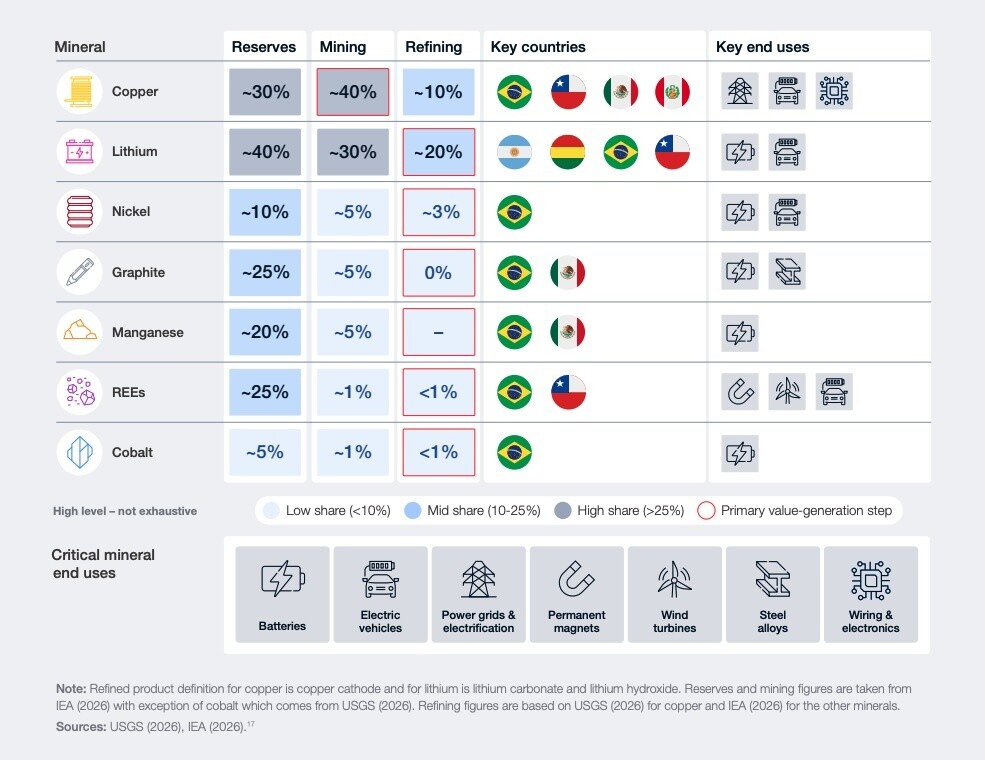
Currently, 62% of critical minerals exported from Latin America and the Caribbean are raw materials, while only 38% are processed goods. This gap highlights an opportunity for countries to generate greater industrial and economic value where competitive advantages exist in refining, processing and downstream manufacturing, the report says.
Factors such as rising geopolitical competition and growing demand for resilient supply chains are driving interest in diversified sources of critical minerals, creating an opportunity for Latin America to strengthen its position in the sector and attract long-term investment.
For some countries, this may mean strengthening upstream productivity. For others, it may mean moving into processing, technology and manufacturing – and doing so will likely require advances in technology and cluster-based ecosystems that connect resources, infrastructure, talent and investment.
With the scale of investment and capabilities needed to build end-to-end critical minerals ecosystems often too large for individual countries to meet, regional collaboration is increasingly important, the report says.
3. News in brief: More energy stories from around the world
Takeaways from the 1st Energy Forum held at the World Economic Forum: Leaders from across the global energy ecosystem met in Geneva this month to explore the forces reshaping the future of energy and work on pathways to create growth, strengthen resilience and accelerate innovation.
With attendees from 35 nations with strong representation from Europe, North America, China and additional representation from India, MENA and ASEAN, discussions focused on how to meet rapidly growing energy demand; build secure, sustainable and affordable energy systems against a backdrop of global uncertainty; and how countries and companies can stay innovative and competitive in this fast-evolving energy landscape.
Key takeaways included the energy transition’s four interconnected challenges of security, sustainability, affordability and competitiveness; the importance of regional and public-private cooperation in driving innovation and resilience; and the critical role of grids and flexibility in determining the pace of energy-system growth.
The overall message was clear: The next phase of the energy transformation is less about identifying individual technologies and more about integrating infrastructure, markets, and policy through collaboration so that innovation can be deployed at scale.
US energy storage record: The United States installed a new quarterly record of 18.9 gigawatt-hours of battery energy storage systems in the second quarter of 2026, according to figures from the American Clean Power Association and Wood Mackenzie.
Italy approves nuclear power law: Italy’s parliament gave final approval to a government plan to restart nuclear power generation in the country, almost 40 years after a referendum led to the closure of its reactors. Italy wants to deploy advanced modular reactors to help decarbonize industry and strengthen energy security.
Germany plans fossil fuel exit: Germany’s cabinet has greenlit a roadmap to phase out coal, oil and gas by 2045. Electric vehicles and heat pumps will form a key part of the transition. France and the Netherlands have recently adopted similar national roadmaps.
South Korea seeks to diversify supply: South Korea is aiming to cut its reliance on crude oil from the Middle East to 50% by 2035, from 70% today, as it moves to diversify energy supplies amid disruption caused by the Iran war. Under its 10-year natural resources security plan, the country adjusted its stockpiling plan for crude oil, targeting an expansion of about 20 million barrels by 2030.
US proposes Gulf energy investment: The US has proposed investing $5 billion in a new fund to help countries in the Middle East rebuild energy infrastructure that has been hit by the Iran war and reduce their reliance on the Strait of Hormuz to transport oil and gas, the Wall Street Journal reports. Countries including Saudi Arabia and the UAE are among the nations discussing the plans.
Construction begins on major Kenyan oil refinery: Ground has been broken on a $16 billion oil refinery in Kenya aimed at lowering East Africa's fuel costs and creating energy self-sufficiency across the region by replacing imports of refined products. East Africa has been hit hard by rising fuel prices amid the Iran war.
4. More on energy from Forum Stories
Energy Nexus Playbook: Energy systems are deeply interconnected with economies, nature and agriculture, but these connections are often misunderstood or managed poorly. To identify approaches to bridge the gap, the WEF’s Global Future Council on Energy Nexus convened experts from across regions and sectors. The Energy Nexus Playbook collates insights from the council through a 'systems lens' on five priority sectors facing imminent vulnerabilities across their value chains: clean energy; food and agriculture; artificial intelligence and data centres; shipping and ports; and fresh and used water. Read more.
Rethinking resilience: For most of the past decade, energy companies have treated cyberattacks, physical sabotage, extreme weather and geopolitical disruption as distinct problems. But in increasingly digitalized and interconnected energy systems, that separation is beginning to look like the problem itself. Energy resilience has to be built in by design across public and private actors – not added on after something has already gone wrong, argues Prajeev Rasiah, SVP and Regional Director, Northern Europe, Energy Systems, DNV.
To learn more about the work of the Centre for Energy and Materials, contact Ella Yutong Lin: ellayutong.lin@weforum.org
License and Republishing
World Economic Forum articles may be republished in accordance with the Creative Commons Attribution-NonCommercial-NoDerivatives 4.0 International Public License, and in accordance with our Terms of Use.
The views expressed in this article are those of the author alone and not the World Economic Forum.

Forum Stories newsletter
Bringing you weekly curated insights and analysis on the global issues that matter.
More on Energy TransitionSee all

Piyush Verma
September 30, 2026


