This French industrial cluster shows how collaboration can drive green reindustrialization
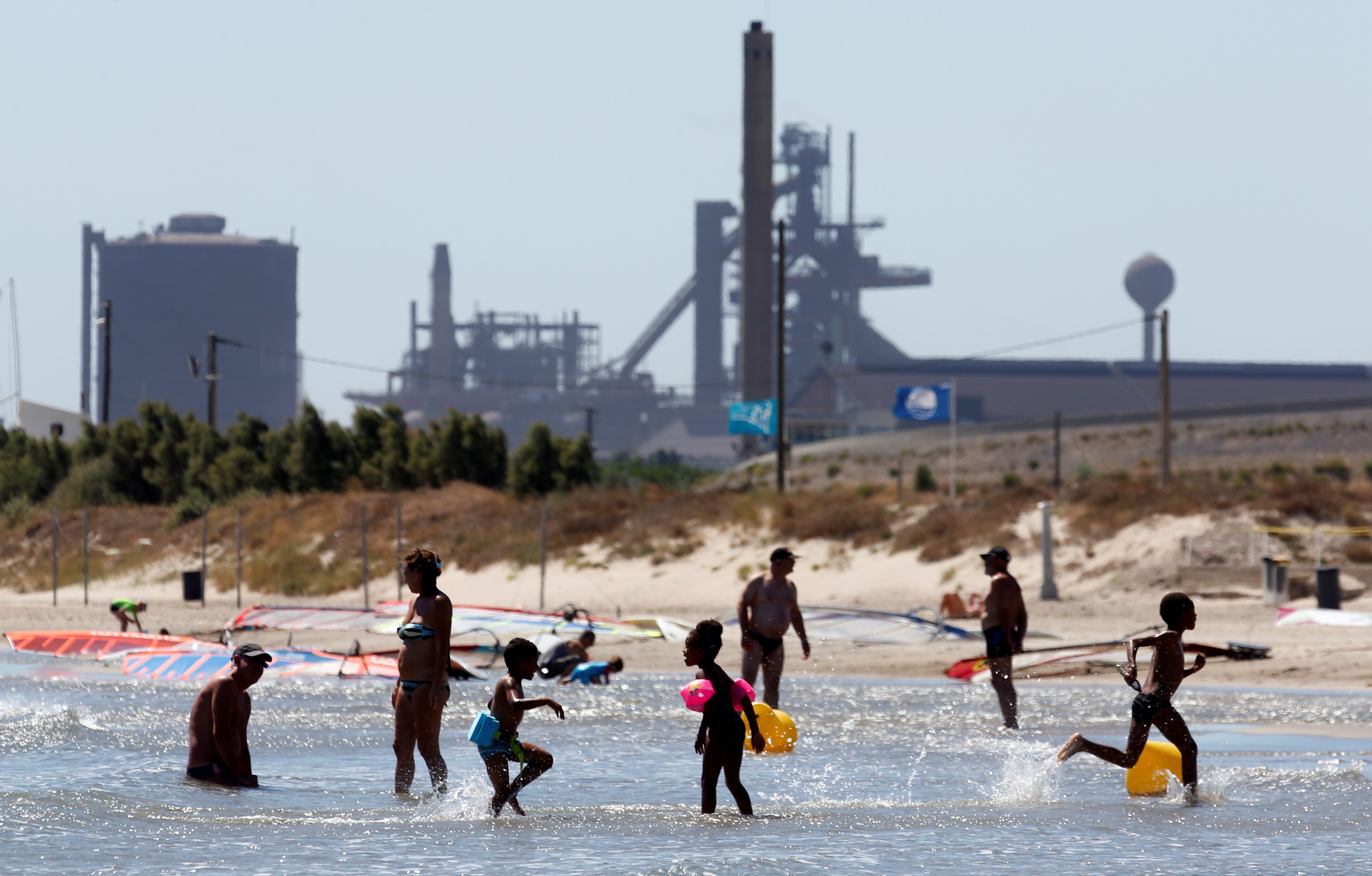
People bath to cool off on a Mediterranean beach near Marseille's Fos-Berre industrial cluster. Image: REUTERS/Jean-Paul Pelissier
- By attracting investments, sharing infrastructure and enabling collaboration,
industrial clusters can drive industrial competitiveness, sustainable growth and job creation. - Marseille's Fos-Berre cluster demonstrates how decarbonization, environmental stewardship and competitiveness can go hand in hand.
- Fos-Berre is emerging as a blueprint for Europe's industrial future, proving that clusters can decarbonize existing industries while building entirely new value chains.
Europe's industrial regions face a defining challenge: remaining globally competitive while accelerating the transition to net zero. Across the continent, industrial clusters – geographic concentrations of industries - are under pressure to decarbonize, strengthen energy security and attract new investment, all while safeguarding jobs and supporting regional development.
The Fos-Berre industrial and port area, near Marseille in southern France, demonstrates that these objectives are not mutually exclusive. Through collaboration, industrial regions can transform decarbonization into a catalyst for competitiveness, innovation and long-term resilience. Fos-Berre is home to one of Europe's largest industrial and port ecosystems, supporting 126,000 jobs and responsible for one quarter of French industrial CO₂ emissions and 40% of regional emissions. It brings together refining, petrochemicals, chemicals, steelmaking, energy production, port logistics and waste treatment within a single geographic area.
For more than a decade, the Fos-Berre industrial and port area has served as a living laboratory for industrial synergies where companies collaborate for decarbonization that other industries and areas can learn from.
From industrial legacy to industrial transformation
Like many European industrial regions, Fos-Berre is responding to profound structural changes. European climate and industrial policies like the EU Green Deal Industrial Plan are encouraging the deployment of new low-carbon industries. At the same time, national ambitions to reindustrialize France have created opportunities to attract new green manufacturing projects via the creation of the national investment programme France 2030. One of its most significant instruments, the Low Carbon Industrial Zones (ZIBaC) programme, brings together co-located industrial players to develop shared low-carbon infrastructure - including hydrogen networks, carbon capture pipelines and renewable energy systems - across France's major industrial basins.
Fos-Berre’s SYnergies Régénératives IndUstrielles Sud (SYRIUS) programme brings together industrial players, public authorities and port stakeholders to develop common decarbonization pathways, identify shared infrastructure needs and coordinate investment across the territory. In its first phase (2023–2025), SYRIUS completed 28 studies and developed three collective decarbonization scenarios for the Fos-Berre industrial territory, identifying shared electricity, hydrogen and CO₂ infrastructure needed to achieve up to 80% reduction in industrial greenhouse gas emissions by 2050.
The role of cluster governance
Central to Fos-Berre's transformation is PIICTO, an association established in 2014 to foster collaboration across the regional industrial ecosystem. Today it brings together 50 industrial firms and 10 public authorities around a shared vision of industrial and territorial ecology. This approach is based on the idea that industrial activities can no longer be viewed in isolation, but rather as components of a shared regional system. They coexist, utilize shared infrastructure and generate flows of materials, energy, resources and waste that can be pooled or recovered.
As a neutral convenor, PIICTO facilitates dialogue between industry, local authorities, infrastructure operators and energy providers, identifies opportunities for new industrial synergies, supports collaborative projects and creates the conditions for long-term industrial transformation. This collaborative governance model enables organizations with different priorities to work collectively towards shared regional objectives.
Reindustrializing through low-carbon projects
A shared vision and common decarbonization strategy have enabled Fos-Berre to develop an ambitious pipeline of industrial projects, designed to decarbonize existing industries while attracting new investment.
GravitHy, for example, plans to produce 3 million tonnes of the emissions-reduced Direct Reduced Iron (DRI) annually using green and low-carbon hydrogen, representing €2.2 billion in investment, creating up to 500 direct jobs and avoiding up to 4 million tonnes of CO₂ each year, equivalent to 5% of French industrial emissions. Commercial production is scheduled for 2029.
On top of that, industrial projects including Rhône CO₂, Elyse Energy Neocarb and Project DEOS are engaging in projects covering biofuel development, carbon capture, utilization and storage (CCUS), hydrogen infrastructure, electrification of industrial processes, energy optimization projects and strategic infrastructure developments.
These projects demonstrate that industrial decarbonization is about creating new industrial value chains while strengthening Europe's strategic industrial capabilities.
Data and digital collaboration for industrial clusters
Physical infrastructure alone is not sufficient to unlock the full potential of industrial collaboration. As industrial ecosystems become increasingly interconnected, digital technologies play a critical role in enabling companies to design, operate and optimise complex value chains collectively.
Digitalization is crucial to support industrial transformation from the earliest design stages. For example, through a collaboration with GravitHy, Siemens is contributing to the development of a digital-native industrial asset by helping define the project's digital roadmap and digital twin strategy. The objective is to create a digital thread linking engineering, construction and operations, enabling more efficient project execution, improved operational performance and enhanced lifecycle optimization.
Beyond individual facilities, digital twins, industrial data platforms and interoperable software architectures are a structural asset for industrial clusters. By creating trusted environments for sharing operational information, simulation results and resource flows, they can help coordinate the use of shared infrastructure, optimise energy and hydrogen consumption, improve maintenance strategies and accelerate innovation across multiple industrial projects. That’s why digital collaboration is emerging as a key enabler of the next generation of industrial ecosystems, alongside the physical advantages of geographic clusters.
Balancing industrial development and biodiversity
One of the most significant challenges facing many industrial clusters is balancing new industrial development with biodiversity preservation.
To achieve this in Fos-Berre – which contains and is adjacent to environmentally sensitive and protected natural areas – the cluster follows the Avoid-Reduce-Compensate (ARC) sequence. New projects are first directed towards existing brownfield sites. Where impacts cannot be entirely avoided, designs are adapted to minimize land use and environmental disturbance. Unavoidable residual impacts are compensated through restoration or conservation measures elsewhere.
This systematic approach encourages companies to identify shared environmental solutions and reinforces the principle that sustainable industrial development depends on collaboration as much as technological innovation.
A model for Europe’s industrial future
Fos-Berre demonstrates that the transition to net-zero can be a story of industrial renewal.
Through collaborative governance, shared infrastructure and an ambitious pipeline of low-carbon projects, Fos-Berre is positioning itself as a model for sustainable growth - attracting new industries, creating quality jobs and building long-term economic resilience.
The World Economic Forum's Transitioning Industrial Clusters (TIC) initiative, which PIICTO recently joined, coordinates these efforts through a rapidly growing international network of industrial clusters, enabling clusters like Fos-Berre to exchange knowledge with global peers.
As industrial regions across Europe confront similar challenges, Fos-Berre offers a compelling example of how collaboration can accelerate both decarbonization and economic development.
Its experience shows that when industries, governments and infrastructure providers work together, industrial clusters can become powerful engines of green reindustrialization and a blueprint for Europe's industrial future.
Don't miss any update on this topic
Create a free account and access your personalized content collection with our latest publications and analyses.
License and Republishing
World Economic Forum articles may be republished in accordance with the Creative Commons Attribution-NonCommercial-NoDerivatives 4.0 International Public License, and in accordance with our Terms of Use.
The views expressed in this article are those of the author alone and not the World Economic Forum.
Stay up to date:
Job Creation
Related topics:


Forum Stories newsletter
Bringing you weekly curated insights and analysis on the global issues that matter.
More on Energy TransitionSee all

Piyush Verma
September 30, 2026


