Europe's devastating heatwaves and wildfires in 4 charts
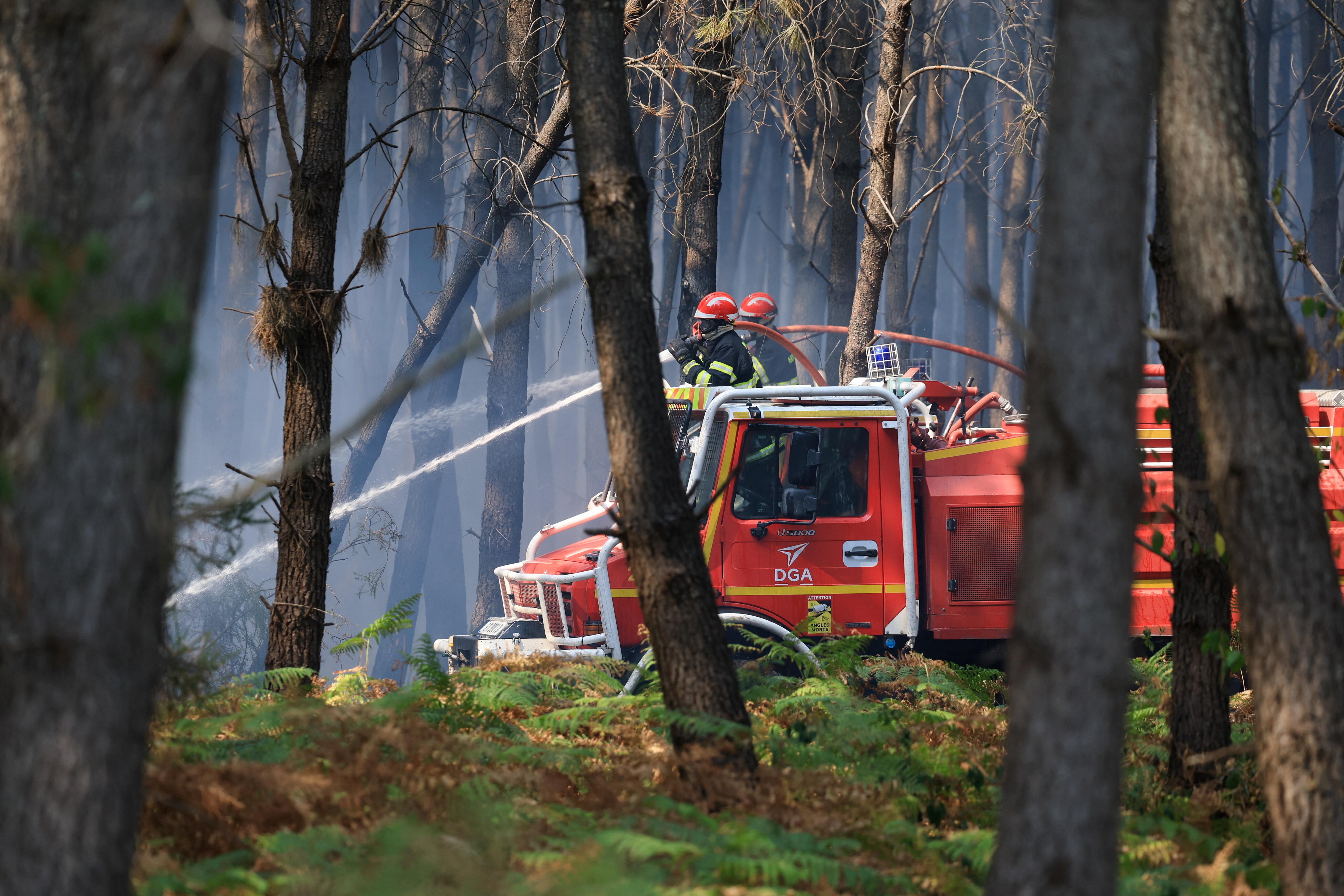
In the Gironde region of France, wildfires burnt over 420 sq km of land in under four days. Image: REUTERS/Yves Herman
- Europe's heatwaves this summer have broken countless records and impacted the continent in unprecedented ways.
- Huge wildfires have spread across France and Spain, leading to mass evacuations.
- The Forum's Global Wildfire Leadership Network catalyzes collective investment in wildfire resilience and connects local initiatives to a global agenda, while the Forum's Workforce Resilience to Extreme Heat workstream supports businesses in addressing the growing risks that rising temperatures pose to worker health, safety and productivity.
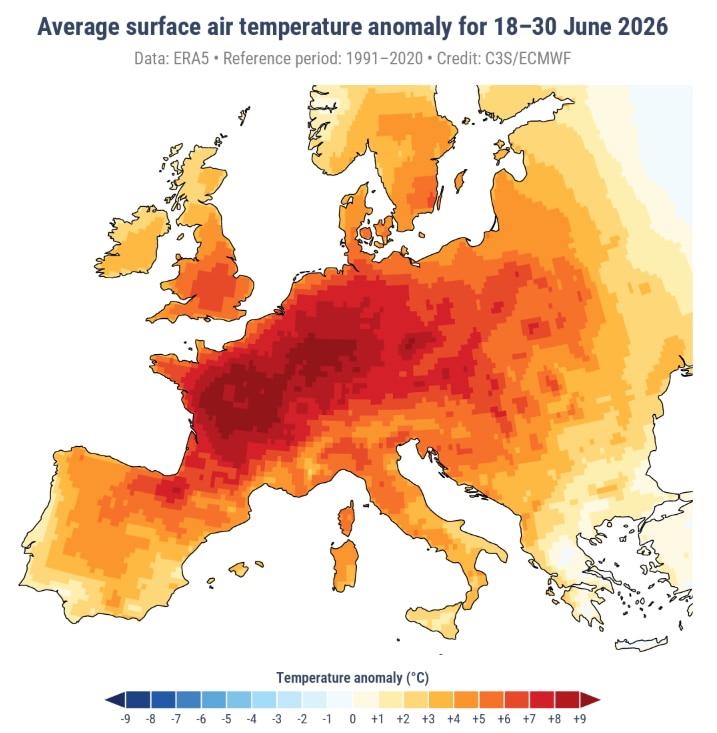
Western Europe experienced its warmest June–July period on record in 2026, according to the EU's Copernicus Climate Change Service. Temperature records continue to be smashed, with no end to the heatwaves currently in sight.
While the climate crisis is behind this extreme shift in the region's summer weather, in more specific terms, changes to the jet stream, El Niño and a hotter-than-usual ocean have combined to lock hot, dry air over much of the continent for the fourth time since May.
The impact has been devastating, with Reuters reporting an estimated 10,000 excess deaths during June's heatwave, according to early data and the whole continent facing a stark new reality. As of early August, water levels are falling, with the River Danube at a record low and threatening the power supply in Hungary; Italy has put most of its major cities on the highest heat alert; and the UK is facing concerns over crop losses and food supply pressures.
At the same time, the intense and prolonged heat has turned Europe's landscapes tinder-dry, and wildfires have been rampaging in several countries as a consequence.
To get a sense of how unprecedented – and alarming – the situation is, the following charts highlight some of the key data behind Europe's heatwave crisis.
Record-breaking heat
For so many countries to be breaking heat records is both extraordinary and expected. As John Kennedy, Head of Climate Information at the World Meteorological Organization (WMO), said, “Heatwaves like this are what we expect to see in a changing climate".
As the heat map (below) from the EU's Copernicus climate service shows, large swathes of Europe experienced temperatures in June that were significantly above the 1991-2020 average.
Europe is the fastest-warming continent on Earth, heating at twice the global average.
”These are just some of the records broken across the continent so far this summer:
- On 8 July, a temperature of 40.5°C was recorded in Barcelona, Spain, the highest in over a century of data collecting at the WMO's Fabra Observatory.
- Vienna, Austria, set a new June temperature record with 40°C recorded in the city.
- For the first time, the Netherlands issued a Red Alert for extreme heat in eight provinces, with a June temperature of 39.4°C smashing all previous records.
- France recorded a temperature of 43.8°C in the western town of Pulluau, with overnight temperatures in the country also breaking records at 22°C.
- In Basel, Switzerland, a new June temperature high of 39°C was recorded.
The countries with the fastest temperature increases
With so many heat records broken, Reuters Climate Monitor shows which countries are experiencing the largest temperature anomalies compared with historical norms.
Comparing current temperatures in 10 European countries to historic norms, Belgium recorded the largest anomaly at the time of writing – its 4 August average high of 32.1°C was more than 11°C above its typical high for the 1961–1990 reference period.
While the UK is far from the hottest of these 10 countries, it recorded a temperature anomaly of 4.4°C on 4 August; the Netherlands, meanwhile, experienced a 9.8°C increase.
Only Portugal recorded a negative anomaly, with its average high 0.4°C below the historical reference.
The economic cost of extreme heat
Extreme heat is not only a health and environmental risk – it is increasingly taking a toll on workers and the wider economy. The International Labour Organization estimates that more than 2.4 billion workers globally are exposed to excessive heat, with around 22.85 million occupational injuries attributable to it each year. By 2030, heat stress is projected to reduce total working hours worldwide by 2.2%, equivalent to 80 million full-time jobs and $2.4 trillion in economic losses.
Those costs are already becoming visible in Europe. In the UK alone, research into the weeklong late-June 2026 heatwave estimated that 24 million working hours were lost, resulting in a $1.55 billion hit to economic output. Workers in more heat-exposed and physically demanding sectors, including construction and agriculture, reported particularly large reductions in working hours.
Wildfires in numbers
France, Spain, Portugal, Greece, the UK, Italy, Germany and the Netherlands have all been battling wildfires as a result of the heatwave.
More than 300,000 people have been evacuated from their homes across both France and Spain, where the fires have been particularly widespread and challenging to contain.
In the Gironde region of France, 2,500 firefighters battled a wildfire that broke out on 22 July and burnt over 420 sq km of land in under four days. At its peak, the blaze was just nine miles from the city of Bordeaux, reports the BBC.
In regions outside Madrid, Spain, wildfires have burnt around 1,570 sq km of land since 1 July, according to the European Forest Fire Information System.
Is this a wildfire tipping point?
As wildfires begin to abate in some regions, evacuated residents are returning to what remains of their homes. In Le Porge, France, depicted in the images below, more than 180 houses were destroyed by fire.
But the heatwave is not over, and the threat of further wildfires remains. During the peak of the wildfires in France, President Emmanuel Macron held an emergency cabinet meeting and a Gironde official told the BBC that France does not have enough firefighters to tackle wildfires on this scale.
“Every summer reminds us that wildfire is no longer an exceptional event but an increasingly predictable consequence of a warming climate,” said Paola Deda of the United Nations' forest division for Europe.
Europe’s most intense fires have even created pyrocumulonimbus clouds or 'fire clouds' - fire-generated thunderstorms that can make fires harder to control. The following video explains further:
Deda emphasizes the need for preventive measures like sustainable forest management and building in more resilient landscapes, ideas discussed in the World Economic Forum and PwC's whitepaper, Wildfire Risk to Resilience: The Investment Case for Action.
With wildfires becoming more frequent, severe, and costly globally, prevention remains chronically underfunded compared to response. Closing that gap requires business, finance, government and civil society to act together. The Forum's Global Wildfire Leadership Network brings leaders into a single community – housed within the Forest Future Alliance – to catalyze collective investment in wildfire resilience, align public and private efforts, and connect local initiatives to a global agenda.
Alongside this, the Forum's Workforce Resilience to Extreme Heat workstream supports businesses in addressing the growing risks that rising temperatures pose to workforce health, safety and productivity, strengthening resilience as extreme heat becomes an increasingly significant risk to people and economies.
License and Republishing
World Economic Forum articles may be republished in accordance with the Creative Commons Attribution-NonCommercial-NoDerivatives 4.0 International Public License, and in accordance with our Terms of Use.
The views expressed in this article are those of the author alone and not the World Economic Forum.
Related topics:

Forum Stories newsletter
Bringing you weekly curated insights and analysis on the global issues that matter.
More on Nature and BiodiversitySee all

Santiago Gowland
September 23, 2026


