Why the world should become 'nature positive' by 2030

Nature is the foundation for both economic and social progress. Image: Chuttersnap/Unsplash
Harvey Locke
Vice Chair for Nature Positive, IUCN World Commission on Protected Areas, International Union for Conservation of Nature (IUCN)- The loss of species, ecosystems and natural processes is weakening the Earth system on which societies and economies depend.
- However, protecting nature is still often not prioritized, despite being the context for both economic and social progress.
- Public and private action is needed across the economy and society to meet global goals to become nature positive by 2030.
Nature’s rapid global decline is eroding the foundations of human prosperity. The loss of species, ecosystems and natural processes is weakening the Earth system on which societies and economies depend. Yet nature is still often treated as one priority among many, to be balanced against other societal goals.
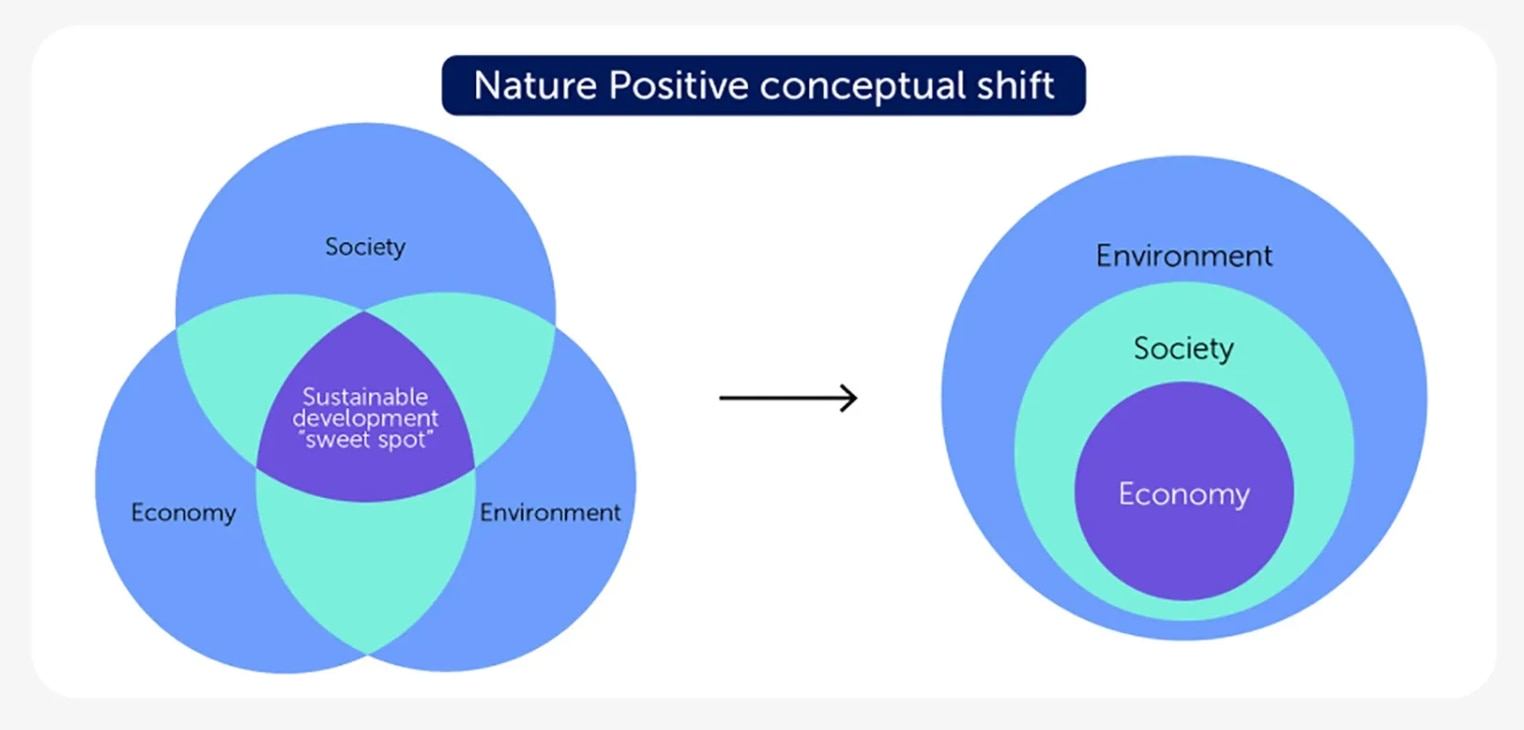
In reality, human societies exist within nature, and economies exist within societies. Protecting nature is therefore not separate from economic and social progress; it is the context for both.
As natural systems lose their capacity to store carbon, regulate climate and sustain water cycles, the consequences are felt across food systems, public health and economic activity.
Recognizing that uncomfortable reality, the Kunming-Montreal Global Biodiversity Framework calls for halting and reversing biodiversity loss by 2030. More precisely, the Nature Positive initiative calls for halting and reversing nature loss by 2030, relative to a 2020 baseline, and achieving full recovery by 2050.
The Nature Positive initiative, as outlined in the Kunming-Montreal Global Biodiversity Framework (GBF), recognizes this uncomfortable reality. To turn things around, it calls for halting and reversing nature loss by 2030, relative to a 2020 baseline and achieving full recovery by 2050.
In our recent Frontiers in Science article, we examined the actions, metrics and enabling conditions needed to achieve a nature-positive world.
Protect what still works
Avoiding further loss of intact nature is the most urgent nature-positive action.
When an intact ecosystem is cleared, fragmented or drained, the loss extends beyond visible vegetation. Carbon stores, species assemblages, water flows and ecological relationships are damaged. The risk of zoonotic disease increases. The resilience needed to adapt to climate change is diminished. And the rapidly changing Earth system is destabilized further.
Restoration is a prominent part of the global environmental agenda, and for good reason: degraded forests, wetlands, rivers, grasslands and coastal ecosystems urgently need recovery. But restoration can only supplement the protection of intact nature.
Trying to become a nature-positive world through restoration while intact systems disappear is like filling a hole with a shovel while a backhoe keeps digging it deeper: the first step to get out of a hole is to stop digging.
Biodiversity targets must protect natural processes
The Kunming–Montreal Global Biodiversity Framework is the main international framework for halting and reversing biodiversity loss. Its targets address many urgent priorities, including protected areas, ecosystem restoration, extinction risk and pollution reduction.
The framework is a major advance in international policy, but it is incomplete. Targets focus primarily on important biodiversity patterns but give too little attention to the natural processes that sustain species and Earth-system function.
Three processes require much greater attention:
- Hydrology: Free-flowing rivers, connected floodplains, groundwater and seasonal sediment movement support ecosystems from watersheds to estuaries. Dams, diversions and drainage can disrupt these relationships across entire river systems, with far-reaching effects on nearby terrestrial ecosystems.
- Biome function: Large forests influence rainfall far beyond their boundaries through moisture recycling. Continued forest loss can affect agriculture, water supply and climate, while increasing the risk of irreversible ecological shifts.
- Migration: Animals moving between breeding, feeding and seasonal habitats connect ecosystems and nutrients across borders and across land, freshwater and ocean. Protecting a wintering area is insufficient if stopover sites, breeding areas or migratory routes disappear elsewhere.
Minimum viable populations are inadequate to maintain a species’ function in the landscape.
When we count trees but lose track of the forest, we miss the forest biome’s contribution to regional weather. The Amazon rainforest, for example, generates rainfall that supports agriculture, hydropower and urban water supplies in the Rio de la Plata Basin.
If around 20% of the Amazon’s primary rainforest is cleared, that function could stop, with catastrophic impacts on the South American economy, as well as severe impacts on regional businesses, global buyers and food supplies.
One goal, different starting points
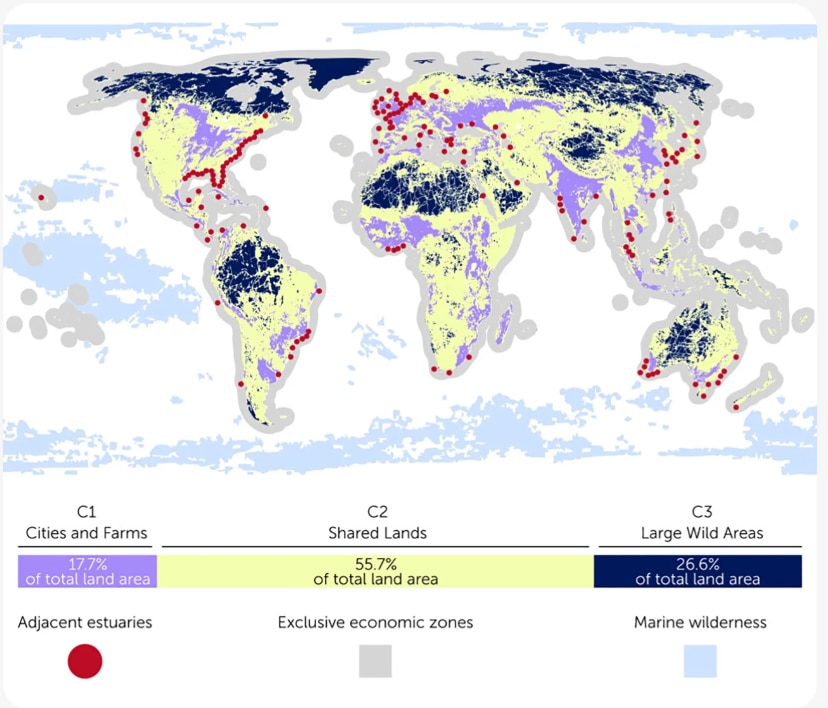
The Nature Positive strategies are contextual. Cities and farms, shared landscapes and large wild areas face distinct pressures and offer unique opportunities.
The Three Global Conditions (3Cs) Framework tailors action to each ecological context rather than prioritizing them. Action across all three conditions is needed to stabilize the Earth system and the benefits people receive from nature:
- Cities and farms: In heavily transformed, highly productive areas, priorities include retaining native habitat, restoring native vegetation especially along streams, reducing pollution, reconnecting fragmented areas, avoiding urban sprawl and reducing hazards to migratory species.
- Shared lands: Where natural areas overlap with extraction and grazing, key strategies include preventing further degradation, maintaining connected habitats and waterways, improving extraction practices, reducing grazing pressure and expanding well-governed, interconnected protected and conserved areas.
- Large wild areas: The central task is to keep these large intact biomes intact. Avoiding new roads, dams, industrial extraction and other fragmenting infrastructure protects hydrology, migration and biome-scale function. These areas are often home to Indigenous peoples with place-based lifeways and also store vast reservoirs of undisturbed carbon.
The 3Cs Framework extends to the ocean. Cities and farms heavily affect estuaries, while bottom trawling damages the coastal shelves in exclusive economic zones.
The ocean’s few large wild areas should stay wild and unexploited. Lowering fishing pressure everywhere would benefit the ocean's vital contribution to the Earth system.
Economic systems must value nature
So long as nature is treated as a free resource and incentives favour degradation over function, we will continue to degrade the Earth system.
This has already begun to imperil the economy.
Large areas are becoming uninsurable. Environmental refugees are increasing. Eventually, climate change and nature loss will put all capital at risk.
Current accounting systems value forests, rivers or mineral-rich landscapes only when their resources are exploited or converted into marketable goods. Carbon storage, water regulation, biodiversity and other public benefits remain off the balance sheet.
A nature-positive economy requires public and private decisions to reflect both the value of nature and the costs of damaging it. This means redirecting harmful subsidies and assessing how business activity and investment both affect nature and depend on it.
Financial innovation can support a nature-positive shift.
The International Public Sector Accounting Standards Board’s IPSAS 51 accounting standard, for example, allows countries to count tangible natural assets held for conservation on national balance sheets.
Nature should also appear on corporate balance sheets. Natural asset companies whose business is safe-guarding nature could create a new asset class that trades like gold or fine art.
Insurance products could combine risk transfer with risk reduction through nature protection.
An equitable approach requires engaging Indigenous peoples and local communities in the design, governance and benefits of investments affecting their traditional lands and waters.
From global ambition to practical action
The world does not lack international commitments on biodiversity, climate, oceans and sustainable development. The challenge is implementing them as one interconnected global agenda.
Aligning national biodiversity and climate plans can reveal shared benefits and trade-offs; track change across species, ecosystems and natural processes; and show whether economic and development decisions protect the natural systems they depend on.
Becoming nature positive by 2030 is an exceptionally important goal.
Protecting all the intact nature that remains is the first priority. But conservation alone is not enough. Public and private action are needed to transform the economy and society.
Of course, the alternative is business as usual: watching nature’s decline displace people, degrade capital and further destabilize the 21st century. A nature-positive future is the better choice for humanity.
Don't miss any update on this topic
Create a free account and access your personalized content collection with our latest publications and analyses.
License and Republishing
World Economic Forum articles may be republished in accordance with the Creative Commons Attribution-NonCommercial-NoDerivatives 4.0 International Public License, and in accordance with our Terms of Use.
The views expressed in this article are those of the author alone and not the World Economic Forum.
Stay up to date:
Future of the Environment


Forum Stories newsletter
Bringing you weekly curated insights and analysis on the global issues that matter.
More on Nature and BiodiversitySee all

Rebecca Geldard
September 21, 2026


