Top international trade stories: Supply dependencies leave global trade exposed; US midterm elections results raise questions over US trade policy; and the EU proposes tougher rules on unfair digital practices.
1. Supply dependencies leave global trade exposed to disruption
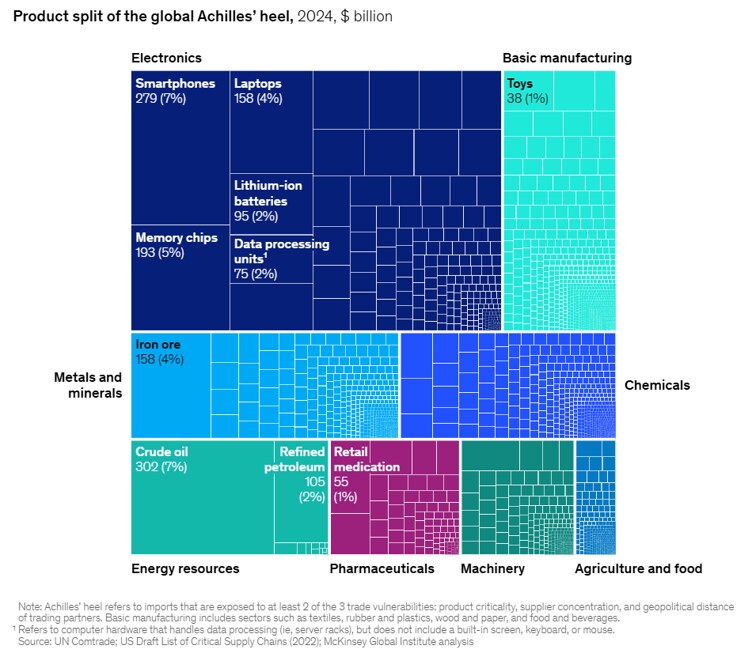
Around a quarter of global goods imports face overlapping vulnerabilities, from concentrated suppliers to geopolitical divisions, which could make disruptions harder to absorb, according to a new McKinsey Global Institute analysis.
The report, The Achilles heel of global trade, examines $19 trillion in goods imports in 2024, excluding trade within the EU, Norway, Switzerland and the UK. It identifies exposure to three factors: products’ importance to economic activity, concentrated sources of supply and trade between geopolitically distant economies, measured using UN voting patterns.
Some 23% of the imports analyzed face at least two of these vulnerabilities, up from 15% in 2000. The dependencies are concentrated in a relatively small group of products, but run in both directions:
Exposure is concentrated: 10 products account for 35% of vulnerable imports, including crude oil, smartphones, memory chips, laptops and iron ore.
Dependence cuts both ways: China supplies 53% of Europe’s vulnerable imports, but sources more than half of its imported retail medication and vaccines from those same economies.
Shipping routes add another risk: around 80% of seaborne trade passes through at least one of the 24 chokepoints examined.
McKinsey argues that short-term fixes, such as rerouting shipments or drawing on reserves, do not remove the underlying dependencies. Nor is self-sufficiency the objective: the report advocates targeting the products and supply relationships where disruption would matter most, while preserving the benefits of trade elsewhere.
Businesses can look to alternative suppliers or build up strategic stockpiles for immediate relief, while longer-term resilience may mean developing substitutes or investing in greater production capacity. But these solutions come with very different timelines: switching suppliers can take weeks, whereas expanding production could take years.
That uncertainty is already weighing on businesses. In a recent International Chamber of Commerce survey, 70% of members identified uncertainty as their biggest trade challenge.
2. How might the US midterms impact global trade?
The Democratic party's sweeping success in the US midterm elections has opened the door to a new battle over economic and trade policy in Washington. While Congress has limited scope to force immediate changes on many of the issues that drove voters to turn against the administration, it holds the purse strings.
Tariffs, energy costs, health policies, the impact of the Iran war and the rapid expansion of AI will all be on the new legislators’ radar screens. Some businesses welcomed the prospect of greater stability, but the wider implications remain unclear. President Trump has already indicated that he intends to veto Democratic Party initiatives challenging his policies.
Even so, existing trade laws still allow the White House to keep current tariffs in place – and impose new ones – without congressional sign-off, while broad scepticism towards China remains one of the few areas of agreement in Washington.
This forms the backdrop to renewed negotiations with Beijing. On 9 November, China announced it would maintain suspension of an additional 24% tariff on US imports for another two months, while retaining a 10% tariff, ahead of an expected meeting between Presidents Xi Jinping and Trump at the Asia-Pacific Economic Cooperation summit in Shenzhen later in the month.
International businesses will continue to face a complex landscape. Incoming Democratic committee leaders are expected to scrutinize tariffs and the administration’s use of delegated trade powers, according to EY, even as its sweeping tariffs face major legal tests in the US courts.
3. News in brief: Trade stories from around the world
Myanmar's military government is seeking US investment in its rare earth deposits as countries look to reduce reliance on China's dominance of critical minerals. The country supplies much of China's rare earth feedstock, but mining remains concentrated in conflict-hit areas, with largely unregulated operations also raising concerns over environmental damage and river pollution, Reuters reports.
Companies could face fines of up to 6% of global annual turnover under proposed European Union (EU) rules targeting unfair digital trade practices. The draft Digital Fairness Act would crack down on manipulative website designs, targeted advertising aimed at vulnerable users and opaque dynamic pricing. If adopted, it would bring further compliance pressures for technology, e-commerce and social media businesses.
European manufacturers risk losing ground to Chinese competitors, with some potentially having to join Chinese supply chains to remain competitive, according to Jens Eskelund, head of the EU Chamber of Commerce in China. He warned that European industry faces a critical turning point by 2030, particularly in automotive, chemicals and renewable energy, urging European leaders to rethink their approach to China, balancing closer trade ties with the need to protect domestic industry.
UK carmakers are pushing for a two-year delay to EU tariffs on electric vehicles, due to take effect on 1 January. Under the Brexit rules, EV batteries must meet strict UK or EU sourcing requirements to avoid a 10% tariff. Manufacturers argue local battery production is not yet sufficient to meet demand, leaving the industry heavily reliant on imports from Asia. The tariffs could add £1.23 billion in costs to EU vehicle exports to the UK in 2027.
The FT reports that President Trump has threatened to double tariffs on Mexican imports unless Mexico takes further action to curb illegal migration into the US. The threat comes as the two countries negotiate changes to existing trade duties, adding uncertainty to their trade relationship.
4. More on trade on Forum Stories
Egypt is boosting its appeal to global supply chains through infrastructure investment, streamlined regulations and international partnerships, writes Mohamed Farid Saleh, Minister of Investment and Foreign Trade of Egypt. Delivering these ambitions, Farid notes, requires continued national reform and international arrangements that support productive investment.
As extreme weather threatens infrastructure, supply chains and business continuity, climate resilience is becoming an increasingly important factor in trade and investment. This article explores why businesses must look beyond protecting individual assets and invest in the wider places and infrastructure they rely on. It also examines how closer collaboration between investors and insurers could help reduce disruption, protect asset values and make resilient locations more attractive for business.
How is AI changing the way we measure the carbon footprint of global trade? The growing use of AI in production and supply chains presents new challenges for calculating emissions embedded in traded goods and services. Discover how AI could also improve emissions reporting, supply-chain transparency and regulatory compliance, with significant implications for businesses navigating measures such as the EU’s Carbon Border Adjustment Mechanism (CBAM).