Europe beats heat records and battles wildfires – and other climate and nature news
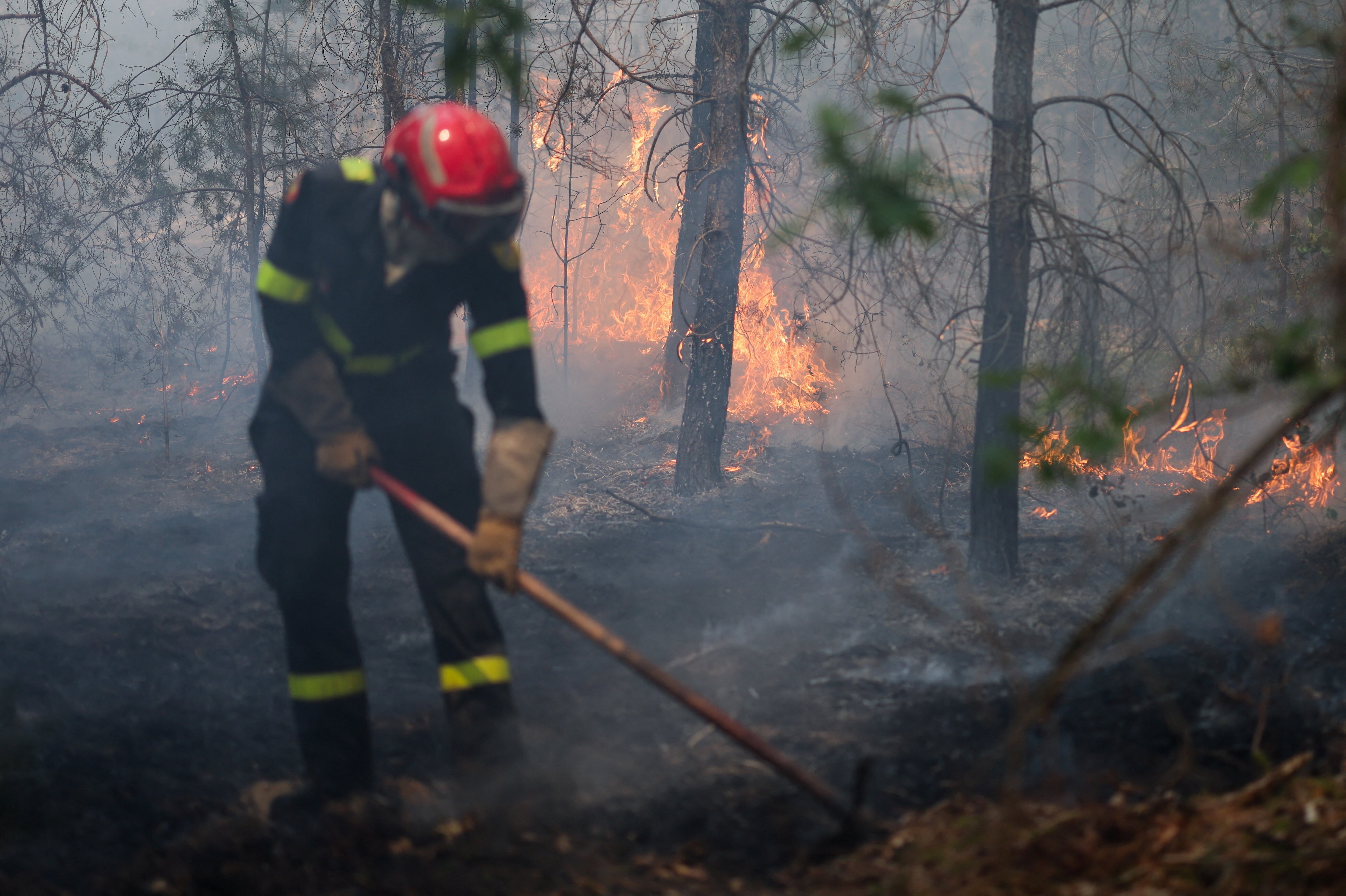
A French firefighter works to extinguish a wildfire near Paris, during a heatwave affecting a large part of the country. Image: REUTERS/Stephane Mahe
- This round-up contains the key nature and climate news from the past month.
- Top news: Europe experiences unprecedented heatwave; UN Secretary-General lays out climate roadmap; Low-level air pollution linked to heart disease.
1. Europe's heatwave is hottest yet, sparking wildfires
The European summer got off to a blistering start last month, with extreme heat caused by the climate crisis leading to wildfires and fatalities.
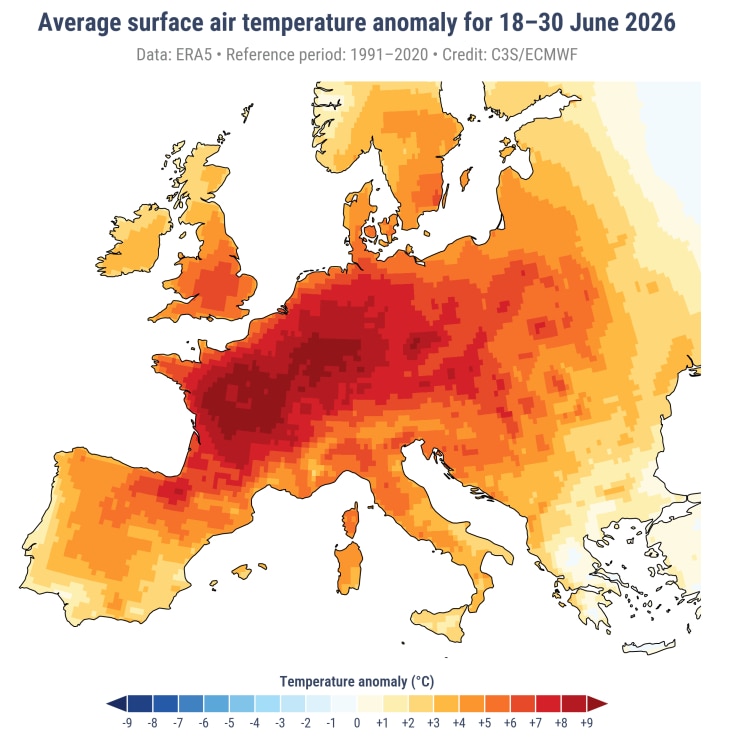
Western Europe experienced the hottest June ever recorded, according to the World Meteorological Organization. It was also the second-warmest June globally and was largely driven by another record breaker – the highest-ever sea surface temperatures for June, data from the Copernicus Climate Change Service shows.
Average temperatures reached 20.74 °C – more than 3 °C above the 1991-2020 average for June and breaking the previous high set during the same month last year. Several countries broke their own heat records, including:
Germany: the eastern town of Coschen reported a temperature of 41.7 °C on 28 June, the third consecutive day of record heat. More than 5,000 excess deaths have already been recorded during the country's latest heatwave, reports Bloomberg.
UK: another three-consecutive-days record was broken here, with 37.3 °C provisionally registered in southern England on 25 June and an unprecedented three-day Red Warning of danger to life issued by the Met Office. At its peak, around 440 people were dying daily across England and Wales due to the heatwave, The Guardian reports.
France: a temperature of 43.8 °C was recorded in the western town of Pulluau on 24 June, and average temperatures in the country reached a new high of 30 °C. Even overnight temperatures were broken, with a new national record of 22 °C. During the last week of June, more than 2,000 excess deaths were recorded, a 29% rise on the previous week, says the BBC.
Spain: the city of Bilbao reached 42.7 °C, its highest-ever temperature, while the northern region of Cantabria hit a record-breaking 43.7 °C on 23 June, reports Euronews. Over 1,000 deaths have been attributed to the heatwave, says France24.
As a result of the prolonged period of extreme heat creating tinderbox-dry conditions, many European countries are now having to deal with wildfires.
More than 10,000 people were evacuated in southern France in early July as a wildfire raged near the Pyrenees, and French firefighters have also been tackling a forest blaze near Paris. Meanwhile, Spain suffered fatalities when a wildfire spread rapidly through a populated area of Andalusia in early July, and the UK is currently tackling around 19 active wildfires (as of 14 July), according to the BBC.
“Climate change is making wildfires more likely," Claire Belcher, Director of the Wildfire Lab at the University of Exeter, told the Guardian, "with wet winters causing more vegetation growth, and prolonged heatwaves drying that vegetation".
2. UN Secretary-General lays out roadmap during climate action week
Amid the UK's record-breaking heatwave, more than 75,000 people from global governments, companies and civil society gathered in the capital for London Climate Action Week (LCAW).
With COP31 in Türkiye this November, delegates were keen to get moving on key climate-related issues, including rapid electrification of the world's energy, a focus on adaptation over mitigation and better use of climate data.
In a keynote speech during the week, UN Secretary-General António Guterres highlighted how the world's dependence on fossil fuels is exacerbating two crises – climate and energy.
"What we need, urgently, is the will to fully implement the Sustainable Development Goals," said Guterres, and he outlined seven steps to help the world achieve them:
- Emissions must peak immediately, with the G20 group of wealthy nations leading and a focus on methane reduction.
- Governments should promote clean energy projects and cease subsidizing fossil fuel enterprises.
- AI companies must "come clean" on their environmental footprints and commit to renewables-powered data centres by 2030.
- Focus on achieving a fair transition, with developing countries, workers and communities set up to benefit.
- Boost climate resilience through investment in adaptation to protect those most at risk of climate impacts.
- Promote and unlock fair finance so that developing countries are financially able to invest in clean energy.
- Tackle climate disinformation and support science.
In a stark reminder of what is at stake, an LCAW event on the impacts of extreme heat had to be cancelled due to extreme heat.
3. News in brief: Other top nature and climate stories
Major industrialized countries were informed about climate-damaging greenhouse gas emissions as far back as 1957, according to a new report, What Countries Knew, by the Center for International Environmental Law. This matters because, following the International Court of Justice's 2025 ruling that countries are legally obligated to curb emissions, this new information is "a matter of legal responsibility", say the report's authors.
Long-term exposure to common air pollutants from vehicles and the burning of fossil fuels can be linked to advanced coronary artery disease – even at levels near or below current regulatory safety limits – finds a new study. Women were found to have an even greater risk than men of "serious artery narrowing", reports Science News.
A frog that found fame on the internet is now at risk of extinction. The desert rain frog, found only in sand dunes in southern Africa, became a meme thanks to its distinctive high-pitched squeak and rotund body. But mining and energy projects in the amphibian's habitat are having an impact, with the IUCN moving it from Near Threatened to Vulnerable on its Red List of endangered species.
In New Zealand, around 120 premature births a year could be attributed to nitrates in drinking water, Reuters reports. A study found a "significant" link between nitrate-contaminated water – a result of fertilizer use and manure run-off – and births that don't reach full-term.
A new monkey species has been 'discovered' in the Democratic Republic of Congo. Known to local communities as 'Likweli', this shy Colobus monkey is notable for having no thumbs and a distinctive pink/orange area around the mouth. It was first spotted by conservationists in 2008, but only now have researchers been able to properly photograph and document this monkey that is now officially identified as Colobus congoensis, reports the BBC.
The European Union's deforestation law, adopted in 2023, is having some adjustments made to it in December 2027. Companies selling goods to the EU with soy, coffee, beef and palm oil, or palm oil derivatives, will have to prove their products did not cause deforestation, says Reuters. While leather, cattle hides and skins, re-treaded tyres, soybeans intended for sowing, as well as car seats, are all set to be removed from the law.
The Trump administration has made a critical change to the Endangered Species Act, reports the New York Times. Destroying a threatened species' habitat will no longer be illegal under the changes announced in early July. This means farming, drilling, mining and property development can be given the green light on previously protected lands. "We are at the precipice of losing 50 years of progress in the protection of America’s wildlife," said Justin Pidot, a professor of environmental law at the University of Arizona.
4. More on the nature and climate crisis from Forum Stories
Malaysia is poised for record high temperatures thanks to 'Super' El Niño events in the year ahead. Such events come as the country is drives an energy transition balancing affordability, energy security and sustainability. A new report Beyond Coal: Building a Flexible, Resilient and Clean Power System for Malaysia breaks down what's needed to create a energy system that's both resilient and secure.
Air pollution is the world's largest environmental health risk, responsible for 6.7 million premature deaths each year, and costing the global economy over $8 trillion annually. Yet 36% of the most impacted countries lack air quality monitoring to help tackle the issue. This article explains why open data is so crucial and lays out the Forum's five guiding principles to stakeholders on how they can effectively take action on air pollution.
Removing deforestation practices from the agricultural supply chain is a challenge. While the 'Agriculture Sector Roadmap to 1.5C', launched at COP27, set out a path to a greener industry, achieving those goals requires collaboration and commitment, say two Forum experts. Here, they highlight five valuable lessons for the agricultural sector – and other sectors impacted by climate risks and geopolitical uncertainty.
As the climate crisis intensifies, tapping into seasonal and indigenous food knowledge could be essential to building more resilient food systems. This piece looks at Indigenous food cultures from around the world to better understand how communities have historically adapted their diets to climate, scarcity and seasonal change.
License and Republishing
World Economic Forum articles may be republished in accordance with the Creative Commons Attribution-NonCommercial-NoDerivatives 4.0 International Public License, and in accordance with our Terms of Use.
The views expressed in this article are those of the author alone and not the World Economic Forum.

Forum Stories newsletter
Bringing you weekly curated insights and analysis on the global issues that matter.
More on Climate Action and Waste Reduction See all

Madeleine North
September 10, 2026


