
Space technology underpins critical infrastructure on Earth, but expanding orbital congestion poses severe risks. Protecting this vital ecosystem requires a dual strategy: removing legacy space debris and enforcing prevention measures through technology, policy and public-private collaboration.
Space technologies provide services integral to life on Earth. They underpin communications, navigation, weather forecasting, disaster response and other essential functions. Yet the orbital infrastructure supporting these services operates in an increasingly congested environment.
This is largely driven by space debris – defunct satellites, spent rocket stages and fragments of junk orbiting Earth at hyper-velocity speeds. Left unchecked, the rising risk of collisions threatens the continuity and reliability of these vital space-based services. Protecting this infrastructure is therefore a shared priority for governments, economies and societies.
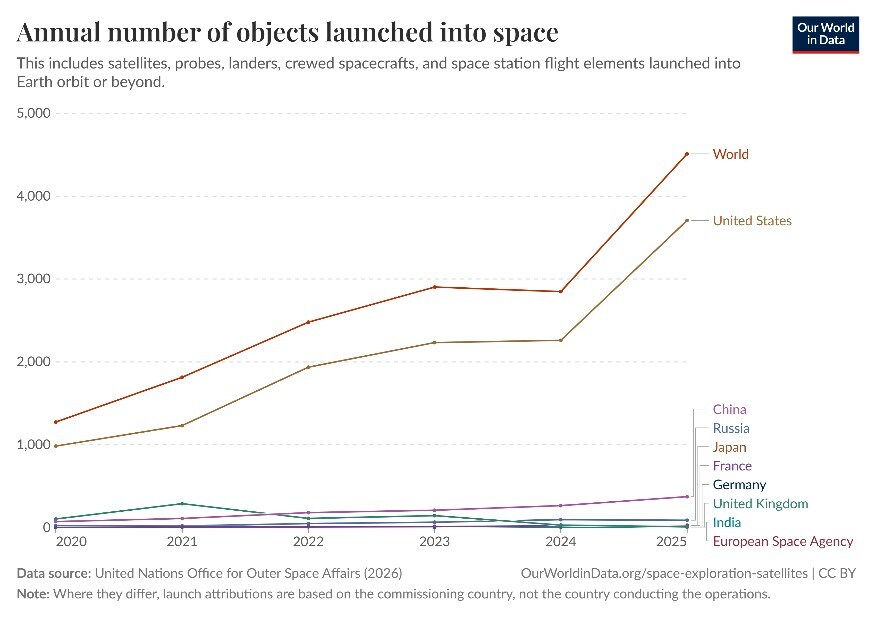
Yet removing legacy debris only solves half the equation. As space activity accelerates, preventing new debris is becoming just as urgent as clearing out the old. The United Nations Office for Outer Space Affairs reports that objects launched into space more than tripled between 2020 and 2025, rising from 1,274 to 4,510, an increase of about 254%. The growing flow of objects makes it increasingly important to ensure that today’s spacecraft and launch-related objects do not become tomorrow’s debris.
Removal and prevention must advance together
Two complementary approaches can preserve the orbital environment by removing and preventing space debris: remediation and mitigation. Active debris removal (ADR) supports remediation by targeting large, high-risk derelict objects. Similarly, post-mission disposal (PMD) supports mitigation by ensuring that spacecraft and rocket bodies are safely disposed of at the end of their missions.
Road safety offers a useful analogy. ADR resembles roadside assistance: an essential intervention when an existing vehicle poses a direct hazard. By comparison, some PMD methods resemble safety features built into a vehicle from the outset, such as seat belts or airbags. While ADR is attracting significant attention and its technologies are advancing, practical implementation remains in the early stages.
The growing importance of debris mitigation
The urgency of mitigation is driven by a fundamental shift in orbit: the rise of commercial satellite constellations – vast networks comprising thousands of spacecraft. At this scale, even a minor failure rate in post-mission disposal can quickly pollute low Earth orbit.
Research from NASA’s Orbital Debris Program Office underscores how sensitive orbital safety is to disposal success rates. In a simulation modeling three large constellations (totaling 8,300 spacecraft), a 90% PMD success rate resulted in 260 catastrophic collisions over 200 years. Raising that success rate to 95% reduced projected collisions to 90, while a 99% success rate cut them down to just 34. These findings demonstrate that as large constellations expand, even modest improvements in PMD reliability yield massive reductions in long-term collision risks.
Without high disposal rates, these projected collisions will trigger massive fragmentation events – satellites shattering or exploding into clouds of debris – that would heighten risks to operators and carry significant economic consequences. Under a business-as-usual scenario, space debris could impose a hidden tax of up to $42.3 billion on the space economy over the next decade. Preventing new debris alongside removing existing hazards is therefore essential to limiting the economic costs of continued orbital activity.
Beyond reducing operational and economic risks, mitigation can avoid some of the legal and diplomatic complexities of remediation. Under Article VIII of the Outer Space Treaty, states retain jurisdiction over their registered space objects, and ownership is not extinguished when those objects cease operating. Third-party removal may require authorization from, and coordination with, the relevant state. Planning and executing disposal as part of the original mission reduces reliance on these more complex interventions. Mitigation thus ensures that responsibility for an object’s end of life is built in from the outset.
From mitigation principles to practical solutions
Effective mitigation depends on disposal solutions that are technically mature, economically viable and suited to different missions. Traditional propulsion-based PMD can impose operational and economic burdens, including reserving propellant and maintaining functioning spacecraft systems through end of life. Passive methods reduce reliance on propellant and active manoeuvring and, in suitable mission conditions, can reduce disposal-system mass. These complementary approaches broaden operators’ options for achieving reliable disposal across different spacecraft and orbits.
Recent technological progress demonstrates this potential. German space engineering company HPS developed the ADEO-N braking sail – a lightweight “space parachute” – which Italian logistics firm D-Orbit deployed in 2022 to use atmospheric drag to accelerate orbital decay without active propulsion.
In 2026, Japanese space start-up BULL successfully conducted the first in-orbit demonstration of HORN, its passive disposal device , launched aboard Japan’s H3 launch vehicle. These demonstrations illustrate progress towards a broader range of practical end-of-life disposal options.
Align policy, investment and commercial adoption
As space sustainability becomes an increasingly urgent infrastructure priority, the focus should shift from technological progress to routine adoption. Mitigation requirements must balance ambitious sustainability goals with the practical constraints of real-world missions. Policy, investment and commercial adoption must therefore advance alongside technological development.
Japan’s SBIR-3 Grant Program illustrates how public funding can support this transition. Its space debris portfolio includes projects spanning remediation as well as passive and propulsion-based PMD. Supporting different technologies in parallel can help move promising solutions towards deployment while ensuring that both existing and future debris risks are addressed.
Commercial actors are equally important. According to an OECD report, private satellites represented 88% of launches in 2025, up from 23% in 2010. BryceTech’s 2025 report breaks down the numbers further, revealing a shift away from government-led launch activity. As private operators drive a growing share of orbital activity, implementing sustainability measures increasingly depends on collaboration between industry and public agencies.
The incentives span the space economy. For operators, practical mitigation can reduce collision risk, maneuvering burdens and service disruptions. For investors and insurers, it can limit the operational and economic risks that debris poses to future growth. For policy-makers, it means translating disposal objectives into proportionate, implementable requirements. Governments can support adoption through research funding, procurement, shared technical standards and incentives for solutions that demonstrate reliability at scale.
The Centre for Space Futures supports this transition through the Space Debris Initiative, which convenes public- and private-sector stakeholders, and through the Space Technology Initiative, which assesses emerging space technologies and connects developers with investors in a live marketplace. Together, these initiatives link policy coordination, technological development and investment to strengthen the resilience of the space-enabled economy.
The path forward is to advance remediation and mitigation as mutually reinforcing elements of a broader sustainability strategy. ADR can reduce hazards from past activity, while PMD can prevent today’s expanding space economy from creating the same risks. Advancing prevention and removal together is essential to protecting critical infrastructure on Earth and in space.