As AI becomes more capable, how can we ensure people become more capable too?

Cognitive augmentation see AI used to expand what people themselves can understand, decide and achieve. Image: DC Studio/Magnific
Global Future Council on Jobs and Frontier Technologies
Network of Global Future Councils (2025-2026), World Economic Forum- As AI takes on more cognitive work, it can either substitute for human cognition or augment what people are able to understand, decide and achieve.
- People-augmenting intelligent systems (PAIS) shift the focus from individual technology tools to the wider system of people, technologies, institutions and infrastructure.
- Greater machine agency should be matched by greater human agency and capability, an outcome that leaders, organizations and institutions must deliberately shape.
The majority of employers expect artificial intelligence (AI) to transform their business, yet the most-desired core skill from employees is a more human one.
According to the World Economic Forum’s latest Future of Jobs report, nearly nine in 10 (86%) of employers expect AI and information-processing technologies to transform their business by 2030, while 39% of workers’ existing skill sets are expected to change or become outdated. However, analytical thinking remains the most sought-after core skill, considered essential by seven in 10 employers.
This creates an important question for the future of work: as our technologies become more capable, how can we ensure people become more capable too?
Cognitive substitution or cognitive augmentation?
Cognitive offloading is not inherently a problem. From calculators to search engines, technology has long allowed people to spend less time on tasks that machines can perform more efficiently. AI extends this possibility considerably: It can synthesize information, identify patterns, generate options and increasingly execute multi-step activities with limited or even no human intervention.
But freeing people from cognitive work is not necessarily the same as augmenting them.
Cognitive substitution happens when technology takes over tasks that help people use or build judgement, reasoning and expertise. Cognitive augmentation, by contrast, uses machine intelligence to expand what people themselves can understand, decide and achieve.
A 2025 study of 319 knowledge workers suggests this distinction deserves attention. The study found that greater confidence in generative AI correlated with lower self-reported critical-thinking effort. At the same time, AI did not simply eliminate critical thinking; it shifted it towards activities such as verifying information, integrating responses and stewarding tasks.
The question, therefore, is not whether people should continue performing every activity that AI can do. It is what kinds of human capability we want technology to free up, preserve and strengthen.
Looking beyond individual AI tools and technologies
Answering that question requires looking beyond individual tools and technologies.
Organizations are increasingly embedding AI in wider systems that combine people, frontier technologies, institutions and infrastructure. These systems can gather information, learn from it, make decisions and act to achieve goals. They can also change and improve over time.
The Global Future Council on Jobs and Frontier Technologies calls these systems people-augmenting intelligent systems (PAIS). In simple terms, PAIS are systems in which people and intelligent technologies work together.
Thinking in systems matters because the same underlying technology can create very different experiences of work depending on how organizations configure responsibilities, workflows and decision-making authority.
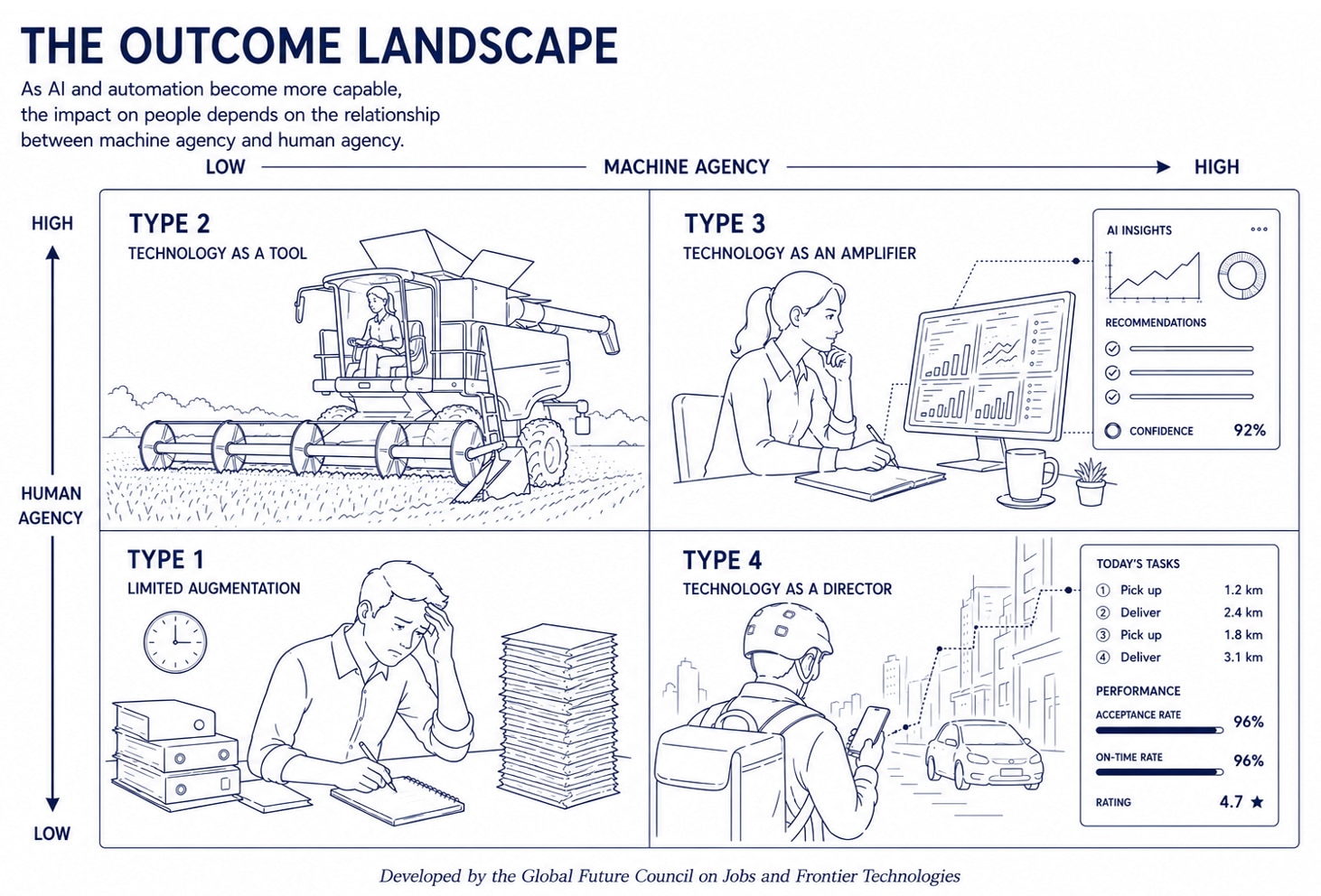
One configuration is familiar: high human agency and relatively low machine agency (Type 2 in the graphic above). Technology operates primarily as a tool, such as a farmer using a combine harvester, for example.
In another configuration, depicted by the Type 4 configuration, machines make more decisions while people have less control. Algorithmic systems may increasingly determine priorities, actions, or the pace of work, with people primarily executing or overseeing machine-generated decisions. A gig food delivery worker delivering food items determined by an algorithm is working in this configuration.
A third possibility is a situation where both people and machines have substantial agency. Here, intelligent technologies do not merely perform work for people. They help people handle more work, access expertise they could not previously reach and make better-informed decisions, which is depicted by the Type 3 configuration.
This is the promise of PAIS.
Designing systems where people and machines learn together
PAIS-type systems will not emerge automatically as technology advances. Achieving high human and machine agency requires deliberate choices across four enabling pillars identified by the Global Future Council on Jobs and Frontier Technologies.
First, people need the capability to learn with and from intelligent systems while contributing the contextual knowledge, expertise and feedback that those systems lack. Human expertise does not disappear in this model; its role changes.
As AI gets better at processing information, people can focus more on defining problems, understanding context, checking outputs, handling unusual cases and making judgements. Work design determines how people and AI interact in practice. This includes how tasks and decision rights are distributed, where human judgement remains essential, and how workers themselves participate in shaping workflows.
People and organizational capability determine whether organizations can sustain these new models of work. Workers need the skills and agency to learn with and from AI, while organizations need management practices, digital capabilities and structures that support adaptation as technology evolves.
Finally, institutions and governance shape the wider environment in which these systems develop. Rules around transparency, accountability, ownership and the distribution of AI’s benefits and externalities can help steer human–technology systems towards augmentation rather than algorithmic direction.
Across all three pillars, incentives influence what organizations invest in and optimize for. They can steer systems towards augmentation, skills and shared value creation, rather than labour substitution or algorithmic control.
Human augmentation is not an inherent outcome of more capable technology; it depends on how the wider system is designed and governed.
The PAIS framework offers a practical lens for assessing whether human–machine systems are moving towards augmentation or substitution, and for identifying the design, capability, governance and incentive choices needed to steer them towards a system that augments and amplifies what humans can achieve.
Don't miss any update on this topic
Create a free account and access your personalized content collection with our latest publications and analyses.
License and Republishing
World Economic Forum articles may be republished in accordance with the Creative Commons Attribution-NonCommercial-NoDerivatives 4.0 International Public License, and in accordance with our Terms of Use.
The views expressed in this article are those of the author alone and not the World Economic Forum.
Stay up to date:
Artificial Intelligence


Forum Stories newsletter
Bringing you weekly curated insights and analysis on the global issues that matter.
More on Jobs and the Future of WorkSee all

John Letzing
September 18, 2026


