How to address the entry-level talent gap in the built environment and infrastructure sector

The built environment and infrastructure sector struggles to attract entry-level talent, despite accounting for 11–13% of global GDP. Image: Unsplash/Getty
Lindsay Ewy
Growth and Impact Design Lead, Centre For The New Economy and Society, World Economic Forum- Physical infrastructure underpins major factors driving the global economy, including AI advancement, the clean energy transition and supply chains.
- However, despite accounting for up to 13% of global GDP, the built environment and infrastructure sector struggles to attract entry-level talent.
- To better understand and drive action on this challenge, the World Economic Forum is partnering with built environment and other industry communities to create a First Mile Sandbox.
Underpinning the advancement of artificial intelligence (AI), the transition to secure and clean energy, and the rerouting of supply chains as geoeconomic fragmentation accelerates is the physical infrastructure that enables it all.
Accounting for 11-13% of gross domestic product globally, the buildings and construction industry employs nearly 1 in 10 people worldwide.
Yet despite this momentum, the sector faces a talent gap, as it continues to struggle to attract the entry-level talent required to capture the growth opportunity at hand.
Why there's a talent gap in the built environment industry
As outlined in the Future of Jobs Report 2025, 40% of infrastructure employers highlight the sector’s inability to attract talent as the single-biggest barrier to industry transformation by 2030. This situation is particularly acute for in-demand skill sets such as AI and green skills, where there is significant competition for talent across industries.
Beyond AI and green skills, there is a broader evolution in skills demand by the infrastructure industry, as growth in skills such as talent management and analytical thinking points to changing expectations and a need for hybrid skill sets.
“The built environment is shaping the future of our planet, but it cannot thrive without young talent,” says Ebru Özdemir, Chairperson of the Board, Limak Holding.
While industry expectations are changing, so are those of entry-level talent. To address the industry talent gap, we need to consider how we might better understand the expectations of entry-level talent to calibrate where we should begin.
Understanding entry-level talent drivers and expectations
The World Economic Forum’s flagship report on youth perspectives, Youth Pulse 2026: Insights From the Next Generation for a Changing World, draws on insights from nearly 4,600 young people from 489 locations worldwide, representing diverse regions and contexts, providing a place for us to start.
According to the report, 42.7% of youth respondents think the growing gap between education and job market needs is one of the economic trends shaping the future the most.
Additional economic trends shaping the future include more remote work and flexible job opportunities (28%) and the expansion of sustainable industries (26.1%).
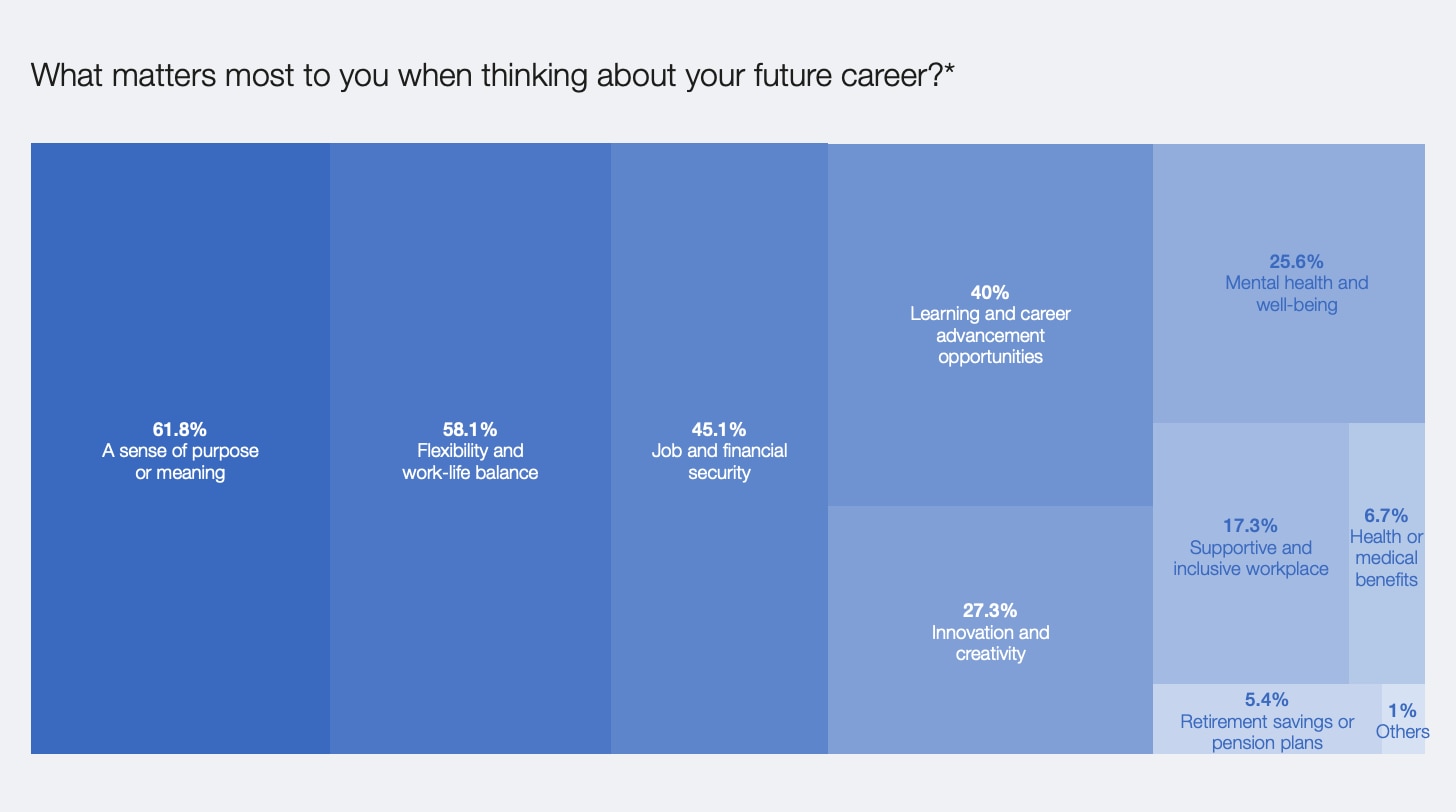
When asked “What matters most to you when thinking about your future career?”, 61.8% of respondents emphasized a sense of purpose or meaning, followed by flexibility and work-life balance at 58.1%.
Ranking significantly higher in importance than job and financial security at 45.1% and learning and career advancement opportunities at 40%, these priorities signal that young people today emphasize meaning, flexibility and alignment with personal values over more traditional measures of success.
Beyond the above drivers, labour market uncertainty is influencing broader shifts in how entry-level talent approaches entering the labour market.
Recent figures from the United States suggest that 42% of Gen Z workers are working in, or pursuing, skilled trade or “blue collar” roles, including 37% of those with a bachelor’s degree. Entry-level talent is attempting to navigate macro-level economic and labour market trends, while remaining true to their career and workplace priorities.
From Global Shaper Edwin Lai, we heard that “the built environment offers purpose in abundance. But too often, it is still shown through traditional professions rather than the missions it enables.
“If the built environment wants to attract the next generation, it should start inspiring people around missions. Young people are not simply choosing careers. They are choosing the future they want to help build, and few industries offer a greater opportunity to shape it.”
How the built environment industry can address the talent attractiveness gap
The expectations and priorities identified in the Youth Pulse survey provide insight into where the industry might begin to address the talent attractiveness gap. In fact, there are innovative programmes working towards that goal already.
Through the Global Engineer Girls (GEG), Limak Holdings is actively building pathways to address the entry-level talent disconnect. Started in Türkiye, the programme has expanded across eight countries – from Kosovo and Saudi Arabia to Spain and Côte d'Ivoire – and empowered more than 2,000 young women in engineering. By equipping them with scholarships, mentorship and trainings, Limak seeks to turn potential talent into the future leaders of the industry.
Harking back to the Global Shapers Community and other youth-based organizations and initiatives, Edwin Lai shares how the "UN Sustainable Development Solutions Network Youth Initiative (SDSN Youth) Local Pathways Fellowship is empowering young urban leaders to advance sustainable development through practical, place-based solutions aligned with Sustainable Development Goal 11 (Sustainable Cities and Communities).
“To date, over 700 fellows from more than 100 cities have undertaken initiatives – from tackling traffic congestion in Thailand to improving sanitation and waste management in Nigeria and creating safe and inclusive public spaces for women in Brazil – proving that young people want to actively create the built environment.
“Together, these initiatives reveal that young people are not just on the sidelines. They are already transforming their communities, tackling local challenges and influencing urban policy. The challenge now is to ensure the built environment tells this story more clearly, and creates pathways that enable more young people to see themselves within it.”
What’s next for entry-level talent readiness and industry attractiveness?
Ensuring the industries driving global growth have the talent they need, addressing changing entry-level talent expectations, and correcting the widening structural gap between how early-career talent is developed and how entry-level work is changing is beyond the role of a single industry, educational institution or region.
To better understand and drive action on this challenge, the World Economic Forum is partnering with built environment and other industry communities to create a First Mile Sandbox.
The sandbox connects universities, employers and other stakeholders with an invitation to scale best practices, pilot new partnership models, and anticipate future workforce transformation pressures on entry-level talent. Join us as we work together to reinvent talent readiness for the next generation.
Don't miss any update on this topic
Create a free account and access your personalized content collection with our latest publications and analyses.
License and Republishing
World Economic Forum articles may be republished in accordance with the Creative Commons Attribution-NonCommercial-NoDerivatives 4.0 International Public License, and in accordance with our Terms of Use.
The views expressed in this article are those of the author alone and not the World Economic Forum.
Stay up to date:
Built Environment and Infrastructure
Related topics:


Forum Stories newsletter
Bringing you weekly curated insights and analysis on the global issues that matter.


