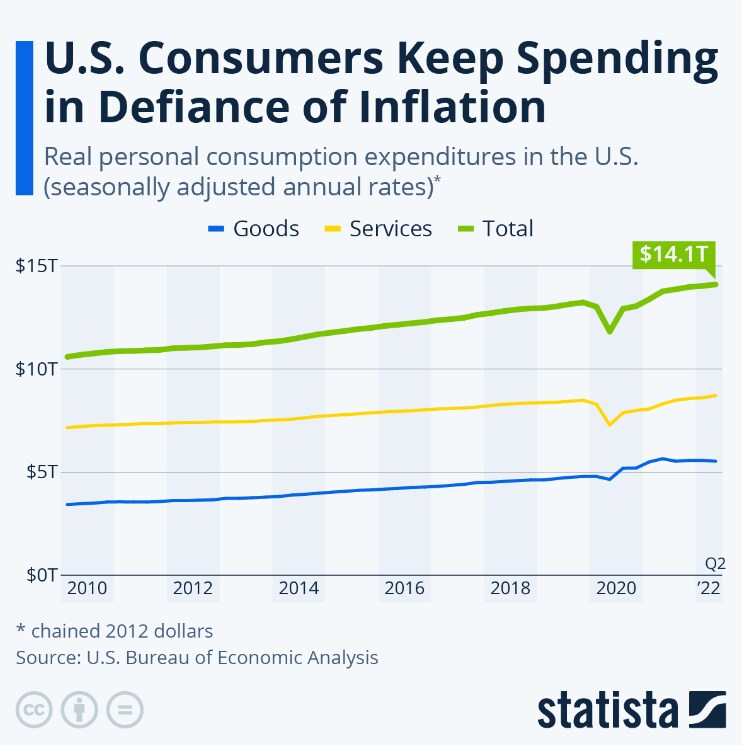
US consumer spending rose by 2% in inflation-adjusted terms in the second quarter.
This was despite the economy contracting for a second consecutive quarter.
But there are some warning signs on spending, such as declines in outgoings on food and beverages.
The U.S. Bureau of Economic Analysis released its third and final estimate of second-quarter GDP on Thursday, confirming that the U.S. economy contracted for the second consecutive quarter amid an environment awash in global crises and uncertainties. Real GDP declined at an annual rate of 0.6 percent in the second quarter, up from a 1.6 percent decline in the first quarter.
Consumer spending, by far the largest component of the gross domestic product, once again proved to be surprisingly resilient in the face of surging inflation. According to the BEA, inflation-adjusted personal consumption expenditures increased at an annual rate of 2 percent in the second quarter, partly offsetting a 14 percent decline in gross private domestic investment. Measured in chained 2012 dollars, real personal consumption expenditures amounted to $14.1 trillion on an annualized basis in Q2 2022, up from $13.8 trillion a year earlier.
How is the World Economic Forum contributing to a more efficient, resilient, inclusive and equitable financial system?
The Centre for Financial and Monetary Systems convenes leaders to make sense of transformation across global financial systems, from sustainability and resilience to innovation and digitalization.
By fostering cooperation and insight, the Centre helps partners align financial systems with long-term economic stability and shared prosperity.
While consumers kept spending despite rising prices through the second quarter, there are some warning signs as spending on goods, led by food and beverages, declined for the second consecutive quarter. Meanwhile services spending increased at an annual rate of 4.6 percent in Q2, as Americans spent more on food services and accommodation compared to the preceding quarter.