The doors are officially open on the World Economic Forum's tech-focused summit in Tianjin. This live blog is where we'll be sharing the most interesting stories, blogs, videos, pictures, tweets and breaking news over the next three days.
The first live sessions, which you'll be able to watch right here on our website, start in about an hour. Before then, here's some useful background reading on the key themes and speakers at this year's gathering:
This will no doubt be one of the key topics of discussion at our meeting in China, and we'll bring you fresh reaction to this breaking news throughout the day.
In the meantime, take a look at this piece by Wendy Cutler, Vice-president of the Asia Society Policy Institute on why the global trade system is broken, and the steps that should be taken to fix it.
01:00 UTC
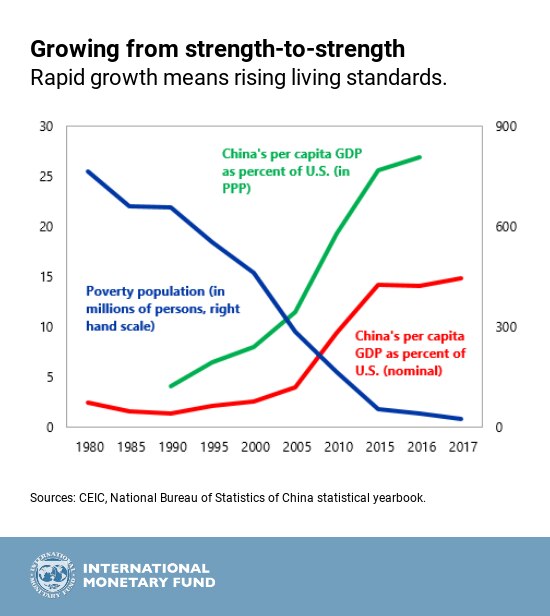
China's Opening-Up: 40 Years On
Forty years after embarking on an open-door policy, China has become the world's second-largest economy based on purchasing power parity (PPP).
The panel of business and civil-society leaders are here to discuss what lies ahead for Chinese enterprises.
IBM chairman Chen Liming has an upbeat take on global cooperation, particularly in light of escalating trade tensions between China and the US, which form the background to the summit in Tianjin this week.
"Going global has been the right decision by China, and we'll continue to stick to that path," he said. "We must make an effort to keep contributing to the world's shared future, whether via private enterprises or state-owned corporations."
Learning the rules
Accept our marketing cookies to access this content.
These cookies are currently disabled in your browser.
Liming recalls what China was like a few decades ago, in the first stages of its "opening up", when foreign businesses first started flowing into the market.
"China had little to lose to begin with so tried very hard. We wanted good products, technology and good international rules. We wanted to learn. The international market was as important as the domestic market. But to thrive domestically we had to understand the international rules of behaviour, whether that was telling people how to tie their tie or what were considered good table manners."
Tomatoes and eggs
It's clear that understanding international mores is still important for China, and Liming suggests an analogy for how China and its foreign business counterparts can hope to continue working together: tomato and egg soup."A tomato and an egg are different from each other, but in China it's common to have soup made of tomato and egg."
The future is private
For Fu Jun, Professor at Peking University, private enterprises are key to China's future success. "Businesses have contributed 60% of China's economy and make up 90% of the workforce," he says.
The view from Japan
For Yasushi Akahoshi, President of the Japan External Trade Organization, the Fourth Industrial Revolution presents opportunities for better relations between China and Japan. "You talk about Made in China - think about Made with Japan as well," he urges.
Image: IMF
Did you know? Panasonic was the first company to come into the Chinese market, says CCTV's Li Sixuan, who is moderating the session.
01:05 UTC
Cracking the Crypto Code - How to Manage Crypto Assets?
With a flood of new entrants to the market and crazy price fluctuations, there is a raft of unanswered questions about the future of cryptocurrencies.
How should the market be regulated, and how will existing financial systems overlap with the likes of bitcoin and Ethereum?
The panel includes Jeremy Allaire, Founder and Chief Executive Officer, Circle Internet Financial; Meltem Demirors, Chief Strategy Officer; Managing Director, USA, CoinShares UK, Canada, and Virginijus Sinkevičius, Minister of Economy of Lithuania.
Before things kick-off, here's a neat animation charting the rise of cryptos.
Accept our marketing cookies to access this content.
These cookies are currently disabled in your browser.
Bitcoin is of course the most talked-about crypto, so let's start with that. Is the market rational?
It's price has started to find its equilibrium, says Mike Kayamori. Other cryptos, not so much.
Not all crypto assets were created equal, adds Jeremy Allaire, and this is important to keep in mind. Early on, much of the market valuations were driven by speculation and retail demand, rather than any formal market infrastructure. We're starting to see corrections in the market, and cryptos are finding their equilibrium.
No-one wants to think about regulations, says Meltem Demirors, but consumer protection is essential. Prices have been completely decoupled from any sort of rational valuation, but there is a tremendous appetite for crypto assets so we need to work together to bring some rationality to the market.
Accept our marketing cookies to access this content.
These cookies are currently disabled in your browser.
For small economies like Lithuania cryptos represent a huge opportunity, says Virginijus Sinkevičius. They can bring wealth, and allow us to compete with large economies like China in a way that is usually not possible. But the playing field has to be fair, and regulations, infrastructure and taxes will play an important role.
Large markets will play a central role, says Allaire. We can't rely on safe havens or countries that allow money laundering to control the future of cryptos. France and Switzerland are doing interesting work, he adds, and we should look to them instead.
Is bitcoin a currency? Right now it's more like a commodity, an asset, says Allaire, a place to store value, like gold.
Countries should start by increasingly going cashless, says Sinkevičius, adding that he doesn't think bitcoin will become a commonly used currency for a long time, if at all.
Accept our marketing cookies to access this content.
These cookies are currently disabled in your browser.
A great factoid from Meltem Demirors to end the session. Twenty-percent of bitcoins are owned by the top 100 wallets, while other cryptos are even worse. So, are we already seeing wealth inequality in the world of cryptocurrencies?
02:35 UTC
This is what China's economy looks like in 2018 - in 6 charts
A new IMF assessment of the Chinese economy looks at the growth, digitalization and rebalancing efforts.
Fifth generation (5G) networks will unlock a new world of connected devices and faster mobile internet speeds. By 2020 there will need to be a significant global investment in 5G readiness. Around $4 trillion will be needed.
Introducing himself to the audience, Huawei chairman Ken Hu says he's most excited about talking about the potential of 5G providers today, and the benefits the technology will bring users in the short term. Among them faster speeds, better connectivity and new services such as cloud-based applications and HD.
The United Kingdom will be launching 5G in 2019, and customer experience is a priority. "We see 5G as an evolution," says Jean-Marc Frangos, Chief Innovation Officer of BT (British Telecom). "We hope to see a future where 5G integrates seamlessly with 4G, where customers don't even have to think about which they're using."
Accept our marketing cookies to access this content.
These cookies are currently disabled in your browser.
"Simply speaking, it's faster speed," says Ken Hu.
"5G will be 100 times faster than 4G, and 50 times more responsive." But it will also consumer experience in unexpected ways too: big, high-definition, foldable screens on smartphones. Massive connectivity, sensors that connect to shoes, glass and other devices.
Consumer applications will be affected, BT's Frangos agrees. "But there's a third category of people - the application developers." These are the people who will create new uses: two-way video, AI-driven applications that link the real world with the virtual. "Stimulating this group will be really important," he says.
Sihan Bo Chen, Head of Greater China at GSMA, is also optimistic, but she urges caution as we proceed with the technology and its many implications. "We need to calm down a little bit. We should think carefully and form partnerships."
Accept our marketing cookies to access this content.
These cookies are currently disabled in your browser.
The business model won't come cheap. Much of the cost will arise from operators' reliance on 5G spectrum band and the number of sites needed to cover a certain area, according to Ericsson's Mikael Bäck.
Sihan Bo Chen warns that consumers must not bear the brunt of the new 5G business model. Industry partners also need to be involved. "They need to understand that 5G technology plus AI will change their industry, that eventually it's going to be revolutionary, especially with AI and cloud-based services. Every industry needs to look closely at these opportunities to know how to succeed."
What is 'network slicing'?
Sihan Bo Chensays networks will be more secure, and more efficient thanks to something called network slicing, which is where operators provide portions of their networks for specific customer uses cases, whether a smartphone application, smart factory or connected car.
Image: Nokia
Hear from Mikael Bäck, Head, Business Strategy, Ericsson; Jean-Marc Frangos, Chief Innovation Officer, BT; Ken Hu, Deputy Chairman and Rotating Chairman, Huawei Technologies; and Sihan Bo Chen, Head of Greater China, GSMA.
This session was developed in partnership with FTChinese and will be moderated by Wang Feng, Editor-in-Chief, FTChinese.com
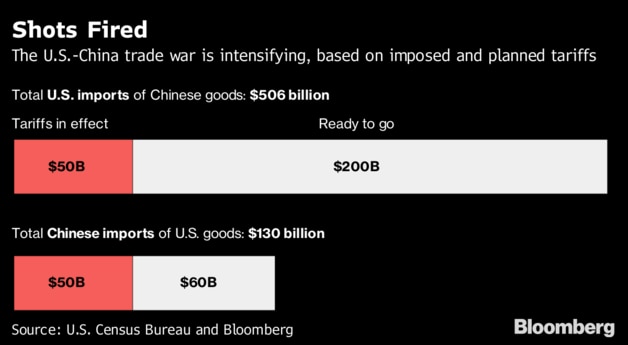
The biggest news story so far today is, of course, the escalation of the trade war between the US and China.
President Donald Trump announced that the US administration is imposing 10% percent tariffs on about $200 billion worth of Chinese imports.
Trump also warned that if China takes retaliatory action against US farmers or industries, “we will immediately pursue phase three, which is tariffs on approximately $267 billion of additional imports.”
So, what would further escalation look like?
Here to hopefully answer that question for us: Timothy P. Stratford, Managing Partner, Beijing, Covington & Burling LLPBiography; Philip Shetler-Jones, World Economic Forum and Jiro Tamura, Keio University.
We should be careful not to focus on the sort of negotiation tactics like Trump is using, and should instead concentrate on a discussion on free, fair and multilateral trade, says Jiro Tamura.
The big challenge for China, says Timothy P. Stratford, has been working out what the US actually wants, as there has been differing views coming out of the country.
Two teams, different game
Using an analogy from the world of sports, Stratford says the trade war between the two sides is like the World Cup champions and the winners of the Superbowl turning up on the same field and trying to play against each other. Both teams have very different skills sets, and they both want different things.
The US government wants China to change their tactics to a market-orientated development model, while the Chinese government is suspicious of its motivations for doing so.
The gap between the two sides is large and he predicts a deadlock that could last a long time.
Accept our marketing cookies to access this content.
These cookies are currently disabled in your browser.
How could this bleed into other areas of the economy?
Trump won't want this to go on too long, says Tamura, and they will hope the two sides can work something out. But if you are of the view that the Chinese economic system is hurting the US, says Stratford, you might think the status quo is better than going back to what we had before. A complete decoupling of the two economies would not be ideal.
Accept our marketing cookies to access this content.
These cookies are currently disabled in your browser.
Could it go beyond tariffs? It already has, says Stratford, with companies reporting increased inspections, slow customs processes and slow investment decisions.
Accept our marketing cookies to access this content.
These cookies are currently disabled in your browser.
There is a lot of thinking and soul-searching going on about the global trading system, says Stratford. Global GDP has improved because of trade, but the benefits have not been allocated equally, and this has led to populist movements that are challenging the assumptions behind the creation of the World Trade Organization.
Without an institution like the WTO, says Tamura, the focus shifts to the bilateral agreements that Trump keeps talking about, and political interests take over from the principles of free and fair trade.
04:30 UTC
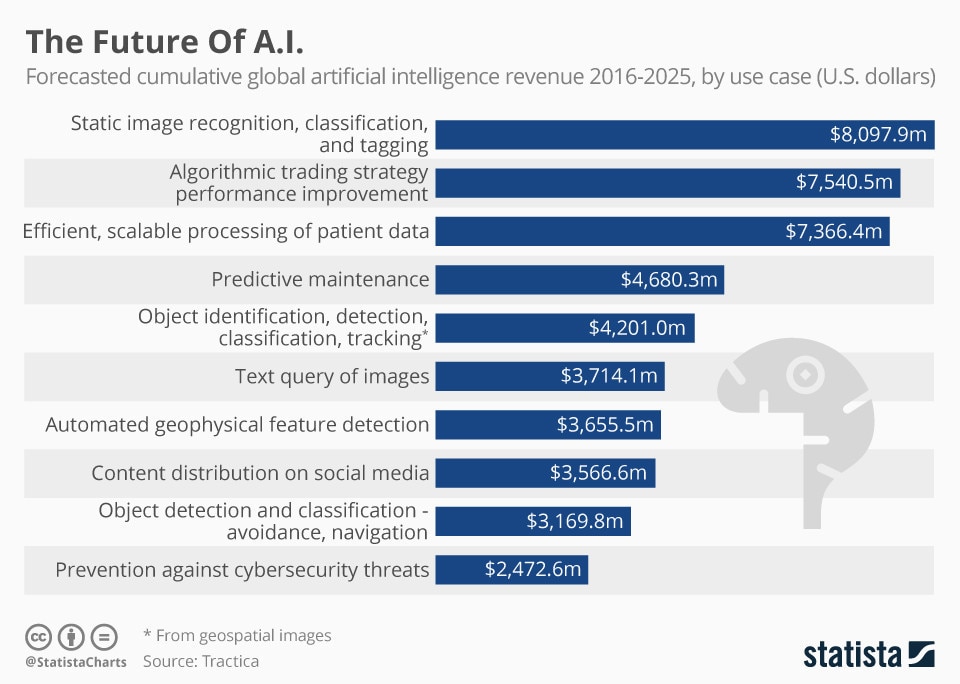
A Global Conversation on Artificial Intelligence
We're creating a digitalised world. Computing has become much cheaper and digital equipment and devices has become widely available, faster and more cheaply available. Multiple applications - from e-commerce to social media - are transforming our world, explains Liu Jiren, Chairman and Chief Executive Officer, Neusoft Corporation.
AI is creating issues - for example ethical considerations - that we've never experienced, he adds.
Image: Statista
From toys to changing the world
Professor Joanna Bryson agrees about the revolutionary impact of expanding access to computing, data generation and governance.
"It went from being toys, to changing the world," she explains. So now people are paying attention.
AI is a means by which we get information and control over our world - including each other. So the big challenge going forward is how do we handle the problems of accountability. We don't need lots of new laws, but people need help enforcing the old laws.
Early days
Doug Merritt reminds us that we're in the early days of what's possible.
"Data is the oxygen for machine learning or AI," he says. It's vital if we want to continue to progress he says. We need to strike a balance between anonymity and open access.
Social and business change
Zhou Kui, Partner, Sequoia Capital China, explained how the cloud can become a super social brain. As the world changes, the choices and decisions we make in our personal and work lives will have to change.
AI has the potential to discover issues and problems in numerous sectors, explain the panel. From healthcare to education, the applications are significant.
For businesses, AI can create value and profit, says Jay Xiao Wenjie Founder and Chief Executive Officer, LexinFintech Holdings Ltd. In China, it's already showing potential in finance, AI can help increase efficiency and lower costs.
AI shouldn't be given ultimate responsibility though - for example by making it a legal entity, says Joanna Bryson, in the same way as companies. The issue is, it can't be made to care.
Education, skills and data
Change is difficult and we're likely to lose jobs, explains Doug Merritt. So we need to right frameworks to help people, to get into areas they can't even imagine now.
It comes back to making data as accessible as possible.
AI and machine learning is coming, so we have to ask, what can we do to make sure as many people as possible can benefit. We have to avoid a divide, so education and re-skilling is key. We can't go backwards.
Emotional skills and communication are likely to remain important, adds Liu Jiren.
How to prepare?
Education is vital says, Zhou Kui, but it needs to look towards the future. We need to learn to learn, explains Joanna Bryson.
The people that will thrive will be those that are able to connect with others, she says.
The legal and regulatory framework also has an important role to play, adds Jay Xiao Wenjie. If bad guys are using the technology, then we should worry.
Evolution and change is constant, concludes Doug Merritt. Curiosity and creativity are key. We have to learn to love and embrace change.
04:48 UTC
Two teams, different game
The US-China trade war is like the World Cup champions and the winners of the Superbowl turning up on the same field and trying to play each other at football, said Covington & Burling's Timothy P. Stratford in the session on tariffs. Well played, sir.
Accept our marketing cookies to access this content.
These cookies are currently disabled in your browser.
We are one of the richest regions in China, explains Paul Chan Mo-po. We have all the strengths and advantages of the New York and San Francisco bay areas. Probably even more, he believes.
There are challenges of course, but the region is well-placed, he says.
Developing talent and human capital
As Hong Kong-based entrepreneur, the Bay Area is significant for all of us, says Calvin Choi.
A strong talent pool is essential for a financial organisation, he says. Leading universities in the area are key for developing this pool.
As well as producing more, we need to empower existing and future talent too, he adds.
Energy
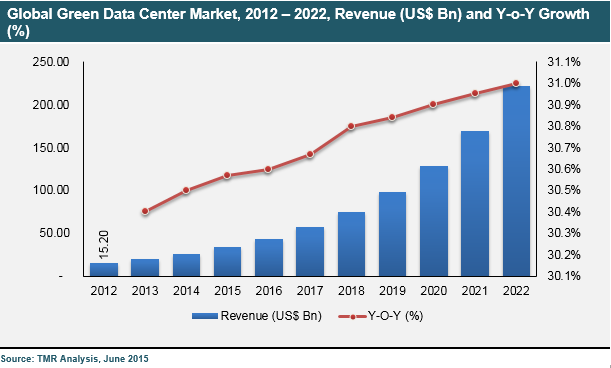
Data and data centres consume significant amounts of energy, explains Qian Jing. So cost of electricity is an overlooked, but significant factor for tech companies.
Therefore, for the future development of the business ecosystem in the Bay Area, energy - and clean energy - will be a significant factor, she believes.
Image: Transparency Market Resarch
What can be learned from San Francisco?
This is a key question for the Bay Area, suggests Zhang Lu; how can the Silicon Valley model be applied elsewhere?
Capital and talent are just two key factors, she believes.
The next steps for the Bay Area?
Integration is very important - we can grow and expand, says Zhu Ning. With increased populations and business activity, this can provide more dynamism to the financial sector development.
Knowledge, talent and education can be integrated because of the geographical proximity. This can create opportunities and an innovation landscape.
Innovation isn't just technological though, he explains. It could also be legal or mindset innovation.
The area needs to be a bay of innovation and creativity, agrees Ian Xue Lan.
He adds, though, that the challenge remains to integrate different cultures and systems.
Policies to move beyond these challenges this are vital, agrees Paul Chan Mo-po. A coordination mechanism is vital for these policies, adds Ian Xue Lan.
The background
China is creating a regional economic hub to rival some of the world’s most powerful global cities. The Greater Bay Area – spanning 11 cities in the Guangdong-Hong Kong-Macao region – will create an economic powerhouse with its own GDP of around $1.5 trillion.
It’s a regional investment to rival the likes of New York and Tokyo, but how will this initiative garner investment impetus and deepen international collaboration?
Image: South China Morning Post
Developed in partnership with Caixin Media, this session will cover dimensions such as:
- From "economy of scale" to "economy of innovation"
- Industrial cluster formation through rapid prototyping
- Regional governance and policy agendas
The panel
Paul Chan Mo-po, Secretary of Finance of Hong Kong SAR
Calvin Choi, Chairman and President, AMTD Group; Young Global Leader
Ian Xue Lan, Professor and Dean, School of Public Policy and Management (SPPM), Tsinghua University
Zhu Ning, Professor, PBC School of Finance, Associate Dean, National Institute of Financial Research, Tsinghua University.
Wang Shuo, Editor-in-Chief at Caixin Media will moderate.
06:29 UTC
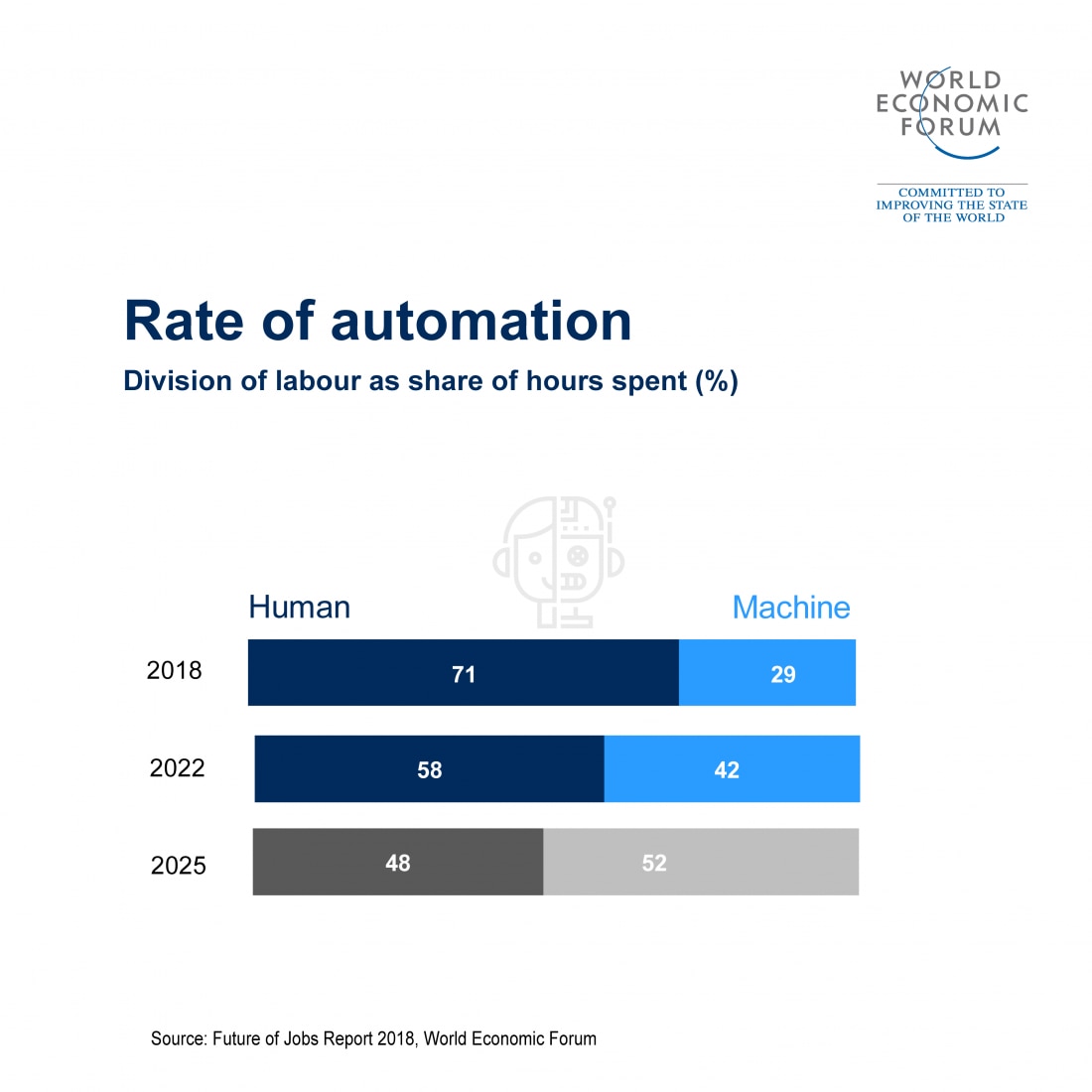
5 things to know about the future of jobs
How will the robot revolution affect the future of work? How many jobs will be lost? How many will be created?
These are some of the questions tackled in the latest edition of our Future of Jobs Report, which was launched here in Tianjin.
The report looks at the trends expected in the 2018-2022 period in 20 economies and 12 industry sectors.
With the mapping of the human genome, a world of medical possibilities began to open up. But as genomic technologies move from lab to clinic, making it possible to create highly targeted treatments, how can society bridge the gap between availability and access?
Genome-sequencing has become vastly faster and cheaper over the past few years. "It once took one machine about three years; now it takes only an hour," says Jay Flatley, Executive Chairman, Illumina.
Accept our marketing cookies to access this content.
These cookies are currently disabled in your browser.
Elisabet de los Pinos Pont of Aura Biosciences Inc. feels optimistic about innovations - especially in oncology. Adaptive trials have been instrumental in fine-tuning therapies and reduce the cost.
Diagnosing cancer faster
Flatley: We hope to be able to detect cancer earlier. The idea is to sequence the blood of people who don't have symptoms. Then we can detect cancers much earlier, when they're still curable through surgery.
Elisabet de los Pinos Pont: At the moment we search for cancer organ by organ, the liver, the breast - but if we can test blood then that will allow us to diagnose a problem much earlier.
Image: HealthITAnalytics
Devil in the data
While the ideal would be a real database for every patient, for every disease (in the words of BGI president Wang Jian), but the risks are real and the process difficult.
For a start, "those who have the data don't have it, and the ones who have it don't want to share it," says Jay Flatley.
Plus, as we gather all this data, how do we protect patient privacy at the same time? It's hard to anonymise data, especially at the core technology level. "As we all know, we leave our DNA around behind us," says Flatley.
Accept our marketing cookies to access this content.
These cookies are currently disabled in your browser.
Distributed-ledger technology could help. "Blockchain tech is promising to secure patient privacy," says Flatley. "It can also help us track value for discoveries."
Wang Jian says: "In China the genome-editing education system is far behind the US. First we need to make people understand about big data, and then worry about privacy.
This session was developed in partnership with Scientific American.
08:00 UTC
The Sports Effect
There is enormous cultural kudos in hosting major global sporting events. But whether it’s the World Cup or the Olympics the costs involved regularly run into double-digit billion dollar figures. How are the benefits of hosting these events being calculated?
Image: Forbes/Statista
This session, which will be moderated by Song Lixin, President, Talents Magazine, Yoshimasa Hayashi, Minister of Education, Culture, Sports, Science and Technology of Japan, and Tinatin Kandelaki, General Producer, Match TV, Russian Federation will discuss whether the economic and societal boosts to a hosting nation are evaluated to really capture their full extent.
09:00 UTC
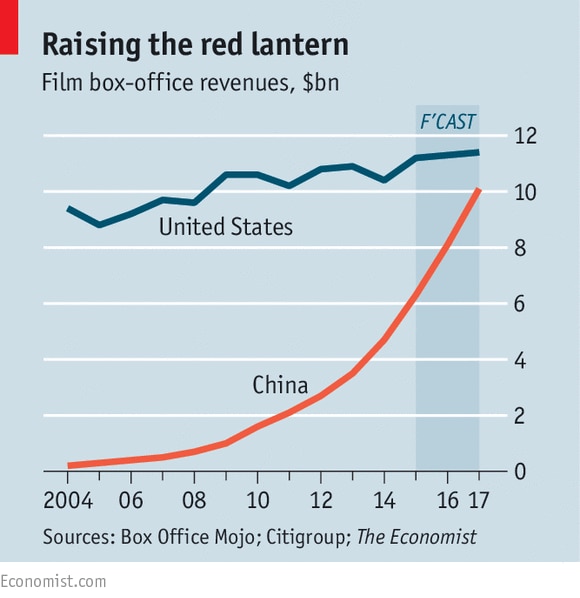
China's Pop Power
As China’s culture and entertainment industry continues to grow, what values and narratives is it projecting to a watching world?
Join Daniel A. Bell, Dean, School of Political Science and Public Policy, Shandong University, Hao Jingfang, Researcher, China Development Research Foundation, and Li Da, Managing Director, Beijing Poly International Auction Company, in a conversation moderated by Chen Wei, Senior Vice-President QIYI.com.
Image: The Economist
09:38 UTC
Bitcoin has a wealth distribution problem, too
Wealth inequality is one of the most well-documented problems facing the global economy. What's less well-known is that it's also a major challenge in the relatively nascent cryptocurrency industry.
"This economic premise of fairness and equality has not yet been realized," says CoinShares' Chief Strategy Officer, Meltem Demirors.
"It is very problematic ... Twenty-percent of bitcoin are owned by the top 100 wallets. Ethereum is even worse, in Ripple it's something like 70%. So not very decentralized.
"Investor disclosure, investor transparency, similar to the way an institution would disclose its positions it holds, or analyst would disclose the positions they have an interest in can go a long way in at least reducing the amount of moral hazard that exists in this industry.
"I've always said if a venture investor owns 50% of the tokens in the new internet, as a consumer, I don't want to use that internet. So for me until we sort that problem it will be very difficult to build globally useable networks."
Accept our marketing cookies to access this content.
These cookies are currently disabled in your browser.
That's it from us on day one of #AMNC18 in Tianjin. We'll be back bright and early tomorrow morning with more highlights from the summit, including a special address by Chinese Premier Li Keqiang. The first livestreamed session kicks-off at 845am CST.