Brad Smith: vaccines are an example of the power of tech
Bradford L. Smith, President, Microsoft Corp says technology hubs are spreading around the world in a "global phenomenon".
"So much real-world progress requires that we weave together new AI technology with cloud-based services and data analytics", he said.
The biggest problem the world needs to solve now is getting vaccines to people around the world. The COVID-19 vaccines are a prime example of the power of technology, with technology used in supply chain logistics, chatbots, scheduling, real-time data analytics and more, Smith said.
Accept our marketing cookies to access this content.
These cookies are currently disabled in your browser.
You can't have good AI unless you have good data, you can't have good data unless you're in the cloud, and you can't get good data unless you have the technology and people to support the effort, she said.
Accept our marketing cookies to access this content.
These cookies are currently disabled in your browser.
"When you think about AI, don't think about it as a destination but as an enabler that is only beginning to reach its full potential," Sweet said.
IBM: Global AI Action Alliance
The Global AI Action Alliance, a multistakeholder group including more than 100 companies to accelerate the adoption of inclusive, trusted and transparent AI was launched at The Davos Agenda today.
Arvind Krishna, Chairman and Chief Executive Officer, IBM Corporation says AI is one of the rare technologies that offer to unlock more than $14 trillion in economic opportunities.
But the big inhibitor is trust. IBM will donate toolkits and other efforts to support the alliance's work, he said.
Accept our marketing cookies to access this content.
These cookies are currently disabled in your browser.
Jonas Prising, CEO of ManPower Group, says "employers in the last 6 years have become more interested in training their employees. In addition, the technology that's coming is going to help enable this transition. Where it lags - is among policy-makers who need to take this as seriously as the climate crisis."
Accept our marketing cookies to access this content.
These cookies are currently disabled in your browser.
On the issue of diversity, he points out that most of the developed world has a declining population growth (although there are exceptions). "The reality is that the availability of the workforce is shrinking", so purposeful skills development that is inclusive is going to be more important. "We can put in extra efforts."
He also emphasises how important it is to see skilling and training as a country initiative. "You have to take into account the culture of the nation."
Salesforce and Deloitte: Partners on UpLink
UpLink, created by the World Economic Forum in partnership with Salesforce and Deloitte, connects the next generation of innovators and entrepreneurs to networks of contacts that have the resources, expertise and experience to help bring about change.
It was launched at the World Economic Forum Annual Meeting 2020 in Davos and is now live with nearly 10,000 users, over 900 solutions, 12 digital communities, and 80 high-quality UpLink Innovators selected by experts and investors.
Accept our marketing cookies to access this content.
These cookies are currently disabled in your browser.
Majid Al Futtaim and Crescent Enterprises: Stakeholder capitalism in MENA
How is the private sector forging ahead with stakeholder capitalism in the middle East and North Africa region?
Alain Bejjani from Majid Al Futtaim says the the era when the business of business was business is over and he speaks of the "big responsibility of the private sector".
“Being aware of the importance of people and the environment and being mindful of the overall environment”.
Accept our marketing cookies to access this content.
These cookies are currently disabled in your browser.
Badr Jafar says stakeholder capitalism can only be achieved if we create enough opportunities for youth. "We also need to instill a sense of purpose and belonging in our youth – the lack of this is a critical threat to the world."
On environmental sustainability, the Middle East faces challenges such as water scarcity, pollution and biodiversity loss, and “If you think the economy is more important than the environment – try hold your breath while you count your money”.
Accept our marketing cookies to access this content.
These cookies are currently disabled in your browser.
He also says philanthropy has traditionally been regarded with suspicion – but the reality is that it is a huge space. "Strategic philanthropy is a mainstream intervention – another tool to help plug the financing gap if we are to achieve the SDGs". And he stresses the importance of incentives and regulatory frameworks.
“Business has no other choice but to be at the forefront of addressing our region’s social and economic challenges. It’s a moral imperative but also a long-term economic imperative”.
EDISON Alliance: Cross-Sector Alliance to Close the Digital Divide
Mastercard, Apollo Hospitals and Vista Equity Partners are among organizations to back a new alliance to close the digital divide.
Access to digital technologies has enabled many to work, learn and live during the COVID-19 pandemic. However, the pandemic has exposed and exacerbated existing gaps and inequalities: almost half of the global population, some 3.6 billion people, remain offline and broadband services are too expensive for 50% of the population in developed countries.
These “connectivity deserts” hamper access to health, education and economic inclusion. To ensure global and equitable access to the digital economy, the World Economic Forum is launching the Essential Digital Infrastructure and Services Network, or EDISON Alliance.
The Alliance will work with governments and industries to accelerate digital inclusion. Its goal is to ensure an unprecedented level of cross-sectoral collaboration between the technology industry and other critical sectors of the economy.
Image: International Monetary Fund
A multi-sector Board will steer the Alliance. Hans Vestberg, Chairman and Chief Executive Officer, Verizon, will serve as Chair of the Alliance and Board.
He is joined by Paula Ingabire, Rwanda’s Minister for ICT and Innovation; Ajay Banga, Mastercard Executive Chair; Shobana Kamineni, Executive Vice-Chairperson of Apollo Hospitals Group; and Robert F. Smith, Founder, Chairman and CEO of Vista Equity Partners. The World Economic Forum will serve as the secretariat and platform for the Alliance. A wider group of Champions Leaders will advise and support the Alliance.
PwC co-author new report with the Forum: Upskilling for Shared Prosperity
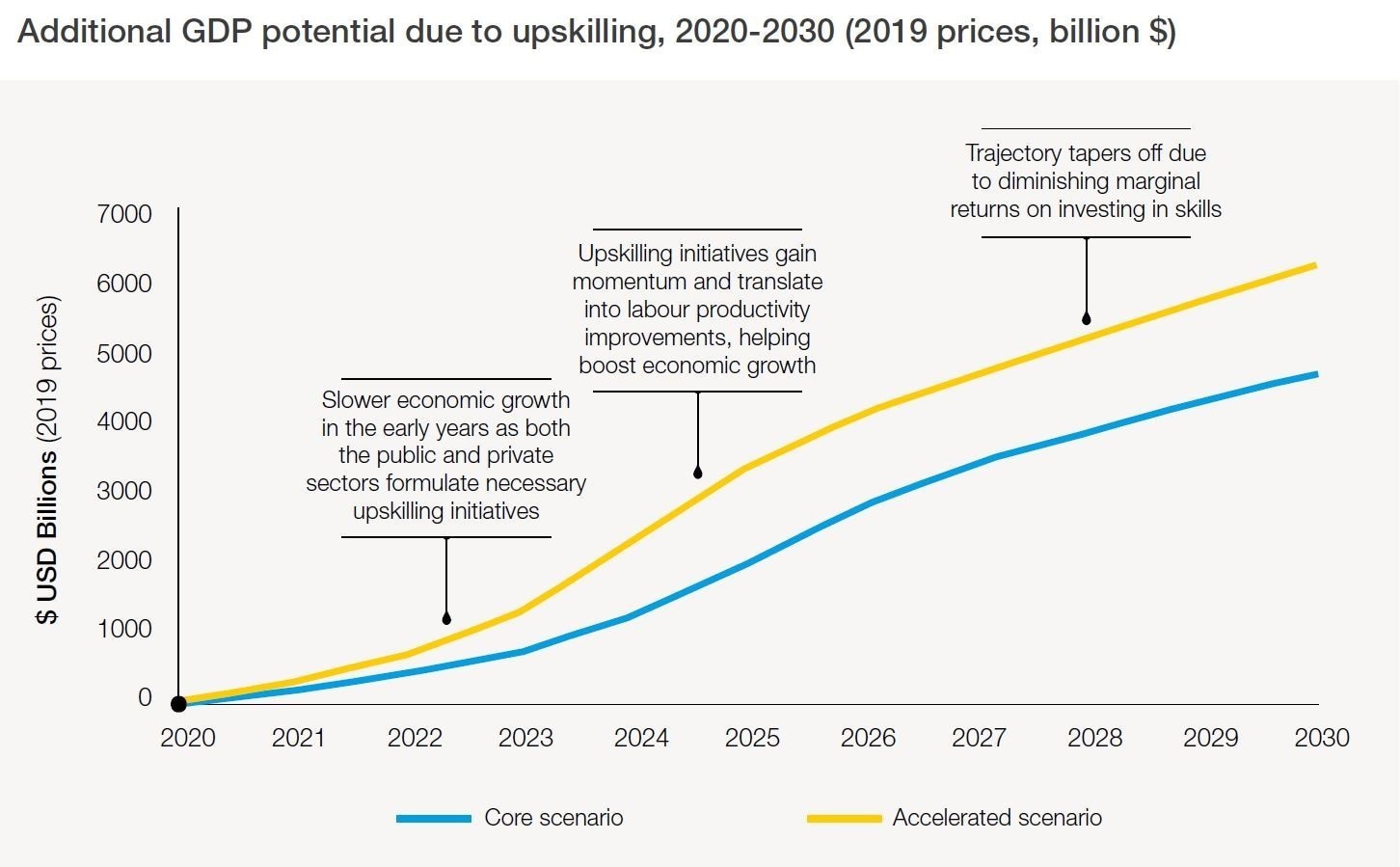
With the launch of a new report earlier this week, highlighting the potential return on reskilling for GDP, business leaders involved in the initiative took part in a discussion this morning - with reflections from Saadia Zahidi, Managing Director, World Economic Forum.
The report was authored in collaboration with PwC.
Reskilling Revolution companies are leading new approaches to support their workforces, and their supply chains and communities through access to education, skills and better jobs.
With 10 years to achieve the Sustainable Development Goals, we need to fundamentally change the way food is produced and consumed. This includes changing the practices of more than 500 million smallholder farmers and the consumption patterns of 7.7 billion individuals.
Accept our marketing cookies to access this content.
These cookies are currently disabled in your browser.
To support this, the World Economic Forum, the Government of the Netherlands and several public and private sector partners are launching Food Innovations Hubs.
This important multistakeholder platform will leverage technology and broader innovations to strengthen local innovation ecosystems for food systems transformation. The hubs have been launched with multi-year funding from the Government of the Netherlands with a Global Coordinating Secretariat based in the country.
From the private sector, Ramon Laguarta, Chief Executive Officer of PepsiCo, said: “Food is one of the main levers we can pull to improve environmental and societal health. With the right investment, innovation and robust collaboration, agriculture could become the world’s first sector to become carbon negative, while meeting the needs of a rapidly growing global population and providing meaningful economic opportunities. Unlocking this potential will take ambitious multistakeholder, precompetitive collaborations to transform the food system — exactly what these hubs are designed to cultivate.”
With the right investment, innovation and robust collaboration, agriculture could become the world’s first sector to become carbon negative
—Ramon Laguarta, Chief Executive Officer, PepsiCo
Alan Jope, Chief Executive Officer of Unilever, said:“The Food Innovation Hubs will help to revolutionize the global food system by bringing innovation and new technology at scale to meet local needs. Unilever is proud to be a part of these Food Innovation Hubs, as we believe that through our collective efforts we can make food a force for good.”
Bringing innovation and new technology at scale to meet local needs.
—Alan Jope, Chief Executive Officer, Unilever
McKinsey: 2021 Trends
Accept our marketing cookies to access this content.
These cookies are currently disabled in your browser.
Huawei Technologies’ Deputy Chairman, Ken Hu, says the 4IR is a combination of innovation and technology. "In China during the pandemic, we started to work with different hospitals to develop platforms with AI tech. Now AI has been deployed across China.AI helped doctors to diagnose for example and the time went from 12 minutes to 2 minutes and this saved lives."
Accept our marketing cookies to access this content.
These cookies are currently disabled in your browser.
Another application – autonomous trucks in the mining industry. Previously, there’d have been 4 drivers for each truck – and there is a driver shortage – and also speed of trucks has gone from 10km per hour up to 35 km per hour. Safety has been greatly improved, too.
There are many good references of AI’s application.
Turning to some of the hurdles, he says, "we need to pay more attention to people. We need to think about the impact of 4th industrial technology to people. There’ll be disruption in many industries. The right strategy is to make sure that all stakeholders, government, industry and people – work together to think about how to help everyone get ready for the future."
He adds, that it is a responsibility of governments to share data – but at the same time, the business community needs to step up. He speaks about data protection and says businesses need to make sure that data is reliable. “We have to make sure that we fully comply with data protection regulations”.
DP World and UNICEF announce global vaccine partnership
DP World and UNICEF have announced a wide-ranging partnership to support the global distribution of COVID-19 vaccines and related immunization supplies in low- and lower-middle-income countries.
The new partnership - with a multi-million dollar value - is the largest to date to support UNICEF’s lead role in procuring and supplying 2 billion doses of COVID-19 vaccines and auxiliary vaccination supplies on behalf of the COVAX Facility. DP World and UNICEF will also collaborate on other global programs in support of education, health, women’s empowerment and water and sanitation.
Infosys: Skilling opportunities and the effects of AI
Companies must make sure that skilling opportunities are available to all employees, says Salil S. Parekh, Chief Executive Officer and Managing Director, Infosys Limited.
"We must go ahead with reskilling because with the change in technology, the digital transformation, that is the key thing that enterprises can do," he said. "Reskilled people can support all the new digital work."
Accept our marketing cookies to access this content.
These cookies are currently disabled in your browser.
On the impact of AI on corporates, Mohit Joshi, President of Infosys says there are four aspects:
1. Business models are changing dramatically – companies are becoming almost completely digital.
2. Cloud, IoT, robotics – there are multiple technologies, AI is just an umbrella and technologies are converging.
3. There are issues of privacy, data security.
4. There are changing workforce dynamics. The workforce is much more distributed now.
"When you look at these four factors – AI is really going to transform businesses. Enterprises are going to be changing their dynamics from a cost and customer perspective quite dramatically."
Accept our marketing cookies to access this content.
These cookies are currently disabled in your browser.
Last night's sessions wrapped up with a conversation on carbon markets between Bill Gates, Co-Chair, Bill & Melinda Gates Foundation; Mark Carney, United Nations Special Envoy for Climate Action and Finance; Bill Winters, Group Chief Executive Officer, Standard Chartered Bank; Annette L. Nazareth, former Commissioner of the US Securities and Exchange Commission; and Nicole Schwab, Co-Head, Nature-based Solutions, World Economic Forum Geneva.
Highlights from the business perspective came from the two Bills - Winters and Gates. Winters said he has been "around the voluntary carbon markets for years, and to date it has never really taken off and is nowhere near as robust as it needs to be to get us to net zero by 2050."
The reduction of emissions have to be first and foremost on the minds of businesses. It's going to be very difficult for them to get to net zero without tapping into the offset markets. Why offsets? Because they are the most efficient and convenient way to migrate the tens of billions of dollars that need to move from the hands of banks like his into the hands of people that can actually remove carbon from the environment.
Accept our marketing cookies to access this content.
These cookies are currently disabled in your browser.
On the role of technology in achieving net zero, Gates said the good news is that a lot of companies are taking carbon into account as they make decisions, and stay away from investments that produce carbon.
"The next step is getting people to monetize those things and put the money into things that have a provable impact," he added, and a number of companies are willing to do that.
Accept our marketing cookies to access this content.
These cookies are currently disabled in your browser.