Measles cases are still high – are we at a tipping point?

The world is facing an 'alarming rise' in measles - how do we set immunization programmes back on track? Image: CDC/Unsplash
Shyam Bishen
Head, Centre for Health and Healthcare; Member of the Executive Committee, World Economic ForumThis article has been updated.
- Measles cases are still at alarming levels across the US, Europe and other parts of the world, with one expert saying we're now living in a post-herd-immunity period.
- The spread of misinformation about vaccine safety has contributed to the largest sustained drop in childhood vaccinations in 30 years.
- The World Economic Forum has been working with its healthcare partners on the Regionalized Vaccine Manufacturing Collaborative to increase access to vaccines.
Measles cases are still at concerning levels. Last year saw 127,350 cases across Europe, double the number compared to 2023 figures and the highest number for more than 25 years. While this year's case numbers have comparatively dipped, they remain high; as of September 2025, 7,000 cases have been reported across Europe, with 1,514 confirmed cases in the US.
In Texas alone, more than 1,088 cases of measles have been reported, 37 of them in vaccinated people. The situation has led one leading immunologist to tell The Guardian: “We’re living in a post-herd-immunity world".
These figures represent a dangerous and escalating global trend.
There were an estimated 10.3 million cases of measles worldwide in 2023 – a 20% increase on 2022 figures, according to the World Health Organization (WHO) – and a 45-fold increase between 2022 and 2023 across 41 countries in Europe and parts of central Asia.
So why are we in the middle of this "alarming rise" in measles cases – and what is being done about it?
What is measles?
Measles is caused by a highly contagious virus that infects the respiratory tract and spreads throughout the body, causing fever and a rash.
At its most severe, it can cause complications such as blindness, pneumonia, encephalitis, or brain swelling, which can be fatal. The latest data from the WHO shows that over 100,000 people died from measles in 2023, the majority of them children.
Young children under five, pregnant women, adults over 20 and those with compromised immune systems are most at risk of measles complications.
Where are measles outbreaks occurring?
While measles is still common in Africa and parts of the Middle East and Asia, countries in Europe and the US that were declared measles-free in recent years are now seeing a worrying resurgence.
Romania, one of 53 countries included in the WHO European Region, has seen the highest number of measles cases, with 30,692 recorded in 2024.
In Western Europe, the UK is one of the worst-affected countries. There were just two confirmed cases of measles in 2021; by 2024, 2,911 were reported. In July 2025, a child died after contracting the disease, the first such death in a decade, reports the Guardian.
Vaccination rates for measles among UK children have fallen to 84.4% – well below the WHO's recommended level of 95% coverage – and Dr Mary Ramsay, Director of Immunisation at UK Health Security Agency warns that "measles, being the most infectious disease, is the 'canary in the coalmine' and a wake-up call that urgent action is needed".
This is in stark contrast to 2017, when the UK, with just 284 cases, was granted “measles-free status” by the WHO.
The US Centers for Disease Control and Prevention (CDC), which is monitoring outbreaks across the US, reported that a majority of the cases confirmed so far in 2025 have been in children aged 5-19, and that three people have died from the disease.
Why are measles cases rising?
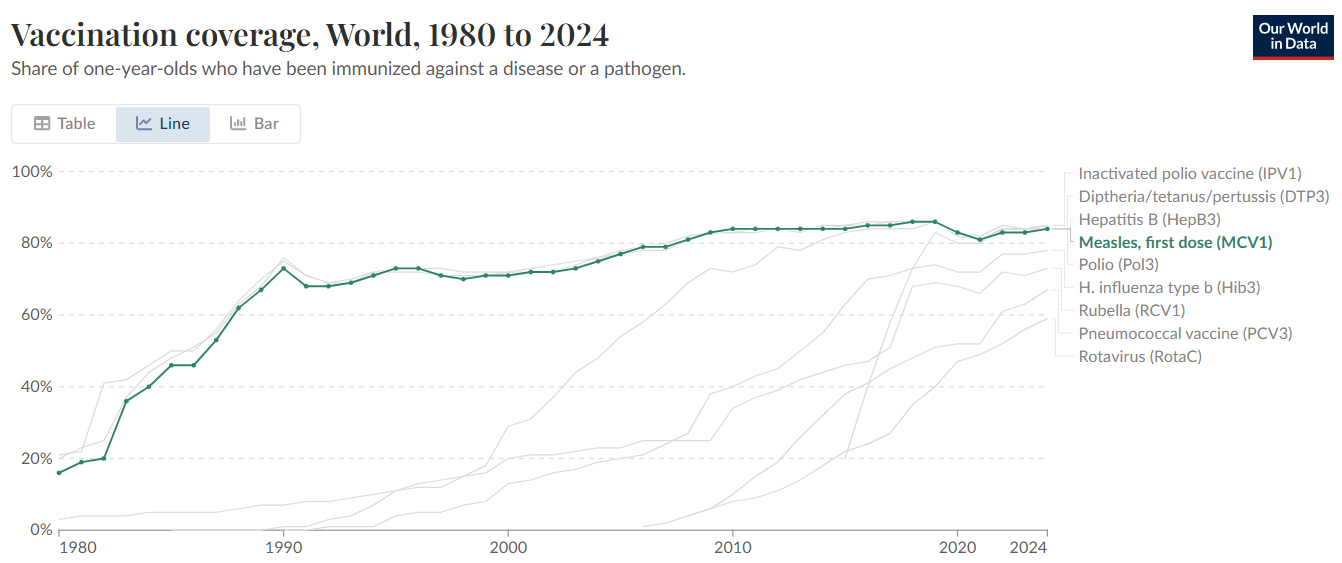
To keep progressing in the fight against measles, countries are expected to achieve a rate of 95% coverage with two doses of measles-containing vaccine.
Between 2000 and 2023, second-dose vaccine coverage rose in all regions, albeit unevenly, as seen in the chart using WHO and CDC data below. This saved an estimated 57 million lives.
But, overall, rates of vaccination coverage have been dropping in recent years.
In the WHO European Region alone, over 1.8 million infants missed their measles vaccination between 2020 and 2022, at least partly caused by the COVID-19 pandemic.
In the UK, more than 3.4 million children under 16 are either completely unprotected or only partially protected against measles, says NHS England. While in the US, an average of 91% of children are sufficiently vaccinated, but that figure is lower in certain communities.
Globally, the spread of misinformation about vaccine safety has contributed to the largest sustained drop in childhood vaccinations in 30 years, in what UNICEF Executive Director Catherine Russell warned in 2022 was a “red alert” for child health.
“We need immunization catch-ups for the missing millions or we will inevitably witness more outbreaks, more sick children and greater pressure on already strained health systems,” she said.
What needs to happen?
As the figures show, there’s urgent work needed to get immunization programmes back on track and to rebuild trust in vaccine safety to reach the 95% coverage threshold.
“Measles is back, and it’s a wake-up call. Without high vaccination rates, there is no health security," the WHO’s Regional Director for Europe, Dr Hans Kluge said. "Every country must step up efforts to reach under-vaccinated communities. The measles virus never rests – and neither can we."
UNICEF and WHO are calling on all governments experiencing measles outbreaks to prioritize case finding and contact tracing, as well as start emergency vaccination programmes. "Reaching hesitant parents and marginalized communities and tackling inequitable access to vaccines must be central to all efforts," they say.
How the Forum helps leaders strengthen health systems through collaboration
Building up regional vaccine manufacturing capacity can help to make access to vaccines more equitable. To this end, the World Economic Forum has been working with its healthcare partners, including the Coalition of Epidemic Preparedness Innovations and the US National Academy of Medicine, on the Regionalized Vaccine Manufacturing Collaborative.
Together, they have created a roadmap for regions to grow production and distribution capabilities sustainably and establish local capacities to respond at scale in epidemics. Read it here: A Framework for Enhancing Vaccine Access Through Regionalized Manufacturing Ecosystems.
Don't miss any update on this topic
Create a free account and access your personalized content collection with our latest publications and analyses.
License and Republishing
World Economic Forum articles may be republished in accordance with the Creative Commons Attribution-NonCommercial-NoDerivatives 4.0 International Public License, and in accordance with our Terms of Use.
The views expressed in this article are those of the author alone and not the World Economic Forum.
Stay up to date:
Global Health


Forum Stories newsletter
Bringing you weekly curated insights and analysis on the global issues that matter.
More on Health and Healthcare SystemsSee all

Priya Abani
February 18, 2026


