Urgent health gaps targeted at UN financing summit, and other health stories

The conference comes as the UN estimates that two-thirds of SDG targets, including those related to health, are off track. Image: REUTERS/Claudia Greco
Shyam Bishen
Head, Centre for Health and Healthcare; Member of the Executive Committee, World Economic Forum- This global round-up brings you health stories from the past fortnight.
- Top health news: UN summit targets health financing gaps; Major pledges bring Gavi closer to $11.9 billion goal; Suriname certified malaria-free.
1. UN summit aims to reshape global finance for universal health coverage
A once-in-a-decade United Nations summit opened on June 30 in the Spanish city of Seville, with world leaders and delegates from 193 countries meeting to address urgent gaps in development and climate funding, including health. At the heart of the four-day event is a pre-agreed pact that sets out reforms aimed at closing the $4 trillion annual development financing gap.
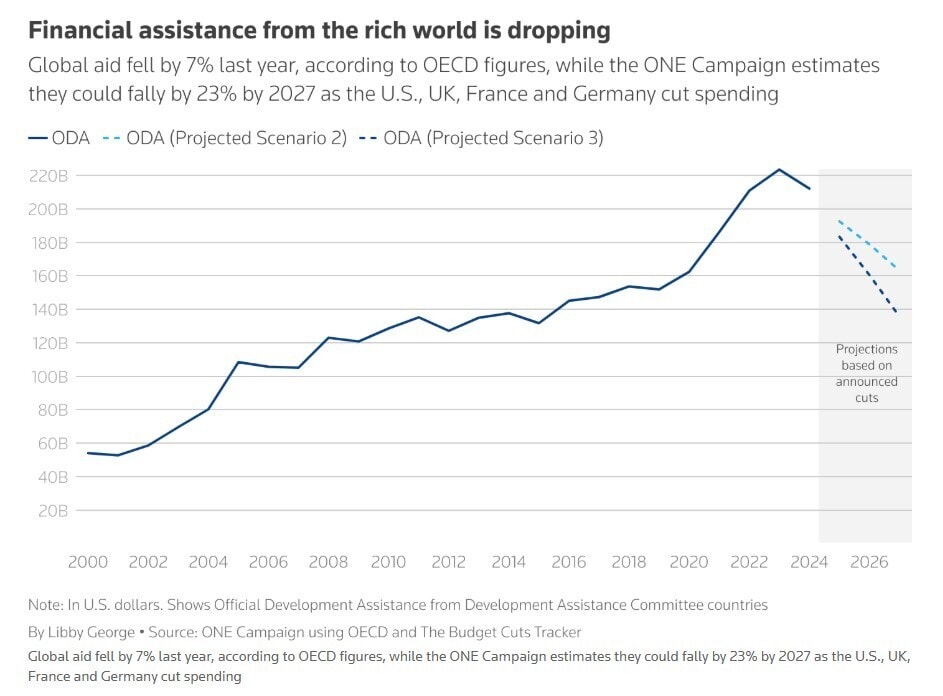
The Fourth International Conference on Financing for Development (FFD4) aims to reshape global financial strategies as progress on the Sustainable Development Goals (SDGs) – such as universal health coverage – lags and development aid declines.
UN Secretary-General António Guterres described the summit as an effort “to repair and rev up” a global system where “trust is fraying and multilateralism is strained”. The summit’s central outcome, the “Seville Commitment”, is a political pledge to overhaul development finance for the next decade.
Measures include tripling multilateral lending, expanding debt relief, increasing tax revenues in developing countries, and exploring new global solidarity levies such as taxes on high-polluting activities and luxury travel.
The conference comes as the UN estimates that two-thirds of SDG targets, including those related to health, are off track. The United States, traditionally the largest donor, was notably absent from the summit after withdrawing support during negotiations.
“Countries need – and deserve – a system that lowers borrowing costs, enables fair and timely debt restructuring and prevents debt crises in the first place,” Guterres said. This is vital when an estimated 3.3 billion people live in countries that spend more on debt than health, Reuters reports.
2. Gavi nears funding goal with $9 billion pledged, but significant gap remains
Before the focus shifted to Seville, the 'Global Summit: Health & Prosperity through Immunization' in Brussels on June 25 delivered a largely positive outcome for health financing. World leaders, philanthropists and private-sector partners pledged more than $9 billion at the event, bringing the Vaccine Alliance, Gavi significantly closer to its $11.9 billion target for 2026-2030.
Co-hosted by the European Union and the Gates Foundation, the summit saw a record number of new and returning donors step forward to support Gavi’s mission to protect 500 million children from preventable diseases in the coming five years.
Headline outcomes from the event include:
- $9+ billion pledged towards Gavi’s $11.9 billion target for 2026-2030, with further commitments expected.
- $4.5 billion in complementary financing from development finance institutions to support country health systems and vaccine access.
- Up to $200 million in cost savings announced by vaccine manufacturers, including major price reductions for malaria and rotavirus vaccines.
- $149 million in new private sector partnerships and a $40 million anchor commitment for an Innovation Scale-Up Fund to improve immunization delivery.
- Record $4 billion in co-financing pledged by implementing countries for their own immunization programmes.
- Nearly €800 million ($942m) pledged for African vaccine manufacturing under the African Vaccine Manufacturing Accelerator.
Despite strong support, some major donors – including the US and UK – were unable to pledge at the summit "due to their domestic budgetary cycles", Gavi said, leaving a significant funding gap. The Alliance warned that without full funding, millions of children could go unvaccinated and global health security risks would rise.
In a constrained budget environment, it’s even more important to focus aid funding on the investments that really work. And Gavi is exactly that.
—Bill Gates, Chair of the Gates Foundation”3. News in brief: Health stories from around the world
The US Food and Drug Administration has removed its REMS safety programme for CAR-T therapies – personalized cancer treatments that modify a patient’s immune cells to attack blood cancers. The agency said risks can now be managed through existing warnings on drug labels. The move, which is expected to ease access, has been welcomed by some leading drugmakers.
Suriname has become the first country in the Amazon region to be certified malaria-free by the World Health Organization (WHO), marking a historic milestone after nearly 70 years of sustained efforts. It joins 46 countries and one territory now recognized as malaria-free, including 12 in the Americas.
A new WHO report reveals that one in six people globally experience loneliness, which is linked to more than 870,000 deaths each year. 'From loneliness to social connection: charting a path to healthier societies' calls for urgent action to build stronger social ties and improve global health and wellbeing.
Deaths from high blood pressure linked to excessive alcohol use rose by more than 50% during the COVID-19 pandemic, according to a new report from the Centers for Disease Control and Prevention (CDC). Between 2020 and 2021, an estimated 21,137 people died annually – up from 13,941 in 2016-2017 – with women disproportionately affected, reports CBS News.
The US has approved lenacapavir, the world’s first twice-yearly HIV prevention shot, which could protect millions by offering long-lasting protection that outperforms daily pills. Experts say it has the potential to greatly reduce new infections – if access challenges can be overcome, reports AP.
England and Wales have seen an increase in the number of births for the first time since 2021. Data from the Office for National Statistics showed there were 594,677 live births in 2024, which constituted a 0.6% increase on 2023's figures. One contributing factor is thought to be the increase (of 14%) in fathers over the age of 60.
How the Forum helps leaders strengthen health systems through collaboration
4. More on health from Forum Stories
With 60-70% of the 57 million people living with dementia worldwide affected by Alzheimer’s, the race to find effective treatments is urgent. From AI-powered diagnoses to implants like InBrain’s ultra-thin graphene device, recent innovations offer new hope in the fight against this devastating disease. Explore eight promising breakthroughs shaping the future of Alzheimer’s care.
Two new Forum articles explore the impact of AI on health, spotlighting breakthroughs in tackling antimicrobial resistance and advancing brain health. Together, they showcase how AI is driving innovation in critical areas of healthcare.
Antimicrobial resistance (AMR) is projected to cause 10 million deaths annually by 2050, worsened by a lack of new antibiotics. Here, leaders at a Paris-based biotech start-up explore how AI is breathing new life into bacteriophage therapy, offering a promising alternative to combat resistant infections.
Meanwhile, neurological conditions are the leading cause of disability worldwide, often diagnosed too late due to limited monitoring tools. AI-powered, non-invasive intracranial monitoring technology is transforming how brain health is assessed and managed, enabling earlier intervention and improved care, explains Plínio Targa, Chief Executive Officer of brain4careAI.
License and Republishing
World Economic Forum articles may be republished in accordance with the Creative Commons Attribution-NonCommercial-NoDerivatives 4.0 International Public License, and in accordance with our Terms of Use.
The views expressed in this article are those of the author alone and not the World Economic Forum.

Forum Stories newsletter
Bringing you weekly curated insights and analysis on the global issues that matter.
More on Health and Healthcare SystemsSee all

Sarah Sáenz Hernández
February 24, 2026