Royal flush: why data can transform sanitation services in sub-Saharan Africa
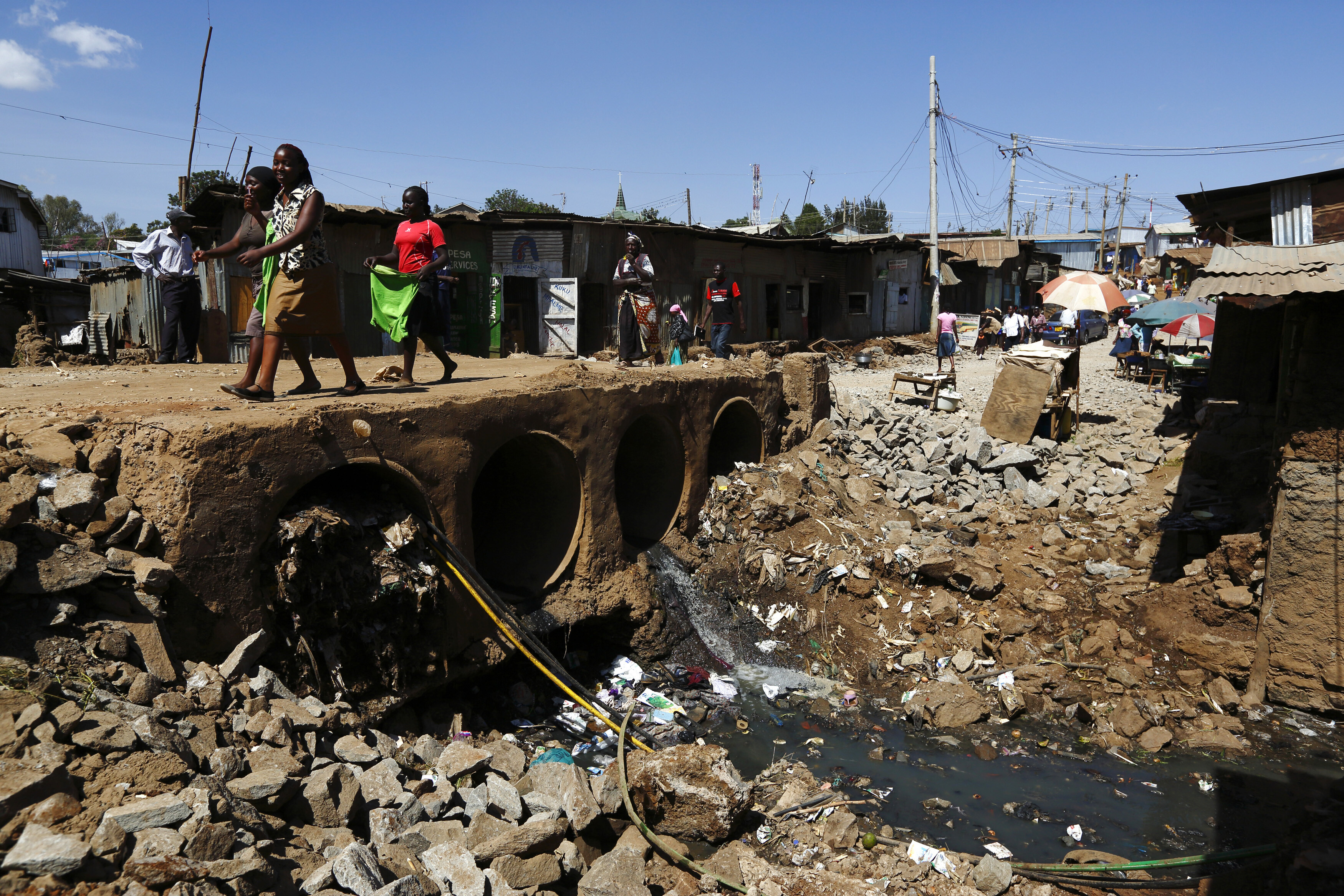
Open sewers in the Kibera slum of Kenya's capital, Nairobi.Better data can help Africa address its lack of safely managed sanitation. Image: Reuters/Darrin Zammit Lupi
- Better data can help Africa address its lack of safely managed sanitation.
- African cities are beginning to invest in data infrastructure that facilitates monitoring of even non-sewered sanitation.
- Further governance changes, utility reforming and financing are needed to build on these developments.
What do 700 million people in Africa have in common? A lack of safely managed sanitation. As cities across sub-Saharan Africa expand rapidly, infrastructure and basic services have failed to keep pace. The result is an undiscussed daily crisis: overflowing latrines and unregulated septage. The investment required seems unattainable. Yet, a quiet, fundamental, potent catalyst has the potential to help resolve this crisis: better data.
Beyond deploying more pipes or toilets, governments must treat public data systems as core infrastructure. As the World Economic Forum's Digital Public Infrastructure (DPI) initiative argues, data systems can be as vital as roads and power grids when inclusive, interoperable and secure. Data infrastructure can improve how sanitation investments and services are planned, delivered, regulated and financed.
The invisible backbone of sanitation
Non-sewered sanitation (NSS) – pit latrines, septic tanks and the subsequent handling of the sludge and effluent – is the dominant sanitation for African cities. But these facilities remain the least managed: a 2024 Dev-Afrique assessment in 10 countries found that most utilities and municipalities do not track NSS services. Less than 15% had facility maps; fewer used data for planning or service monitoring.
This is a gap in data, management and governance. Without data-driven service management systems, knowing where sanitation services are failing and how to fix them is difficult. It is almost impossible to manage costs and ensure scarce public investment efficiently reaches the most in need. The result is fragmented, expensive, low-quality service systems and underinvestment in waste containment and treatment. WEF’s Global Risks Report shows that sanitation gaps fuel health crises, climate vulnerability and economic exclusion.
Building a sanitation data value pipeline
To address this, Dev-Afrique developed the Sanitation Data Value Pipeline, a practical model consisting of:
- Data generation: Moving beyond surveys to real-time, digitally captured data across sanitation and finance, not tied to short-term projects.
- Data analysis: Equipping local authorities with tools like Geographic Information Systems (GIS), Enterprise Resource Planning (ERP) and AI to support budgeting, track performance and uncover service gaps.
- Data operationalization: Integrating digital data into daily decision-making, planning, maintenance and investment systems.
Unfortunately, most African utilities lack monitoring, evaluation and learning units, dedicated data staff, or integrated management systems. Many donor-driven, project-specific data collections leave gaps once projects end. Some collect data, but don’t use it – the “data-rich, decision-poor” paradox.
Smart cities invest in smart sanitation
Sanitation data systems are essential for urban resilience, climate adaptation, social equity and targeted emergency response. Across Africa, smart cities are investing in data infrastructure to strengthen sanitation services. Change is happening with strong coordination from actors like the Eastern and Southern Africa Water and Sanitation Regulators Association (ESAWAS), a continental coordinating body for water and sanitation regulators, providing guidance, tools and grants to its members to strengthen public data systems and correct market failures in service provision.
Tanzania has led the region in demonstrating how best-practice sanitation can be efficiently scaled through national investments in digital public infrastructure. The national regulator, Energy and Water Utilities Regulatory Authority, ensures that all water and sanitation utilities use ERP systems to integrate sector performance reporting with its national unified utility system for harmonized national reporting.
Apps like Uganda’s Weyonje allow residents to request licensed emptying services, incentivizing operators to comply with standards. The platform collects sanitation data, enabling Kampala City to target subsidies and enforcement to protect public health and improve service quality. ESAWAS is now scaling this digital model to more African countries through the new Sanitracker system.
In Zambia, the Lusaka Water Supply and Sanitation Company developed the Lusaka Sanitation System, a real-time platform tracking capture, emptying, treatment and billing. Lusaka uses sanitation job cards and GPS to track every pit that is emptied and every drop of waste that reaches a treatment plant. Lusaka is transforming data systems to incentivize private companies to extend sanitation services to underserved and cholera-prone areas.
Strong models are also emerging in South Asia, including Bangladesh, the Philippines and Malaysia. Bangladesh’s Integrated Municipal Information System supports local service authorities with service monitoring and aggregates sanitation data nationally, helping municipalities coordinate private operators, target underserved zones and enable faecal sludge treatment. These systems inform and drive service standards enforcement and accountability. They allow public investment decisions in sanitation to be informed by data from local service systems.
Data as a public good
For Africa to foster healthy, modern urban centres as engines of national growth and advancement, its leaders must invest in Sustainable Development Goal 6.2, universal access to sanitation, and treat public data systems as critical infrastructure. Associations like ESAWAS and AfWASA are helping move that needle, but more is needed:
- Policy leadership: Governments must enforce standard KPIs, fund local data teams and embed water and sanitation into national digital strategies.
- Utility reform: Data must serve operations, not just donors. Utilities need operational performance dashboards, not dusty reports.
- Regulatory strengthening: Regulators must extend utility targets to include NSS, require digital management systems and invest in integrated platforms.
- Financing transformation: Infrastructure loans should be tied to utility performance systems, ensuring public investment delivers services and revenue.
We need to stop thinking of toilets as the end of the chain. In the age of digital transformation, they are only the beginning of cleaner cities, stronger institutions and a more dignified urban future.
Don't miss any update on this topic
Create a free account and access your personalized content collection with our latest publications and analyses.
License and Republishing
World Economic Forum articles may be republished in accordance with the Creative Commons Attribution-NonCommercial-NoDerivatives 4.0 International Public License, and in accordance with our Terms of Use.
The views expressed in this article are those of the author alone and not the World Economic Forum.
Stay up to date:
Sanitation
Related topics:


Forum Stories newsletter
Bringing you weekly curated insights and analysis on the global issues that matter.
More on Built Environment and InfrastructureSee all

Fabienne Robert
February 18, 2026


