1 in 4 people still lack access to safe drinking water, and other health stories

The WHO's One Health framework recognizes the interdependence of human, animal and environmental health. Image: REUTERS/Ognen Teofilovski
Shyam Bishen
Head, Centre for Health and Healthcare; Member of the Executive Committee, World Economic Forum- This global round-up brings you health stories from the past fortnight.
- Top health news: One in four people lack access to safe drinking water; Pattern in Dengue outbreaks identified; Diabetes treatment should offer weight-loss drugs, public body says.
1. One-quarter of the world lacks access to safely managed drinking water
Despite gains since 2015, one in four – or 2.1 billion people globally – still lack access to safely-managed drinking water, according to a report from the World Health Organization (WHO) and UNICEF.
The WHO defines safely-managed drinking water as "water from an improved source that is accessible on premises, available when needed, and free from faecal and priority chemical contamination".
Since 2015, 961 million people have gained access to safely-managed drinking water services, but major gaps still persist in access.
The authors state that people living in low-income countries, fragile contexts, rural communities, as well as children and minority ethnic and indigenous groups, face the greatest disparities in access to safe drinking water.
People in least-developed countries are more than twice as likely as people in other countries to lack basic drinking water and sanitation services.
“Water, sanitation and hygiene are not privileges, they are basic human rights,” said Dr Rüdiger Krech, Director, Environment, Climate Change and Migration a.i. at the WHO. “We must accelerate action, especially for the most marginalized communities, if we are to keep our promise to reach the Sustainable Development Goals.”
2. Dengue outbreaks sync with heat and rain patterns
Dengue outbreaks in the Americas typically occur about five months after an El Niño event, a study published in Science Translational Medicine has found. At the local level, outbreaks are more likely to occur about three months after summer temperatures peak and one month after peak rainfall.
The research drew upon three decades of surveillance data from 14 countries. Cases in the region tended to rise and fall in sync, on average, six months apart, even in places as far as 10,000 kilometres apart.
Co-author Talia Quandelacy says that the findings are “useful to anticipate when a region might expect to see an epidemic, which can help inform planning and preparedness”.
3. News in brief: Health stories from around the world
Treatment for type 2 diabetes patients should be more personalized, with greater access to newer medicines such as weight-loss drugs, the National Institute for Health and Care Excellence (NICE) has recommended. NICE is calling for newer diabetes medicines called SGLT-2 inhibitors, which protect the heart and kidneys as well as lower blood sugar levels, to become the first-choice treatment for all diabetes patients, which would make around 2.3 million people eligible for these drugs.
The first human case of a flesh-eating parasite has been confirmed in the US. The patient returned from El Salvador to the US, an official from the Department of Health and Human Services has stated. Cases have now been confirmed in every Central American country - in addition to the US and Mexico, the BBC reports.
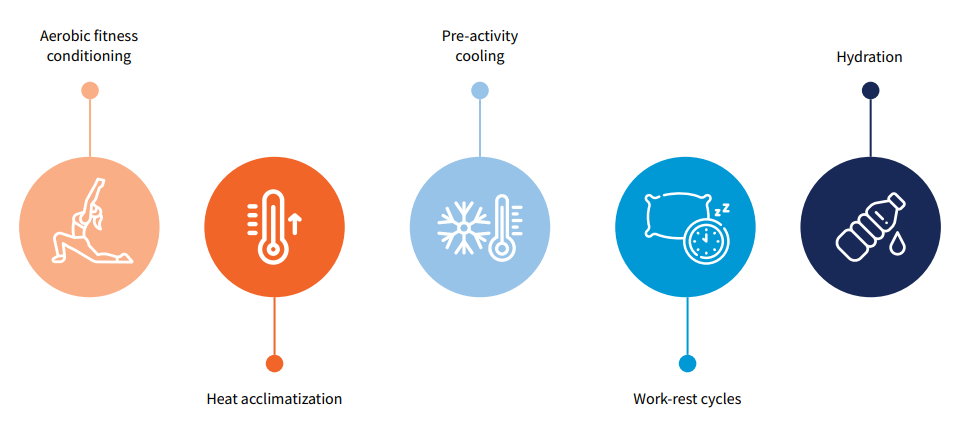
The WHO and the World Meteorological Organization (WMO) have published a report highlighting the growing global health challenges posed by extreme heat on workers, and what organizations can do to protect their employees.
The report outlines key issues such as the average decline in worker productivity of 2.6% for every degree above 24C, as well as some of the health risks, which include heatstroke, dehydration, kidney dysfunction and neurological disorders. Some key adaptation strategies are outlined in the graphic below.
Botswana's President, Duma Boko, has declared a public health emergency for the nation as hospitals and clinics are short or out of vital medicines, covering ailments from cancer and asthma to mental health conditions. "The medical supply chain as run by central medical stores has failed," Boko said in a televised address: "This failure has led to a severe disruption to health supplies countrywide".
Over in China, customs have reportedly screened 600 million people at international ports for infectious diseases over the past five years. "Over 600 million inbound travellers and 300 million inbound vehicles and vessels were screened, and 5.25 million disease vectors were intercepted, effectively preventing the entry of over 30 types of vector-borne diseases," Zhao Zenglian, deputy director general of the customs agency, told a news conference.
Four common allergens have been recommended to be added to the mandatory food packaging warning list in the UK and the EU. Researchers say that the following should be added to the list as emerging allergens: goat or sheep milk; pine nuts; peas and lentils; buckwheat.
How the Forum helps leaders strengthen health systems through collaboration
4. More on health from Forum Stories
The WHO's One Health framework recognizes the interdependence of human, animal and environmental health. Unfortunately, policy delivery from this framework remains slow and fragmented, as key policy actors are still largely operating in incoherent silos. What society needs is an institutional mechanism to mobilize collective ambition and unify multiple policy areas. Read Global Shaper James Balzer's article on this topic to find out how to enable coordinated missions and projects such as integrated zoonotic early-warning systems or regenerative agriculture transitions.
With 4.5 billion people currently without access to essential healthcare services and a health worker shortage of 11 million expected by 2030, AI has the potential to help bridge that gap and revolutionize global healthcare. As the chart below shows, levels of private investment in AI in the healthcare sector vary.
This article highlights seven examples of how AI technologies are already making a difference in the medical field, from spotting bone fractures to assessing ambulance needs.
A critical, yet often overlooked, factor in healthy ageing is the link between economic security and health outcomes. Building resilient longevity systems requires integrating health and economic protections and ensuring that insecurity does not lead to poor outcomes. Yet, sustainability in healthcare is not only financial, it is also cultural, and systems reflecting local values and norms are more likely to be trusted and sustained. In this article, Global Shapers David Ebube Nwachukwu and Adam Skali explore why strategies for healthy longevity must be grounded in the cultural realities of the communities they support.
License and Republishing
World Economic Forum articles may be republished in accordance with the Creative Commons Attribution-NonCommercial-NoDerivatives 4.0 International Public License, and in accordance with our Terms of Use.
The views expressed in this article are those of the author alone and not the World Economic Forum.

Forum Stories newsletter
Bringing you weekly curated insights and analysis on the global issues that matter.
More on Health and Healthcare SystemsSee all

Shyam Bishen
April 9, 2026


