Quantum in focus: how finance is adapting and what else to watch in frontier tech
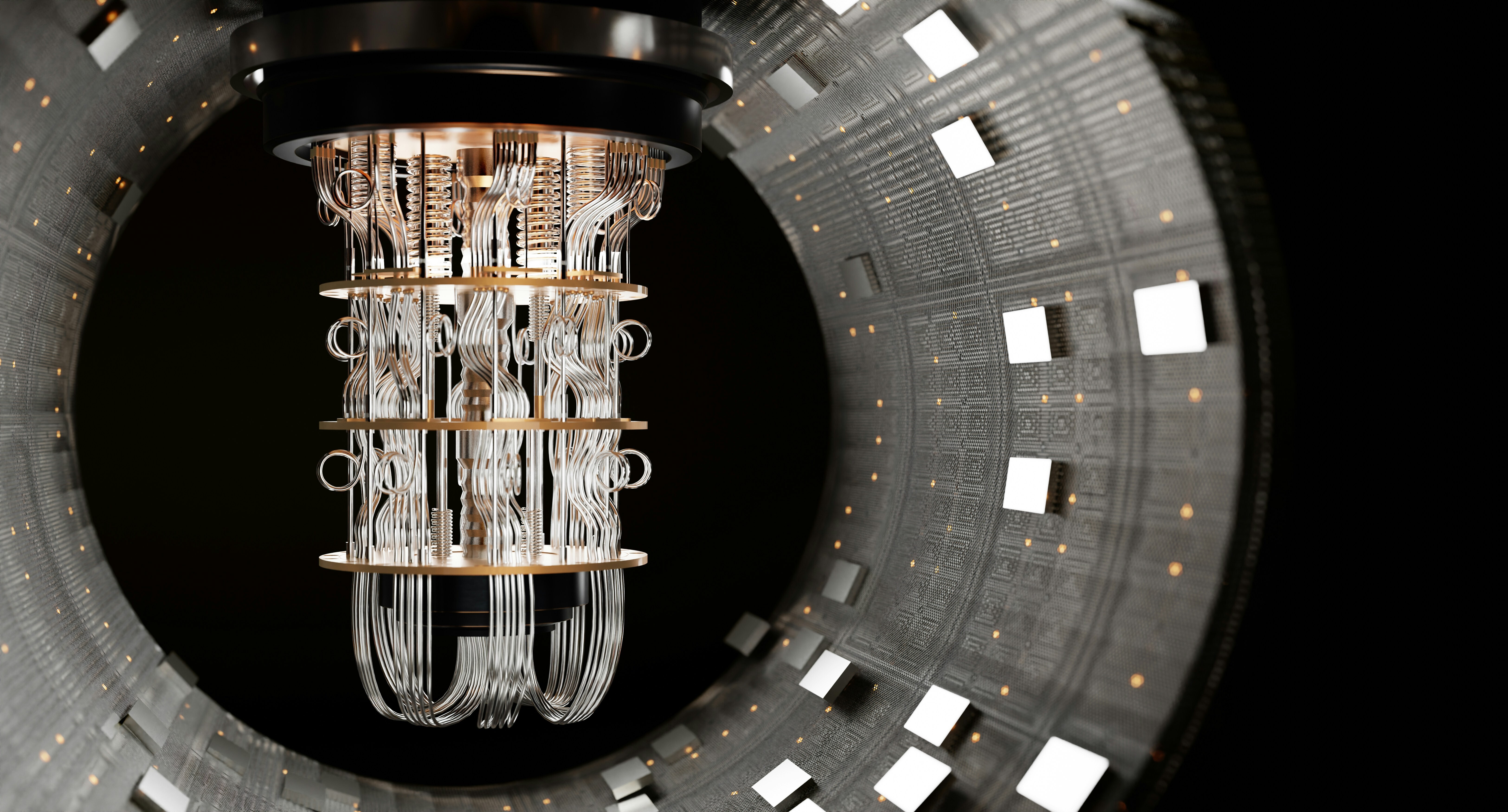
Quantum technology is no longer a distant prospect for finance. Image: Unsplash+/Galina Nelyubova
The year 2025 has been declared the International Year of Quantum Science and Technology, marking a turning point in how quantum innovation is shaping economies and industries.
In this edition of the Frontier Technologies & Innovation wrapper, we focus on the financial sector, where banks are rethinking cybersecurity in response to the quantum era. Later in this issue, we’ll also spotlight Haiqu, one of this year’s World Economic Forum Technology Pioneers, to see how startups are accelerating progress toward practical quantum advantage.
1. Deep dive: How banks are preparing for quantum-era security
Quantum technology is no longer a distant prospect for finance. Banks are beginning to adapt their cybersecurity frameworks in recognition of both the opportunities and the risks this shift brings.
The World Economic Forum’s recent paper with Accenture, Quantum Technologies: Key Strategies and Opportunities for Financial Services Leaders, shows how banks are already testing quantum-safe methods:
- Post-quantum cryptography (PQC): algorithms designed to build resistance to quantum computer attacks, helping to protect sensitive financial data from emerging threats
- Quantum key distribution (QKD) and Quantum random number generation (QRNG): methods to enable theoretically unbreakable encryption - QKD is specifically designed for secure key exchange and QRNGs use quantum processes to generate truly unpredictable random numbers.
These approaches are already being tested in live transactions — HSBC, for instance, is securing tokenized gold trades with PQC-encrypted VPNs and QRNG.
"Recent quantum advancements are creating both excitement and urgency, pushing financial institutions to accelerate their quantum-safe efforts," notes Drew Propson, Head of Technology and Innovation in Financial Services. "These technological developments are also driving multistakeholder collaboration, which will be vital to protecting the financial system."
The work builds on last year's Forum and UK Financial Conduct Authority report, Quantum Security for the Financial Sector, which called for regulators and financial institutions to act in tandem. Philip Intallura, HSBC's Global Head of Quantum Technologies, noted then: "Industry and regulators must work together to navigate the uncharted territories of quantum computing and quantum-resistant cybersecurity."
Momentum is spreading. Banco Sabadell and Intesa Sanpaolo are using quantum-inspired approaches to enhance risk modelling and fraud detection, while regulators across the G7 and EU are advancing quantum-readiness strategies.
The lesson is clear: technical innovation alone won’t be enough. Public-private collaboration, targeted R&D investments, adaptive regulation and global standards will be key enablers in helping financial institutions navigate the complexities of the quantum era with confidence.
Dig Deeper:
- Read our explainer on the quantum technologies being deployed in the financial services industry, or browse the full report 'Quantum Technologies: Key Strategies and Opportunities for Financial Services Leaders'.
- Explore related work from the Forum's Quantum Economy Network and the Quantum in Financial Services initiative.
2. Start-up spotlight: Haiqu
While banks and regulators are laying the groundwork for quantum security, startups like Haiqu are experimenting with approaches to make quantum technology scalable in practice.
We spoke with Haiqu’s Co-Founder and CTO, Mykola Maksymenko, to understand the problem they are tackling, the solutions they are developing and why their work could prove pivotal for the quantum era.
➡️ The pain: why quantum hasn’t scaled yet
Quantum hardware has made strides, with systems reaching over 150 qubits but that hasn't yet translated into practical impact. The gap lies not in the machines themselves, but in how they can be used, according to Maksymenko. "We've seen hardware progress — IBM, for example, is already showing systems at 156 qubits — but the perception is still that quantum is not delivering value. The gap is in the software layer."
He compared it to the early days of classical computing: large, expensive machines existed but without the right software layer, they were far from mainstream utility.
"In the 1950s and 1960s, classical computers were already here, but no one outside specialized labs could use them. Quantum is in a similar moment now — we need the software infrastructure to make it usable."
➡️ The fix: Haiqu’s approach
Haiqu focuses on building that missing software layer which can help "stretch" the performance of today's quantum systems, giving industries a way to experiment now rather than later.
He explained that today's devices are powerful but unstable. Every additional step in a calculation increases the chances of error - a problem researchers call "noise".
"Hardware noise is a very similar situation that we had with classical computers 70 to 80 years ago. The first classical computers were operating with vacuum tubes, which could crash at times. These were very fragile systems. And here we have a similar situation, but on a much more microscopic quantum level."
Haiqu's technology tackles this head-on, helping stabilize results and buy more usable time on current machines. "There are software methods allowing the removal or minimizing the effects of the noise in the calculations. It's a very tedious exercise that requires considerable expertise. That's partly what our system does automatically, so the user doesn't need to worry about it much and can now focus on application development."
The company has already run pilots to show how this works in practice, using their software layer to deliver nearly comparable performance with classical systems but running on quantum hardware. "Our goal in the company is to enable quantum utility years faster than everyone is expecting."
These pilots include financial modelling and logistics optimization, where quantum-inspired algorithms have helped reduce computational overhead and improve accuracy.
"We are working with enterprises and research teams to identify applications that do not require millions of qubits, but can be run within hundreds of qubits and a few thousand operations. Some of these can generate quantum states that are not possible to simulate classically."
"Here, quantum devices may begin to show potential utility in domains such as chemistry, optimization and scientific computing."
➡️ Reality check: the road ahead
Despite the excitement, today's quantum landscape is still narrow, with just a handful of pioneers experimenting at the edge.
"Currently, we are in the very early stage of the technological curve, of course. It's essentially a small group of early adopters experimenting with quantum computing. I think there are below a thousand active players in this game."
For now, the emphasis is on finding out what quantum can really do. "The primary focus is on discovering those use cases and applications. That's the discovery phase today," he explained.
But the horizon is clear: "As we progress, we will move towards so-called fault-tolerant quantum computing. At some point, fault-tolerance is when all the errors are corrected, and we can run these calculations for as long as we need to calculate some particular algorithms." That shift will mark the productivity phase. "With that system, we will move into the space where we are today with our high-performance computing. And that will be a productivity phase."
Already, benchmarks are emerging. "We have almost on-par performance of quantum computers and classical computers, and within literally the next weeks, months, maybe half a year, we will see an advantage experiment in one or another narrow case. As more of such examples appear, this will change the perception of the larger community that Quantum Computers can already be useful."
Among the first areas? "Right now, the most interesting near-term applications space is quantum chemistry," he noted, pointing to applications in material science like superconductors and magnets. Beyond that, he sees potential in "computational fluid dynamics," and further out, "optimization applications" that could transform everyday systems like ride-hailing or factory testing.
As Maksymenko summed it up: "The first step is to match the level of your classical computers, and then the idea is to surpass that. New iterations of quantum computers are projected to be exponentially more powerful. So, once the parity is reached, the progress will become more noticeable across targeted domains such as chemistry or optimisation."
Haiqu was founded in 2022 and named a World Economic Forum Technology Pioneer in 2025. Explore the full list of companies here.
3. On our radar: 3 tech breakthroughs
- A new AI algorithm that enables fleets of robotic arms to collaborate smoothly in complex factory settings has been unveiled. Researchers at UCL, Google DeepMind, and Intrinsic have unveiled RoboBallet and say that by using a graph neural network and reinforcement learning, the system is able to automate multi-robot planning, generating efficient movement plans in seconds - even for unfamiliar layouts. The code - which has been open-sourced - aims to accelerate progress across robotics research by reducing manual planning hours and increasing industrial flexibility.
- Researchers at the University of Minnesota Twin Cities have debuted AI-powered aerial robots that fly directly into wildfire smoke, collecting high-resolution, 3D data on plume dynamics. This cutting-edge drone swarm can track and model smoke in real time, vastly improving air quality predictions and wildfire management. The system delivers cost-effective, detailed information previously unattainable with satellites, and could also help monitor sandstorms, volcanic eruptions, and other airborne hazards.
- Scientists at NASA’s Glenn Research Center in Cleveland are evaluating compact, handheld X-ray devices designed for long-duration space missions. These portable systems would enable astronauts to quickly diagnose injuries or detect problems with equipment, all without the need to take machinery apart. “Technological innovations like that of the mini-X-ray will help keep our astronauts healthy as we endeavor farther into space than ever before,” said acting NASA Administrator Sean Duffy. “Future missions to the Moon and Mars will be safer due to the research of our scientists at NASA Glenn.”
4. What's next for frontier tech at the Forum?
- Releasing in October: Our first-ever '10 Emerging Technology Solutions for Planetary Health' report
The first 10 Emerging Technology Solutions for Planetary Health report will spotlight technology solutions that can help the world adapt to climate change, protect nature, and build resilience. It will showcase breakthrough science tackling today’s environmental challenges and share strategies for putting these solutions into action while respecting the planet’s limits.
License and Republishing
World Economic Forum articles may be republished in accordance with the Creative Commons Attribution-NonCommercial-NoDerivatives 4.0 International Public License, and in accordance with our Terms of Use.
The views expressed in this article are those of the author alone and not the World Economic Forum.

Forum Stories newsletter
Bringing you weekly curated insights and analysis on the global issues that matter.
More on Emerging TechnologiesSee all

Markus Kirchschlager and Benedikt Gieger
March 20, 2026


