How investments in smaller cities in emerging economies can boost global economic growth

Investing in smaller 'Tier-2' and 'Tier-3' cities in countries like India, Indonesia and Vietnam offers remarkable opportunities. Image: Google Images
- 'Tier-2' and 'Tier-3' cities in India, Indonesia and Vietnam are emerging hubs for innovation, manufacturing and digital growth.
- Improved physical and digital infrastructure, skilled talent and supportive policies are fuelling the global competitiveness of these smaller cities.
- Smaller cities present high-return opportunities for investors as they mature into key growth engines.
Global ties and economic clusters are evolving in the current environment of digital innovation, geopolitical compulsions, bilateral/multilateral policy shifts and supply-chain risks. S&P Global expects for 65% of global economic growth between 2024 and 2035 to come from emerging markets and developing economies; nine of these countries are expected to rank among the 20 largest economies in the world. Within this group, countries in the Asia Pacific region, including India, Indonesia and Vietnam, are expected to lead the growth curve.
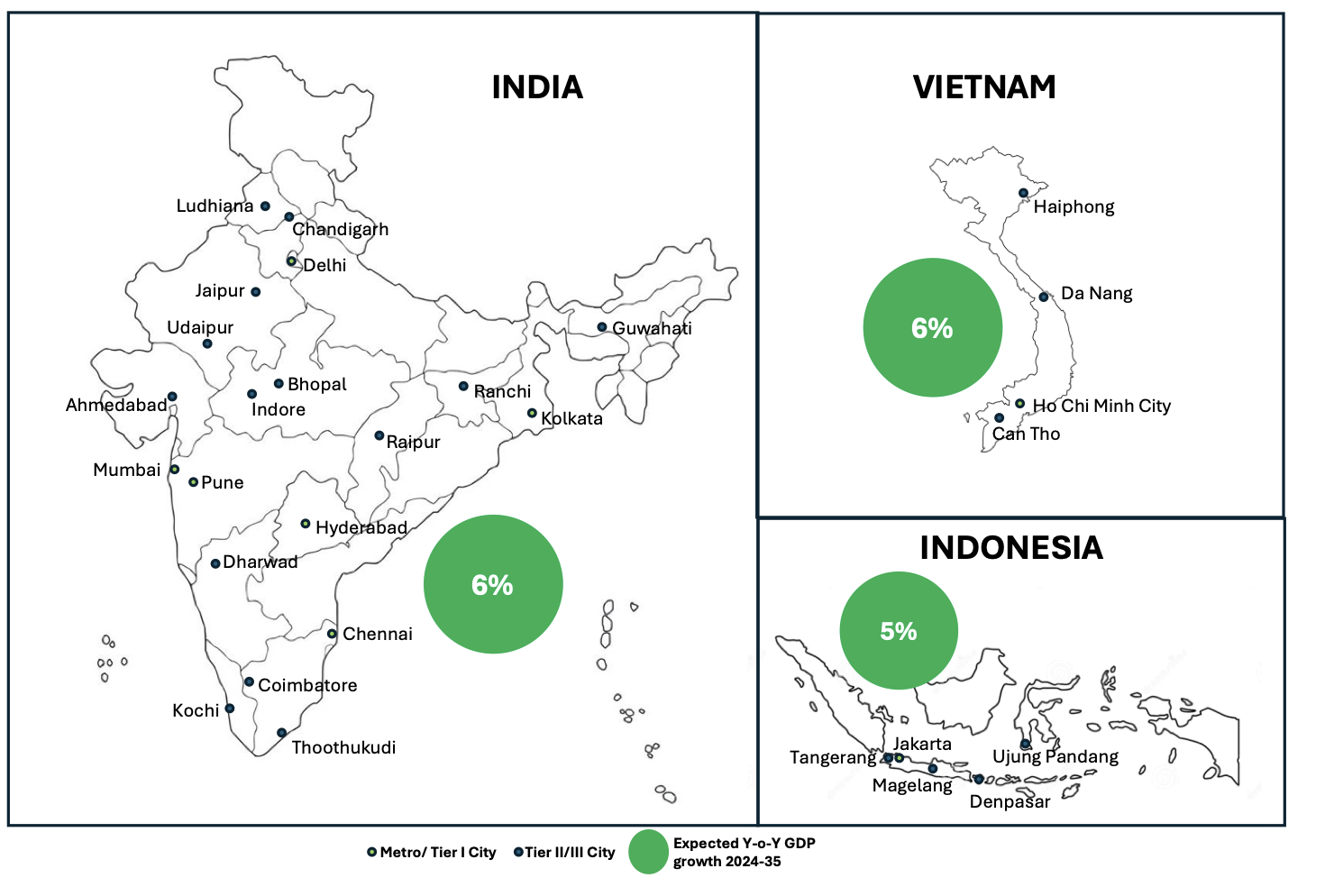
Such consistent high growth rates at current levels are poised to place India as the world’s third largest economy and Indonesia as the eighth largest. These countries are witnessing sustained growth backed by enhancement in domestic capacity and consumption, along with increase in global trade.
What is the World Economic Forum doing to promote sustainable urban development?
The growth potential of Tier-2 and Tier-3 cities
It is interesting to note that beyond metros and Tier-1 cities (metros), which are traditionally viewed as the nodes of growth, Tier-2 and Tier-3 smaller cities in countries like India, Indonesia and Vietnam are poised to generate the next wave of economic value-creation. While these locations have always offered the benefits of lower operational costs compared to Tier-1 cities, there are other multi-dimensional parameters boosting their competitiveness as extended frontiers of economic value addition.
These include the development of physical and digital infrastructure, an ecosystem of innovation, optimum financial investments, availability of human capital and knowledge capital, along with supportive regulatory and fiscal policies.
Strengthening of digital infrastructure is already seen in Tier-2 and Tier-3 cities in these countries through greater internet penetration, greater literacy rates and the growth of knowledge-based start-ups and SMEs.
In India Tier-2 and Tier-3 cities have 45% of India’s urban population, ~50% registered SMEs and contribute 37% to the country’s GDP. India has also seen a rapid growth in digital wallet and online payments facility adoption. Moreover, reportedly 95% of villages in India also have internet access, which renders them as fertile grounds for both digital consumers and sellers.
There are multiple examples of foundational and incremental growth emanating from non-metro and non-Tier 1 locations in emerging economies. Some of these include:
1. Channelling innovation promotion ecosystems: Over the past decade, India’s Tier-2 cities have built a mature innovation ecosystem with university-linked incubators, state innovation missions, MSME clusters and grants from programmes such as Startup India and DST. This environment has enabled ventures to scale globally while staying rooted outside metros. Aether Industries, a specialty chemicals firm from Surat, Gujarat, leveraged local talent and institutional support to grow from a young enterprise into a publicly listed company with a market capitalization above $1 billion. Such stories show how Tier-2 cities are no longer peripheral but are becoming centres of India’s industrial and technological transformation. Another example is the development and testing of a six-stroke engine in Prayagraj, Uttar Pradesh, which can triple fuel efficiency with conventional fuels and drastically cut consumption.
2. Aggregating local talent for global business delivery: Zoho, one of India’s leading enterprise software companies, was founded in 1996 (as AdventNet) in its founder’s hometown Tenkasi, Tamil Nadu, and now has offices in nearby villages alongside a global presence across Asia, North America, South America, Europe and Africa. Its rise as a global player in web-based business software highlights the reach of India’s digital infrastructure into its rural heartland. Tamil Nadu, which launched its first IT-services oriented TIDEL Park in Chennai, is now developing several more in Tier-2 cities including Madurai, Thanjavur and Salem.
3. Impacting the digital economy: Indonesia has about 180 Tier-2 and Tier-3 cities, including Denpasar and Magelang, expected to drive growth and contribute 30–50% of the digital economy by 2025. This will largely stem from rising e-commerce, lending, e-payments and other tech-enabled businesses. For example, Tangerang-based Assistani Agri has built a precision agriculture platform using IoT tools and SaaS applications, such as soil testing, to improve both the quality and quantity of output. The share of Tier-2 and Tier-3 cities is expected to increase from 3% to 5% of the country’s GDP by 2030. Apart from digital businesses, the country’s mission on creating over 100 smart cities aimed at improving quality of life, creating jobs and achieving carbon neutrality.
4. Developing manufacturing capacity for global markets: In August 2025, Vietnam-based EV company VinFast inaugurated an integrated manufacturing facility in Thoothukudi, Tamil Nadu, with an expected $500 million investment over five years. The plant is projected to produce 150,000 vehicles annually and employ at least 3,000 people, serving both local demand and regional exports. This model is enabled by strong industrial and transport infrastructure and a skilled hinterland workforce.
A true investment opportunity
Tier-2 and Tier-3 cities in emerging economies offer not only conventional business opportunities through extended physical and digital infrastructure but also fertile ground for innovation, especially in ESG-focused solutions. Many face rapid environmental change, seen in stronger hurricanes, rising sea levels and biodiversity loss. Kochi in Kerala became the first Indian city to launch an urban water metro, an intra-city transport system using electric-hybrid ferries. Other cities, including Varanasi in Uttar Pradesh, have also been identified for similar systems.
These cities also show growing relevance in real estate and industrial logistics, worthy of separate discussion. The examples above provide clear proof of the contribution of Tier-2 and Tier-3 cities to global economic growth. Many have already completed their 0-to-1 journeys (and in some cases 1-to-100), establishing strong value propositions domestically and globally. As more players enter these markets and existing ones mature, investors have major opportunities for high returns over the short, medium and long term. The most interesting development will be the combined growth driven by all major levers, supported by well-timed investment, in locations once considered remote.
Don't miss any update on this topic
Create a free account and access your personalized content collection with our latest publications and analyses.
License and Republishing
World Economic Forum articles may be republished in accordance with the Creative Commons Attribution-NonCommercial-NoDerivatives 4.0 International Public License, and in accordance with our Terms of Use.
The views expressed in this article are those of the author alone and not the World Economic Forum.
Stay up to date:
Economic Growth


Forum Stories newsletter
Bringing you weekly curated insights and analysis on the global issues that matter.
More on Built Environment and InfrastructureSee all

Fabienne Robert
February 18, 2026


