How AI-powered solutions enable preventive health at scale

New AI capabilities are making it possible to provide hyper-personalized health recommendations at scale. Image: Philips
- Non-communicable diseases represent a global behavioural crisis requiring personalized interventions rather than generic public health measures.
- AI technologies can now integrate fragmented data to deliver scalable, hyper-personalized health recommendations for better outcomes.
- Insurers can leverage these AI-driven insights and incentives to encourage sustainable behaviour change, improving global longevity.
Five years after the pandemic, the world’s greatest health crisis isn’t infectious, it’s behavioural. Non-communicable diseases (NCDs) like heart disease and diabetes are the biggest drivers of mortality globally, yet existing public health interventions haven’t gone far enough in addressing the behaviours that underpin these conditions. Unlike infectious diseases, which require widescale generic remedies like vaccinations, diseases of lifestyle often require tailored guidance based on an individual’s specific context.
To date, this has been hindered by various factors, including the fragmented nature of personal health data. New AI capabilities, however, are making it possible to provide hyper-personalized health recommendations at scale – with the potential to dramatically improve global health outcomes.
NCDs are a macro problem, but require intervention at a personal level
Non-communicable diseases account for more than 70% of all deaths globally – every minute, more than 70 people die from these largely preventable conditions. Existing public health initiatives like smoke-free laws, excise taxes and advertising bans can be effective but issues with design, enforcement and compliance remain. Critically, these interventions lack key contextual elements that can make or break behaviour change. We need mechanisms to deliver health guidance at a personal level, which means equipping people with the knowledge of both what to do and how to do it.
How the Forum helps leaders strengthen health systems through collaboration
The power of behaviour change
Our data set, spanning 60 million life years, across 80 sources and 2,800 dimensions, validates the power of behaviour change.
The first powerful observation from our data is causality, namely, a change in behaviour can be proven to cause a change in health outcomes. For example, an analysis of more than 500,000 participants over five years showed that those aged 45 to 65 years who transitioned from no exercise to medium or high levels of exercise saw a 38% and 58% decrease in mortality risk, respectively.
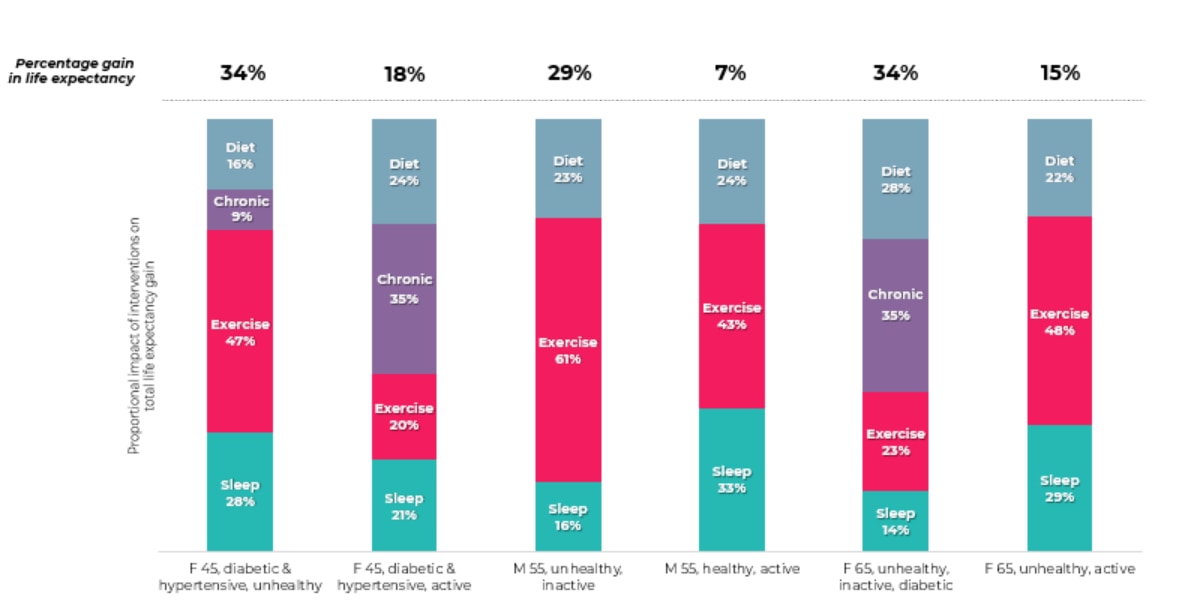
We also see that this effect is elastic and universal; in other words, just a few changes in behaviour deliver dramatic increases in lifespan and healthspan, and the effect increases for those who are older and have more health conditions.
Based on Vitality data, a moderately healthy 30-year-old can increase their lifespan by 6% and their healthspan by 7% through a few key actions, but an unhealthy 70-year-old can see a 45% increase in lifespan and a staggering 90% increase in healthspan by changing behaviour. You are never too old or too sick to become healthier.
And lastly, behaviour change compounds through its habitual nature. Habits can form quickly and easily for many people, and once a strong habit is formed, health outcomes improve dramatically. Previous research shows it takes most people seven to 15 weeks to form a strong habit, and individuals who sustain a habit of moderate-intensity exercise reduce their common-cause mortality risk by 27%. Healthy habits also reduce specific disease risk: those who do 7,500 steps five times per week for two years can reduce their risk of type 2 diabetes by 41% and of stage 4 cancer by 36%.
Health data is dispersed and fragmented
We have made the case for how powerful behaviour change is in terms of extending lifespan and healthspan. But there’s an important caveat – precision is required to get the right impact. We need to know with absolute accuracy the specific lifestyle changes a given individual needs to take, with a longitudinal perspective of how that behaviour change will impact their mortality and morbidity over time.
A number of industries have emerged to solve this problem – devices, wearables, lab testing platforms, health coaches – but they often function in isolation and typically only cover a few metrics of health. Often these platforms don’t have insights into clinical data from hospitals and doctors, or insurance claims data and mortality patterns over time. To overcome this, one needs massive amounts of computing power and complex technology to make sense of the fragmented data.
Moving from collection to connection
Thanks to the recent progression of artificial intelligence (AI), new opportunities are emerging to tackle this challenge. One example is Vitality AI, a partnership between Vitality and Google, which combines Google’s AI and data analytics capabilities, including Vertex AI and Gemini models, with Vitality’s diverse and longitudinal range of healthspan and lifespan data. This makes it possible to coalesce disparate data sources into a single technology platform that is easy to scale.
The output is hyper-relevant and personalized health recommendations to millions of customers. These recommendations include lifestyle choices like physical activity and sleep, as well as screenings, chronic disease management, and wellness coaching.
Based on Discovery data, AI-powered, personalized screening recommendations have already led to a 1.22x increase in screening rates and a 19% improvement in early cancer detection, underscoring the power of targeted prevention.
Another example of how AI is enabling data integration is MediKarma, a health tech platform that uses AI and data analytics to personalize wellness, prevention and care navigation. By analysing medical records, biometric data and behavioural inputs, MediKarma offers step-by-step guidance to help individuals stay ahead of health issues and make more informed decisions about their care – while prompting relevant questions to discuss with their physician.
There’s also Ada Health, a US company that combines clinical expertise and advanced AI to help people and health organizations act on insights earlier. Ada’s platform integrates medical history, lifestyle data and wearable inputs to provide personalized diagnostic suggestions and next steps. In a maternal health study based in South Africa, called “SafeMom”, 98% of Ada’s urgency advice was deemed safe by clinicians and around one in three women changed their initial health‐seeking plan after using the service.
Engagement: The missing link
Yet, even when people know what to do, they don’t always do it. That’s why incentives are needed. This moves us from what to do per individual, to how to effect change. By layering insights from different data sources, including people’s propensity to engage in actions, the incentives likely to motivate them, and the communication style that most resonates with them, it’s possible to offer personalized rewards with the best chance of incentivizing change per individual. We can now scale this capability through the partnership with Google.
These AI-enabled models are not only revolutionizing health and changing people’s lives, they are also set to transform one of the largest and most influential industries in the world – insurance. The interaction between insurance and health-related behaviour change is bi-directional: Life and health insurers stand to benefit enormously from improvements in health and mortality because they are invested in the health and longevity of people’s lives.
At the same time, insurers are one of the only actors that can monetize improvements in health and are therefore perfectly positioned to drive change at scale: they can act as funders for health improvements, channelling additional profits from behaviour change into the rewards and incentives that ensure that very behaviour change continues to happen.
It’s a virtuous cycle that benefits individuals, insurers and society: the individual through better health and rewards; the industry through better profitability, lower claims and increased competitiveness; and society by lowering the disease burden and creating a healthier, more productive population.
Don't miss any update on this topic
Create a free account and access your personalized content collection with our latest publications and analyses.
License and Republishing
World Economic Forum articles may be republished in accordance with the Creative Commons Attribution-NonCommercial-NoDerivatives 4.0 International Public License, and in accordance with our Terms of Use.
The views expressed in this article are those of the author alone and not the World Economic Forum.
Stay up to date:
Artificial Intelligence


Forum Stories newsletter
Bringing you weekly curated insights and analysis on the global issues that matter.