Purposeful innovation for more inclusive business models
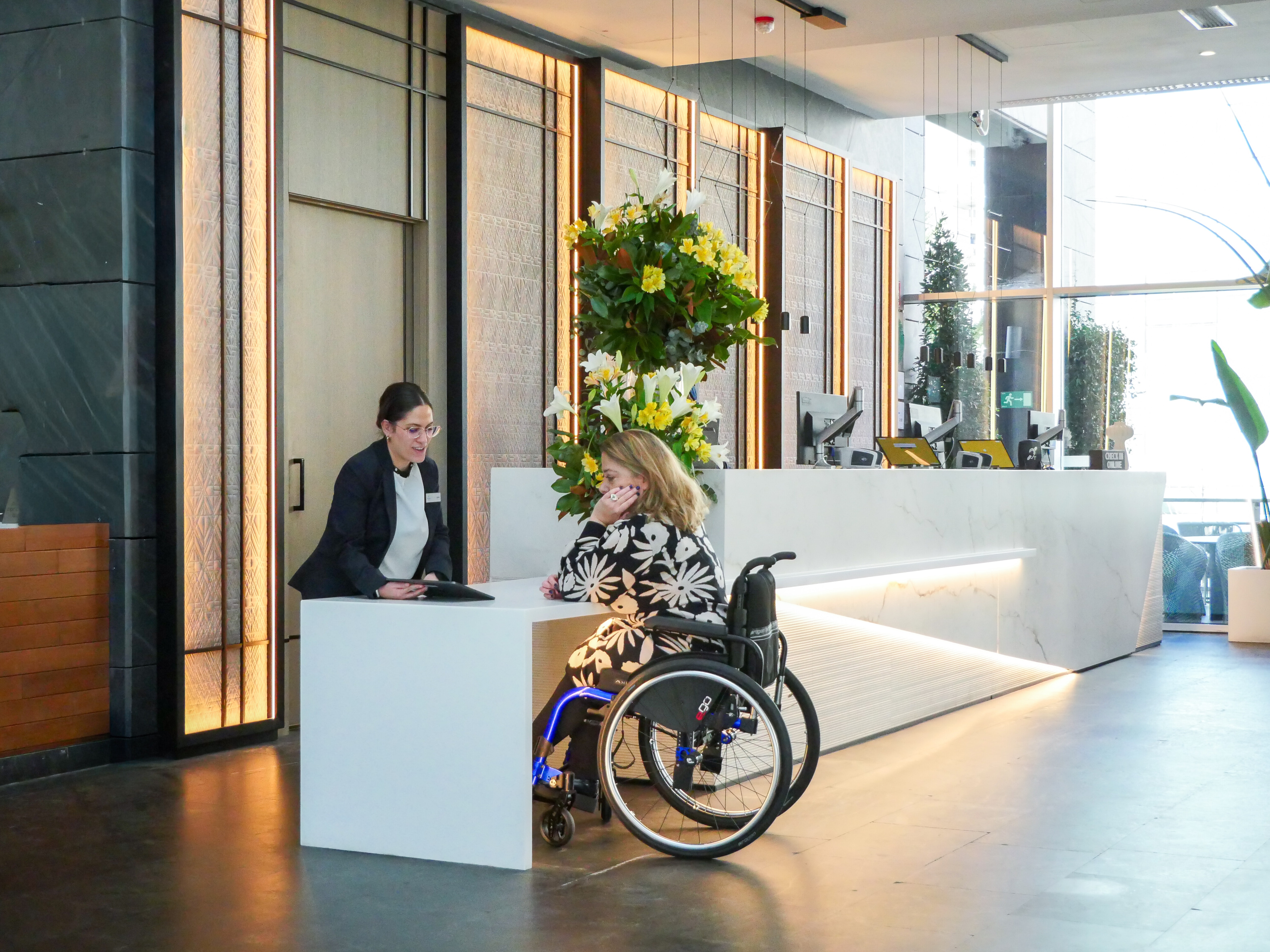
Purposeful business models can help create a more inclusive and sustainable society. Image: ILUNION Hotels
- Companies are increasingly expected to take an active role in fostering positive social impact.
- The challenge for businesses is how to respond to changing demographics and increasingly demanding societal expectations.
- Purposeful business models highlight how profitability and engagement can also create lasting social impact.
With companies increasingly expected to take a more active role in building an inclusive and sustainable society, innovation is taking on a new meaning.
It's no longer just about improving processes or launching products, it's about making a lasting social impact. Purposeful business models prove that profitability and engagement can go hand in hand.
One of today's great challenges is how organizations respond to changing demographics and increasingly demanding societal expectations.
Accessible and inclusive environments
In 2024, nearly a quarter (24%) of the European Union population over the age of 16 had some form of disability, according to Eurostat. Added to this is a growing social sensitivity towards inclusion, equity and sustainability.
This reality forces us to rethink business models and create more accessible, inclusive and responsible environments.
Among the key issues that need to be addressed, two stand out:
- Insufficient inclusion of people with disabilities or in vulnerable situations: Although they represent a significant part of the population, these groups continue to face barriers to access employment and full participation in society. Inclusion is not always integrated as a talent strategy, but as a one-off action. The challenge is to move from partial integration to structural inclusion, which strengthens the organizational culture, improves reputation and generates tangible value.
- Accessibility is often only understood as a legal obligation: Many organizations approach accessibility from a normative approach, without taking advantage of its potential as a factor of quality and differentiation. This narrow view restricts the scope of the service and excludes key market segments. Rethinking accessibility as a criterion of excellence enables us to improve the customer experience, expand the user base and position ourselves as a benchmark in social responsibility.
Tackling inclusion challenges requires a long-term view
Overcoming these challenges requires a long-term view, which understands inclusion and accessibility not as isolated actions, but as strategic pillars.
In this process, collaboration with stakeholders – employees, customers, suppliers, investors, regulators and society in general – is essential. Co-creating solutions together with them enables us to generate shared value, strengthen trust and move towards more coherent and sustainable models.
Here we analyse how companies are transforming their models from the purpose, with special attention to the case of ILUNION Hotels as an example of social innovation applied to the tourism sector.
What is an innovative business model with a purpose?
A purposeful business model puts social and environmental impact at the heart of its operations – using innovation as a strategic tool for transformation. This approach is based on four fundamental pillars:
- Innovation with purpose: developing products and services that improve people's lives, promoting inclusion, sustainability and ethical values.
- Collaborative culture: promoting co-creation with employees, customers, suppliers, investors, regulators and society in general, promoting an open culture of shared responsibility.
- Organizational transformation: Activating innovation through clear processes, agile methodologies, performance indicators and systems that turn ideas into real, measurable changes.
- Tangible value, beyond economic: measuring success not only by revenue, but also by environmental, social and reputational impact.
Inclusion and accessibility as a long-term strategy
Accessibility is often understood as a legal requirement, but it has the potential to become a real driver of operational excellence. Applied transversally – in physical spaces, digital services and customer service – it enables expanding reach, improving quality and connecting with audiences that are usually underserved.
This transformation is already under way in the hotel sector. ILUNION Hotels, a Spanish company with more than 30 locations, has integrated universal accessibility into its business strategy.
From adapted rooms and sensory signage, to inclusive booking systems and specialized training for internal teams, the entire customer experience is designed to be barrier-free.
This commitment is also reflected in its workforce: more than 60% of the people who work at ILUNION Hotels have disabilities or are in a vulnerable situation. It is not a symbolic figure, but a central component of their identity. These teams bring empathy, flexibility and authenticity to the service, as well as reinforcing the organization's social purpose from within.
Rethinking profitability in terms of social impact
For decades, business profitability has been measured in terms of operational efficiency, occupancy or cost reduction. However, more and more organizations are demonstrating that it is possible to combine social impact and good economic performance.
ILUNION Hotels, for example, has achieved an EBITDA in 2024 that is 30% higher than the previous year – a competitive figure within the sector – while maintaining its mission of social and labour inclusion. This case shows that when purpose is an integral part of the strategy, trust is strengthened, reputation is improved and stable and committed teams are consolidated.
The consistency between what a company offers and what it stands for becomes increasingly valuable. In the case of ILUNION Hotels, this consistency is recognized through certifications such as B Corp, EFQM 700 or ISO 56001 in innovation management. These accreditations not only validate your operational excellence, but also open the door to new partnerships, markets and funding sources.
Digitalization as a driver of impact
Digital transformation is no longer optional, but what really makes a difference is the purpose for which it is implemented. When applied with inclusion criteria, technology can become a powerful ally to improve the experience of both users and the human team.
At ILUNION Hotels, for example, check-in automation and accessible digital platforms enable people with different abilities to interact autonomously and comfortably. Internally, digital tools also support professional development: their training platforms offer content in accessible formats – pictograms, audio guides, subtitles – to ensure that no one is left out.
In addition, digital systems make it possible to measure and reduce the consumption of resources, optimize waste management and reinforce the commitment to sustainability as a strategic axis of the business.
When applied with an inclusive approach, technology does not replace human contact: it enriches it.
A roadmap to inclusive transformation
Purposeful innovation is redefining the way companies grow, relate and adapt. Accessibility, inclusion, social impact and digitalization are no longer peripheral elements: they are pillars for relevance, sustainability and business resilience.
The case of ILUNION Hotels demonstrates that it is possible to align financial success with social commitment through a coherent, scalable and future-oriented model. But it is not a question of replicating a single formula. Every organization must find its way to embed purpose in an authentic, measurable and sustainable way.
In a changing environment, companies that put people and purpose at the heart of their innovation will be better prepared to lead, inspire and make real, lasting impact.
Don't miss any update on this topic
Create a free account and access your personalized content collection with our latest publications and analyses.
License and Republishing
World Economic Forum articles may be republished in accordance with the Creative Commons Attribution-NonCommercial-NoDerivatives 4.0 International Public License, and in accordance with our Terms of Use.
The views expressed in this article are those of the author alone and not the World Economic Forum.
Stay up to date:
Social Innovation


Forum Stories newsletter
Bringing you weekly curated insights and analysis on the global issues that matter.
More on Social InnovationSee all

Darlington Sibanda
March 25, 2026


