AI is transforming education by allowing us to be more human

Technology, including AI, can be helpful in education, but human interaction is more important. Image: Alexandr Podvalny via Unsplash.com
- The co-founder of Avanti Fellows, Akshay Saxena, argues that caregiving and a sense of safety are more crucial for success in education than content and technology.
- Artificial intelligence (AI) can support this human-centric model by freeing up teachers' time for caregiving and mentoring.
- The World Economic Forum report, Shaping the Future of Learning: The Role of AI in Education 4.0, examines how AI can help schools by personalizing learning and reducing administrative burdens for teachers.
“I think the biggest lesson we've learned is, it's not about the content.”
”Avanti Fellows is a social enterprise that takes talented but deprived students from rural India and tutors them for the national university entrance exams for the country’s top 1% STEM and medical courses. Its co-founder and CEO, Akshay Saxena, told the World Economic Forum that in his experience, the secret to success in education is neither content nor technology.
“It is one of the biggest misnomers in education reform: that if you can give kids better technology, if you give them a laptop, if you give them better content, they will learn.
“Children learn when they feel safe, when they feel cared for and when they have a community of learning. This is why the caregiving aspect of even something as academically intense as test prep is actually far more important than academic content delivery,” he said.
While this comes down to human factors and teachers' ability to instill a sense of safety in students, Saxena also believes that artificial intelligence (AI) can contribute by lightening teachers' workloads and giving them more time with students.

Enabling teachers to provide more care than content
Realizing the value of a caring environment for learning over technology and content was rooted in Avanti’s early days as a charity.
“When we started, we had no money. So the one thing we could do was to make sure the kids were in the same space and had someone caring who could guide them through learning.
“That was the only model we could start with. But we found it to be extraordinarily effective. So even when we had more funding, we kept that at the core of our work.”
Saxena explains that, starting out in rural India, they had to work closely with the local communities: “You can't really parachute in teachers or experts from outside. So, it really has to be very community-oriented. It has to involve all the stakeholders, the parents, the children, the principals, the school system administrators.”
Yet, what started almost as an accident has built up robust evidence over the years.
“Care matters, role models matter, feeling safe really matters. In fact, the biggest investments we are now making are in integrating good psychological practices into our classrooms. We are working with therapists and psychologists to make sure that we can help students manage stress and anxiety.”
From intergenerational poverty to wealth
Saxena highlights that when Avanti started 10 years ago, one of India’s best engineering schools, in the province of Karnataka, typically accepted two children from poor rural areas. Today, this figure has risen to 40, and 10% of the college’s intake comes through Avanti’s programmes. “We've created massive representational equity shifts there.”
Most families Avanti’s students come from earn around $2,000 a year on average, he adds. Once their children have completed college, the median starting salary is around $5,000. After 10 years, they can earn between $20,000 and $50,000.
“It's not really a leap from intergenerational poverty to no poverty, it's from inter-generational poverty to intergenerational wealth. These families now have homes, the rest of the community knows that their child has been able to do this for them because they invested in education.”
Saxena is especially proud of Avanti’s female students, who now don’t marry until they are in their thirties and have become role models for the community.
How AI can transform education
The focus on care has not stopped Avanti from bringing in technology and, more recently, AI to support teachers and students.
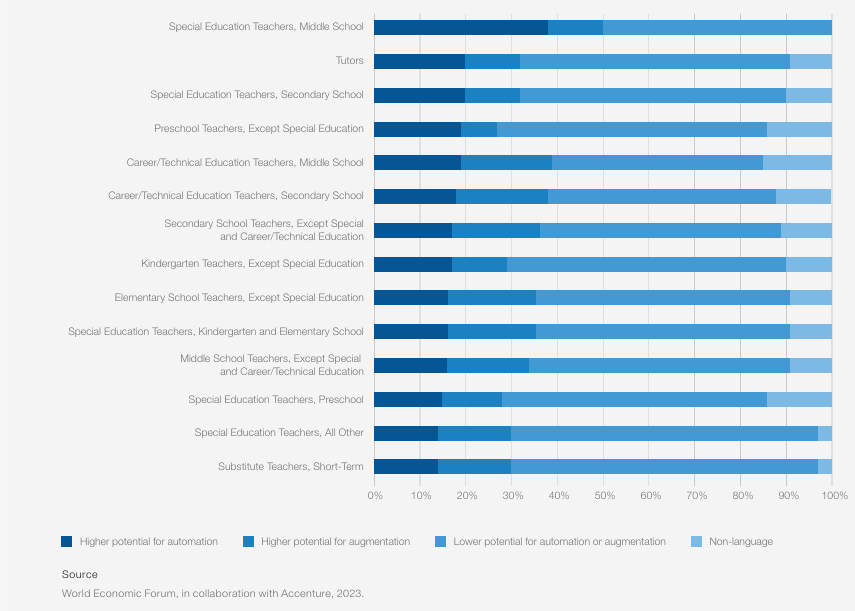
The World Economic Forum’s Shaping the Future of Learning insight report highlights that the main impacts of AI will be in areas such as personalized learning and augmented teaching. AI also lifts administrative burdens, so that people in caring roles can focus on more meaningful tasks, such as mentorship.
Saxena agrees, stressing that AI's biggest impact will be improving human connectivity and interaction.
How the Forum helps leaders make sense of AI and collaborate on responsible innovation
“The first beneficiaries of this have actually been the teachers, because they're able to rapidly interpret data. We can try and start to use AI to help them counsel kids. We can help them have skillsets that they didn't have before.
“Most teachers are not very skilled at talking like a psychiatrist or managing motivation. These are things that these models can be trained to do quite well. I think this is going to be very transformative.”
What is vital, however, is ensuring equitable access to AI, so that young people from deprived backgrounds can benefit from the same quality tutoring as children who come from better-off families.
“The best way to train these models to be better is to put them in the hands of people who are actually working in the community.”
Reskilling for the AI age
However, Saxena is also mindful of the impact AI will have on the job market Avanti’s students face. There is already a decline in entry-level roles for university leavers in areas such as software development and business process outsourcing.
“One of the big effects is that the nature of work has changed in India,” he said. “So, in the work that we do with our government partners, we will need to think about how we reskill our students, so that they can still compete.
“The bar has been raised, but at the same time, these tools are remarkable.”
The quotes in this article have been lightly edited for clarity.
License and Republishing
World Economic Forum articles may be republished in accordance with the Creative Commons Attribution-NonCommercial-NoDerivatives 4.0 International Public License, and in accordance with our Terms of Use.
The views expressed in this article are those of the author alone and not the World Economic Forum.

Forum Stories newsletter
Bringing you weekly curated insights and analysis on the global issues that matter.
More on Artificial IntelligenceSee all

David Haber
March 6, 2026


