From experimentation to infrastructure: the AI shifts that defined 2025

AI is fundamentally transforming the way we interact with technology. Image: REUTERS/Priyanshu Singh
- AI moved from pilots to embedded systems across sectors but governance maturity lagged adoption.
- Energy, safety and equity emerged as binding constraints on AI’s next phase of growth.
- The year 2025 clarified where policy, investment and institutional capacity must move next. Here's an end-of-year roundup of the highlights.
1. No sector left untouched
AI has become firmly embedded across industries this year, as trust and acceptance in the technology has accelerated.
As adoption continues to grow, so too have the ways companies are using AI across and within different sectors and regions. At the Forum's 2025 Annual Meeting of the New Champions, a panel of experts explored how the adoption of AI is playing out and what the deviations in usage could mean for business collaboration. Watch the full session below.
Keen to learn more about the cross-industry impacts of AI? Developed in collaboration with Accenture, the AI in Action: Beyond Experimentation to Transform Industry Forum report provides a comprehensive analysis of the impacts of emerging AI technologies on industries.
2. AI drives digital safety
Online harms – such as child sexual exploitation, scams, privacy violations and disinformation – are growing both in complexity and volume.
As organizations struggle to implement interventions due to limited resources, regulatory complexity and rapidly evolving threats, this places them at risk of legal and reputational consequences.
The Intervention Journey: A Roadmap to Effective Digital Safety Measures, is a Forum paper that proposes a guide on how to implement digital safety interventions, from identifying risks to evaluating the effectiveness of measures.
The paper uses TikTok as a case study for how AI can be used to empower and protect its users, from the labelling of AI-generated content to the removal of deceptive AI content.


3. The rise and risks of AI agents
With 82% of executives planning to adopt AI agents within the next one to three years, the gap between accelerating experimentation and mature oversight is widening, creating new risks.
A Forum paper, in collaboration with Capgemini, AI Agents in Action: Foundations for Evaluation and Governance, explores how to close this gap. Through case studies and practical advice, it outlines how organizations can safely adopt AI agents into their workflows. Read about it below.


These agents are now even hitting the high street. Recently, mainstream assistants including ChatGPT and Google have begun rolling out features that allow users to ask AI agents to research, select and purchase goods on their behalf.
And it seems consumers are also warming to the concept. Data from Statista captured over the past 12 months shows that around a quarter of Americans between the ages of 18 and 39 say they like to use AI to shop, or have used the technology to search for products.
4. Creativity's new role in an AI age
The boom in AI brings opportunities for the creative industries, but also raises several challenges.
While GenAI will surely expand the canvas of possibility, empowering more people - including those without deep technical or artistic skills - to join the creators' board, ensuring the advent of this technology benefits humanity is of paramount importance.

Concerns have emerged about data privacy, intellectual property infringement, ethical implications, the negative impact on the information ecosystem, bias and inaccuracy risks, and potential job displacement.
Yet soft skills like creative thinking are now the 'hard currency' of the AI-era job market, according to a new World Economic Forum report.
One expert thinks these technological shifts could boost the value of human creativity. CHANEL's Yana Peel spoke with Meet the Leader earlier this year, where she outlined how we can harness human creativity in an AI age.
5. AI's energy dilemma
AI has an energy challenge. By 2035, data-centre electricity use globally could exceed 1,200 terawatt-hours, nearly triple 2024 levels. A Forum report, produced in collaboration with Accenture, From Paradox to Progress: A Net-Positive AI Energy Framework, outlines how AI can strengthen, rather than burden, global energy systems.
The report is centred around three levers to align AI growth with energy goals:
- Design for efficiency: Build AI systems that use as little energy as possible - by running data centres on renewable power, using energy-efficient hardware, and creating models that are only as large as they need to be.
- Deploy for impact: Scale up AI development that cuts emissions and boosts efficiency across grids, buildings, transport and industry.
- Shape demand wisely: Focus on the applications with the highest returns, avoid unnecessary processing, and encourage responsible, low-impact digital use.
6. Responsibility takes centre-stage
AI's regulation has been a real focus this year, with the European Union's AI Act – the first comprehensive regulation on AI by a major regulator anywhere – coming into force.
The Forum reinforced the importance of nurturing responsible AI with its paper, Advancing Responsible AI Innovation: A Playbook, produced in collaboration with Accenture, which offers nine actionable, scalable and adaptable plays for turning responsible AI principles into practice.
Despite increased awareness, responsible AI practices by organizations remain immature, as the chart below illustrates.
Sandboxes are effective tools for furthering responsible AI. They aim to unlock innovation by addressing key gaps in accessing data, infrastructure, models, validation tools and markets. This Forum paper outlines a two-part framework – strategic and operational – for planning, implementing and governing AI sandboxes that enable innovation while remaining inclusive, accountable and aligned with the public interest.
7. AGI edges ever closer
Artificial general intelligence (AGI) could possess the versatility to reason, learn and innovate in any task.
GenAI has already given rise to concerns about job losses, among other issues, so will AGI be a force for progress or a threat to the very fabric of humanity? Experts at the Forum's 2025 Annual Meeting in Davos explored this issue during a session.
We've summarized their discussion in this short video below.
8. Emphasis on equitable access
The promise of AI is becoming a reality in some parts of the world. Yet, the combination of energy-intensive AI infrastructure, advanced computing capability, high-quality data and a lack of on-the-ground AI upskilling, means billions of people risk missing out on the economic and societal benefits.
This year, the Forum's AI Global Alliance launched the Inclusive AI for Growth and Development Initiative to promote the implementation of approaches to advancing safe and inclusive innovation, deployment and adoption of AI by all.
To accompany this launch, a Forum white paper, in collaboration with KPMG, Blueprint for Intelligent Economies – AI Competitiveness through Regional Collaboration, provides guidance for nations to achieve a successful AI revolution, regardless of their level of digital and AI maturity.
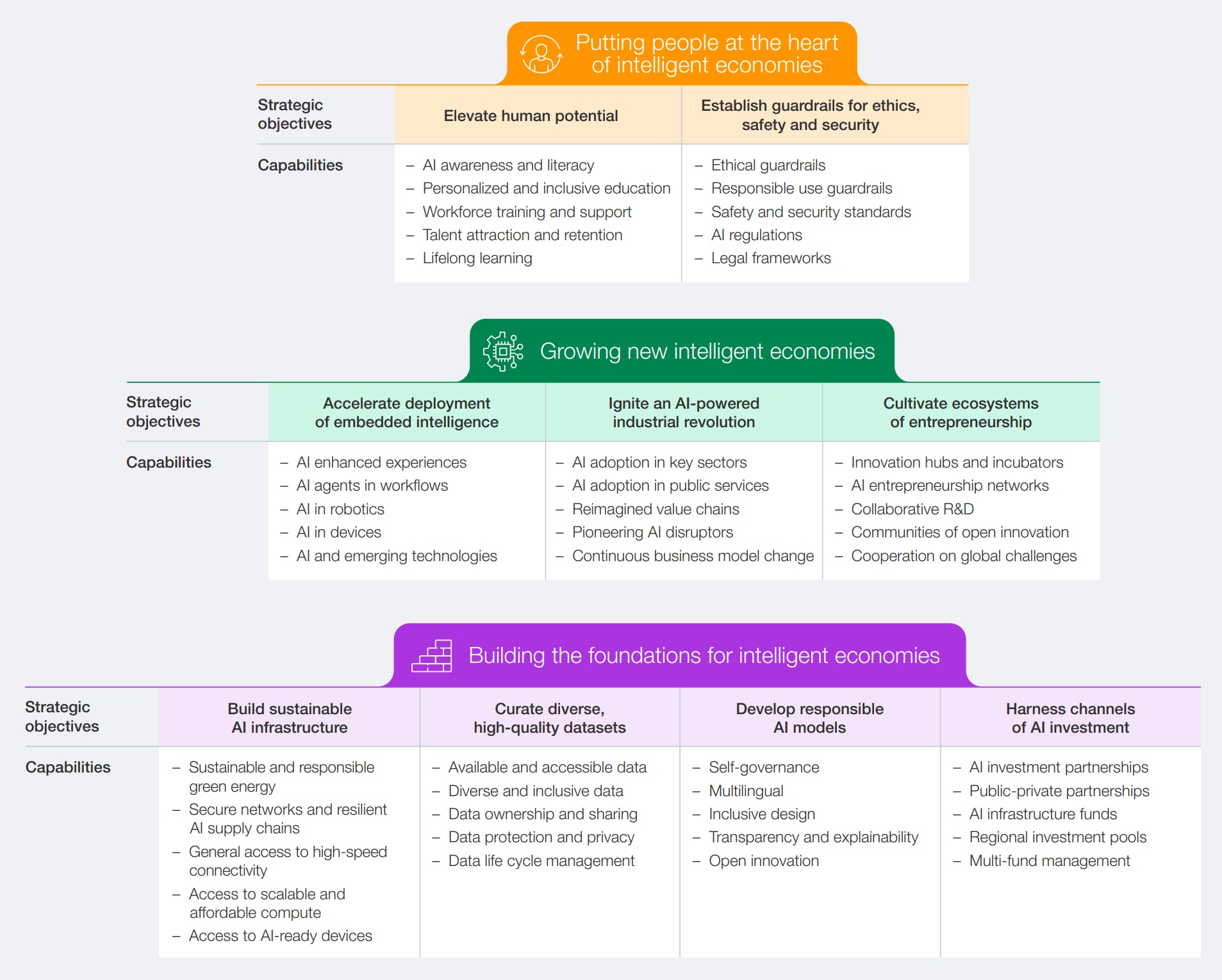
The challenge of making AI truly equitable, sustainable and successful requires collaboration and cross-stakeholder commitment. Read the full report below to learn more.

License and Republishing
World Economic Forum articles may be republished in accordance with the Creative Commons Attribution-NonCommercial-NoDerivatives 4.0 International Public License, and in accordance with our Terms of Use.
The views expressed in this article are those of the author alone and not the World Economic Forum.

Forum Stories newsletter
Bringing you weekly curated insights and analysis on the global issues that matter.
More on Artificial IntelligenceSee all

Mark Esposito
March 18, 2026


