8 myths that are sabotaging modern AI governance
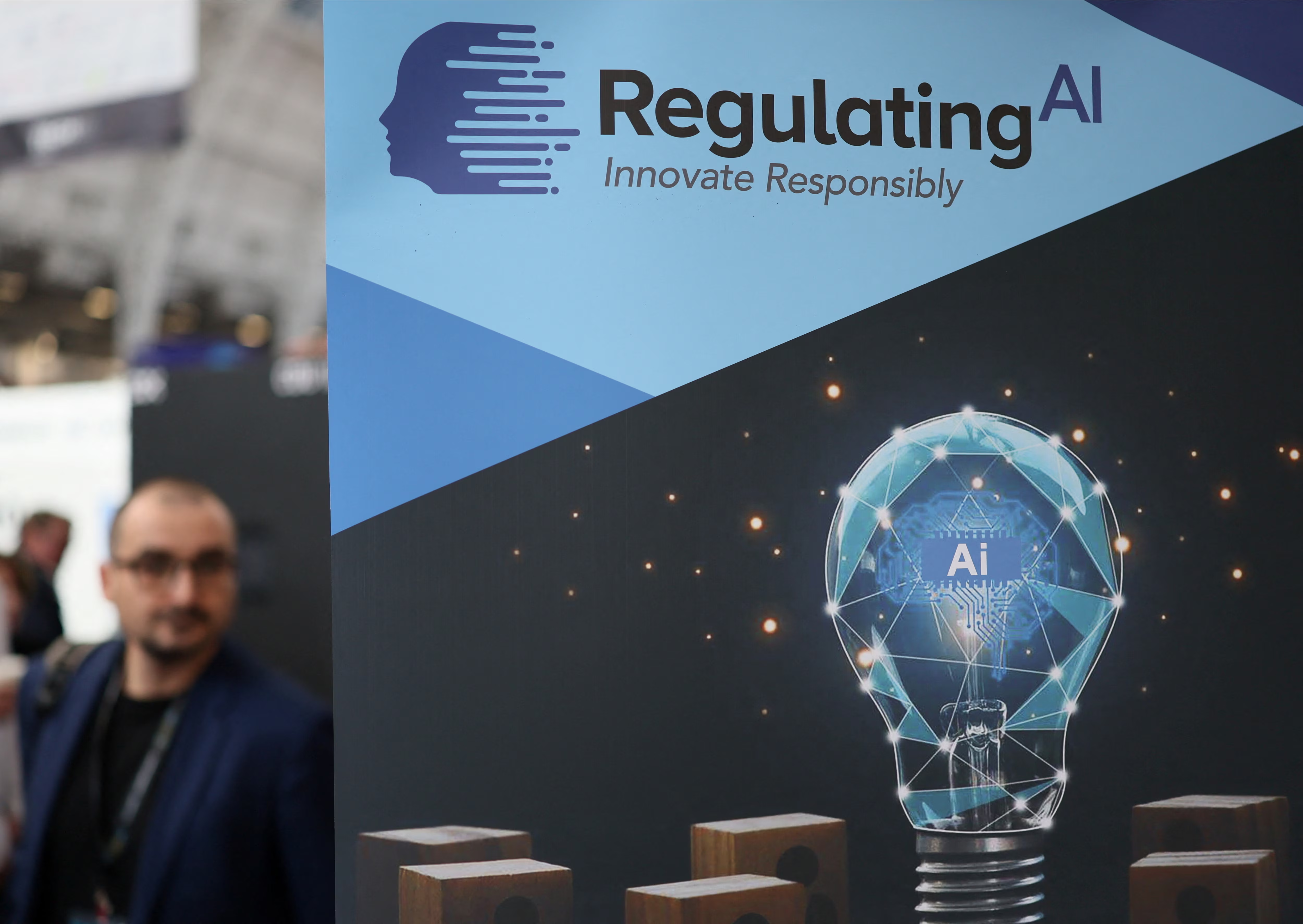
Effective governance requires treating AI as a human-driven socio-technical system rather than a neutral tool. Image: REUTERS/Isabel Infantes
- Misunderstanding current AI systems shifts critical focus away from the true risks we face today.
- Effective governance requires treating AI as a human-driven socio-technical system rather than a neutral tool.
- Leaders must move past future speculation to mandate immediate standards for accountability and data quality.
Artificial intelligence is already embedded in hiring systems, workplace monitoring, eligibility assessments, credit decisions and public administration. These systems influence who is shortlisted for jobs, which applications are prioritized, how compliance risks are flagged and how public resources are allocated.
Yet, policy debates still tend to frame AI in one of two ways: as an existential future threat, or as a neutral technical tool. Both are misleading. The real regulatory risk does not lie in hypothetical future systems, but in misunderstanding the AI systems that are already shaping legally consequential decisions today.
This misunderstanding is sustained by a small set of persistent myths, which do more than just oversimplify AI. They weaken governance, obscure accountability and misdirect regulatory attention away from present-day risks that institutions are already struggling to manage.
Myth 1: AI is just mathematics or code
Framing AI as purely technical allows organizations to externalize responsibility. In reality, AI systems are socio-technical systems shaped by human choices about data selection, optimization targets, deployment context and acceptable error. In employment screening, automated performance scoring or administrative triage, the risk rarely lies in “the algorithm” alone. It lies in the institutional decisions surrounding how these systems are designed, deployed and relied upon. Treating AI as merely technical undermines clear lines of legal and organizational accountability.
Myth 2: Bigger datasets automatically produce better AI
Scale is often mistaken for reliability. In regulated contexts, large datasets can amplify noise, bias and spurious correlations rather than reduce them. High-quality, representative datasets routinely outperform massive but poorly curated ones. Policy-makers who equate scale with safety risk endorsing systems that fail basic standards of validation, documentation and due diligence.
Myth 3: AI is either neutral or inevitably biased
Both assumptions are incorrect. AI systems are not neutral, but bias is not an inevitable feature. Bias can be reduced, and in some cases effectively eliminated, through deliberate technical and governance choices. These include careful data curation, constrained optimization, validation across sub-populations and continuous auditing. The regulatory failure lies in treating bias as either absent or unavoidable, rather than mandating enforceable bias-management obligations in employment, credit and administrative systems.
Myth 4: AI replaces expert judgement
AI can assist professionals by flagging anomalies, ranking options or simulating outcomes. It cannot replace judgement, discretion or legal responsibility. In decisions about employment termination, benefits eligibility or regulatory compliance, over-delegation to AI creates accountability gaps. Policy-makers must ensure that human oversight is meaningful rather than symbolic, and that responsibility remains clearly assigned when AI-assisted decisions cause harm.
Myth 5: AI is only predictive
Much regulation focuses narrowly on prediction, overlooking AI’s broader role in ranking, optimization and decision shaping. Generative and optimization-based systems influence outcomes even when no explicit prediction is made. Treating AI solely as a forecasting tool leads to incomplete governance frameworks that fail to capture how these systems actually affect legal and administrative decisions.
Myth 6: AI systems are unexplainable black boxes
Opacity is often presented as inevitable. In practice, explainability is frequently a design and governance choice. Interpretable models, explainability techniques and documentation standards already exist and are used in safety-critical domains. Accepting opacity by default undermines transparency, due process and auditability obligations that sit at the core of administrative and employment law.
Myth 7: AI is inherently unsafe
AI systems are not intrinsically safe or unsafe. Safety emerges from standards, testing, monitoring and oversight. Blanket restrictions driven by fear can be as ineffective as regulatory inaction. Effective governance focuses on certification, validation and accountability rather than assuming risk cannot be managed.
Myth 8: AI is a future problem
Perhaps the most damaging myth is that AI regulation can wait. AI already shapes hiring, promotion, dismissal, eligibility assessments and administrative prioritization. Treating AI as a future concern delays oversight of systems that are already producing legal consequences today.
What policy-makers should focus on instead
AI governance failures are rarely caused by technological limits. They stem from conceptual errors that misdirect regulation. Policy-makers should focus less on speculative futures and more on enforceable obligations. These include clear accountability for deployment decisions, standards for data quality and validation, requirements for explainability and auditability, and mechanisms for redress when AI-assisted decisions cause harm.
Correcting these myths will not eliminate risk. But it will allow policy-makers to regulate AI as it actually exists, not as a future abstraction, and to address the real legal and compliance challenges institutions are already facing.
Don't miss any update on this topic
Create a free account and access your personalized content collection with our latest publications and analyses.
License and Republishing
World Economic Forum articles may be republished in accordance with the Creative Commons Attribution-NonCommercial-NoDerivatives 4.0 International Public License, and in accordance with our Terms of Use.
The views expressed in this article are those of the author alone and not the World Economic Forum.
Stay up to date:
Artificial Intelligence


Forum Stories newsletter
Bringing you weekly curated insights and analysis on the global issues that matter.