How India is scaling its energy-technology innovation ecosystem
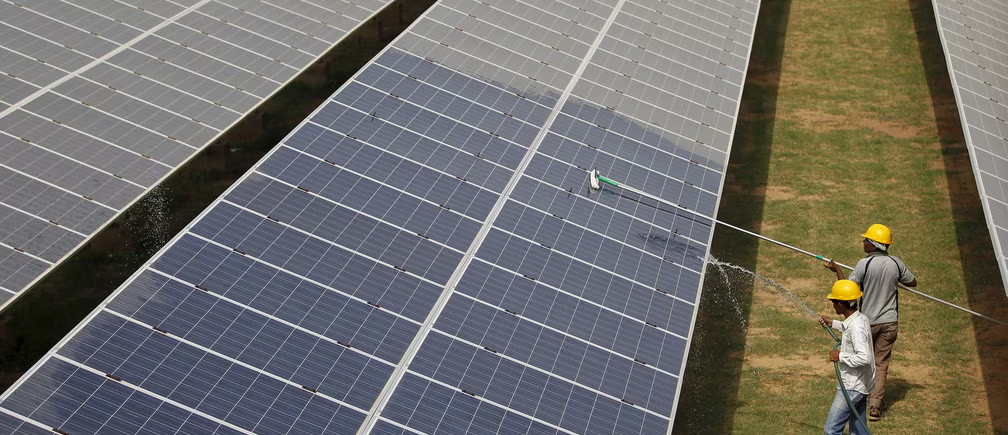
These experiences offer tangible lessons for how similar coalitions can now be mobilized to accelerate energy-technology innovation. Image: REUTERS/Amit Dave
- India has surpassed its 2030 renewable energy targets five years early through massive infrastructure scaling.
- The nation is transitioning from simple technology adoption to a fully integrated green innovation ecosystem.
- Success depends on synchronizing policy, finance, and industrial clusters to de-risk frontier energy technologies globally.
India’s energy transition is one of the defining stories of the global clean energy narrative. As of late 2025, India’s installed renewable energy capacity had crossed 250 GW, driven primarily by rapid deployment of solar and wind power. At COP26, India committed to achieving 500 GW of non-fossil electricity capacity by 2030, one of the most ambitious clean energy transitions among major economies; in the end, it achieved that five years ahead of schedule. This scale and pace have positioned the country as a leading destination for clean energy investment and deployment.
Crucially, India’s transition is not limited to the diffusion of mature technologies. It increasingly reflects the emergence of an energy-technology innovation ecosystem, one that connects policy, finance, industry, research institutions and consumers in a coordinated manner to move innovation from pilots to scale. International experience shows that such ecosystem-based approaches, which explicitly map stakeholders, innovation domains and enabling actions, are essential for accelerating adoption and managing systemic transitions.
India has already demonstrated the power of ecosystem thinking in adjacent sectors. The rapid scaling of the solar value chain, enabled by long-term policy visibility, competitive procurement, concessional finance, Production Linked Incentives Schemes and a diverse developer base, transformed solar power from a niche technology into one of the country’s most cost-competitive energy sources. Similarly, India’s digital public infrastructure, exemplified by the Unified Payments Interface (UPI), illustrates how coordinated action across government, regulators, incumbents, startups and users can create system-wide value. These experiences offer tangible lessons for how similar coalitions can now be mobilized to accelerate energy-technology innovation.
The foundations for clean energy innovation
India has laid strong foundations for energy innovation through clear policy direction and institutional support. The National Green Hydrogen Mission, approved by the Union Cabinet, aims to make India a global hub for green hydrogen production, electrolyser manufacturing and downstream applications, with a target of 5 million tonnes of annual green hydrogen production by 2030. The Mission’s Strategic Interventions for Green Hydrogen Transition (SIGHT) programme provides targeted incentives for both hydrogen production and electrolyser manufacturing, translating policy ambition into early market creation.
Energy storage has similarly moved from the periphery to the centre of India’s power-sector strategy. The Ministry of Power formally recognizes energy storage as a critical system resource, essential for integrating variable renewable energy at scale. In 2025, the government approved viability gap funding support for battery energy storage systems (BESS) to accelerate deployment and de-risk early projects. At the same time, pumped storage hydropower is being actively pursued as a long-duration storage option, with a growing pipeline of projects identified by the Central Electricity Authority. Grid integration capabilities are also strengthening. Investments under the Green Energy Corridor programme are expanding transmission infrastructure to connect renewable-rich regions with demand centres, reducing curtailment risks and improving system.
Innovation cannot be treated as a sequence of isolated interventions, but must be approached as an integrated ecosystem.
”Collectively, these developments reflect a transition from fragmented interventions to a more integrated innovation ecosystem, where deployment, system planning and early-stage innovation reinforce one another.
Mapping stakeholders and ecosystem actions
India’s energy-technology ecosystem is characterized by coordinated action across a diverse set of stakeholders. Central ministries and regulators provide long-term policy direction and market frameworks; state governments and utilities operationalize these policies through procurement, pilots and system-level reforms. Financial institutions are expanding green finance instruments and blended-finance structures to lower the cost of capital for emerging technologies, while domestic and international manufacturers are strengthening supply chains across batteries, electrolysers and clean energy equipment.
Research institutions, startups and civil society organizations play a complementary role by piloting new technologies, building skills and supporting inclusive adoption. This multi-actor engagement is increasingly aligned around shared system objectives, reliability, affordability and decarbonization, rather than isolated technology deployment.
Priority domains for innovation
Building on this foundation, the next phase of India’s energy transition will depend on deepening the link between large-scale deployment and frontier innovation across five priority domains.
1. Next-generation renewables and system integration
While solar and wind deployment has reached technological maturity, innovation is now focused on managing variability and system complexity. Hybrid projects, improved forecasting and grid-edge solutions are becoming central to maintaining reliability as renewable penetration rises. National planning increasingly emphasises system-level performance and flexibility, rather than capacity addition alone.
2. Advanced storage technologies and critical materials
Beyond scaling lithium-ion batteries, India is investing in supply-chain resilience through innovation in recycling, circular-economy processes and alternative chemistries such as sodium-ion batteries. The Advanced Chemistry Cell (ACC) Battery PLI scheme supports domestic manufacturing, while regulatory frameworks such as the Battery Waste Management Rules encourage recycling and material recovery. Parallel efforts under the Critical Minerals Mission seek to reduce strategic dependencies.
3. Long-duration energy storage
As renewable shares increase, short-duration storage alone will be insufficient to ensure system adequacy. India is therefore exploring long-duration energy storage options, including pumped storage, thermal storage and other emerging pathways, to support seasonal balancing and round-the-clock clean power.
4. Green molecules and industrial decarbonization
India’s innovation agenda extends beyond electricity to address emissions from hard-to-abate sectors. Under the National Green Hydrogen Mission, green hydrogen is being complemented by hydrogen derivatives such as green ammonia and methanol, as well as advanced biofuels, to decarbonize steel, fertilizers, refining and shipping. These initiatives reflect a shift from technology pilots towards integrated industrial decarbonization pathways.
5. Digital intelligence and AI-enabled energy systems
With smart metering deployments expanding under the Revamped Distribution Sector Scheme, India is creating a data backbone for more intelligent power systems. The next innovation frontier lies in applying advanced analytics and AI to demand forecasting, predictive maintenance and grid optimization, drawing on India’s strengths in digital technologies.
From ambition to acceleration
India’s energy transition illustrates how ecosystem-driven innovation can convert structural challenges into opportunities. Policy instruments such as production-linked incentives, viability gap funding and demand aggregation mechanisms are creating credible signals for investment in emerging technologies. At the same time, coordinated action across utilities, industry and research institutions is accelerating learning and reducing commercial risks.
It was against this backdrop that, during the recent India Energy Week, the World Economic Forum convened a leadership roundtable on Making India a Global Hub for Energy Innovation. The discussion brought together senior leaders from government, industry, finance, research institutions and the innovation ecosystem to reflect on what it will take to move from scale in deployment to scale in innovation.
Across the discussion, a clear message emerged: innovation cannot be treated as a sequence of isolated interventions, but must be approached as an integrated ecosystem. Participants highlighted the importance of solution-oriented capital, aligned policy signals, industrial clustering and international partnerships as practical levers to crowd in investment, manage risk across the innovation lifecycle, and translate India’s scale, talent base and cost advantages into globally competitive outcomes.
These insights point to a broader shift now underway, from agenda-setting to sustained ecosystem building. The leadership roundtable marked not a conclusion, but a step in an ongoing effort to strengthen the India energy innovation ecosystem: one focused on operationalizing ecosystem thinking in practice, deepening coordination across stakeholders, and ensuring that promising technologies can move more predictably from pilots to system-wide impact. As India’s energy transition enters its next phase, the challenge, and opportunity, lies in turning collective ambition into durable pathways for acceleration.
The author is a member of the Global Future Council on Energy Technology Frontiers, which is working to surface new insights on how to accelerate and leverage new technologies and innovative tech combinations for the energy transition.
Don't miss any update on this topic
Create a free account and access your personalized content collection with our latest publications and analyses.
License and Republishing
World Economic Forum articles may be republished in accordance with the Creative Commons Attribution-NonCommercial-NoDerivatives 4.0 International Public License, and in accordance with our Terms of Use.
The views expressed in this article are those of the author alone and not the World Economic Forum.

Forum Stories newsletter
Bringing you weekly curated insights and analysis on the global issues that matter.