This month in AI: Race for AI sovereignty intensifies as companies push enterprise adoption

AI sovereignty is under the spotlight as global leaders consider how the technology can support sustainable growth within trusted systems. Image: REUTERS/Florence Lo/Illustration/File Photo/File Photo
- The big signals this month: AI sovereignty is moving up the policy agenda as governments rethink dependencies across the AI stack.
- Enterprise adoption remains the biggest bottleneck, despite huge investment in models and infrastructure.
- Telecom operators may emerge as strategic AI infrastructure providers.
This month in AI, leaders are grappling with a central question: how to turn rapid advances in AI into sustainable economic growth and trusted systems.
At the India AI Impact Summit 2026, policymakers and industry leaders debated how governance, infrastructure and talent strategies will shape competitiveness. Meanwhile, telecom operators are exploring new roles in the AI value chain — and major AI providers are accelerating enterprise partnerships to move beyond experimentation to large-scale deployment.
Plus, a chart on the key barriers preventing strategic AI adoption.
1. Big picture: AI competitiveness and sovereignty move to the centre of policy debates
In February, experts from around the world gathered in Delhi for the India AI Impact Summit 2026. Structured around three pillars – people, planet and progress – attendees considered how AI can promote economic growth and social good, how resources can be democratized and how safe and trusted systems can be created.
The World Economic Forum’s Centre for AI Excellence held two high-level discussions at the event, exploring AI competitiveness, shared prosperity and governance. Nearly 50 multistakeholder organizations working in government, industry, academia and international institutions joined the sessions and, throughout the conversations, three key themes emerged:
- AI governance is becoming a competitiveness strategy: Governments increasingly see coordinated standards and regulatory alignment as tools for economic growth — not just compliance.
- Governance must work amid regulatory uncertainty: Policymakers emphasized adaptable risk monitoring, capacity-building and practical implementation tools, particularly for emerging economies.
- Global coordination remains critical: Initiatives such as the Hiroshima AI Process show the continued need to translate shared principles into operational cooperation to avoid fragmented governance.
These themes reflected the findings of a recent Forum white paper Rethinking AI Sovereignty: Pathways to Competitiveness through Strategic Investments. The research, written in collaboration with Bain & Company, examines how economies can strengthen AI competitiveness through strategic investment choices, resilient infrastructure development and trusted international partnerships.
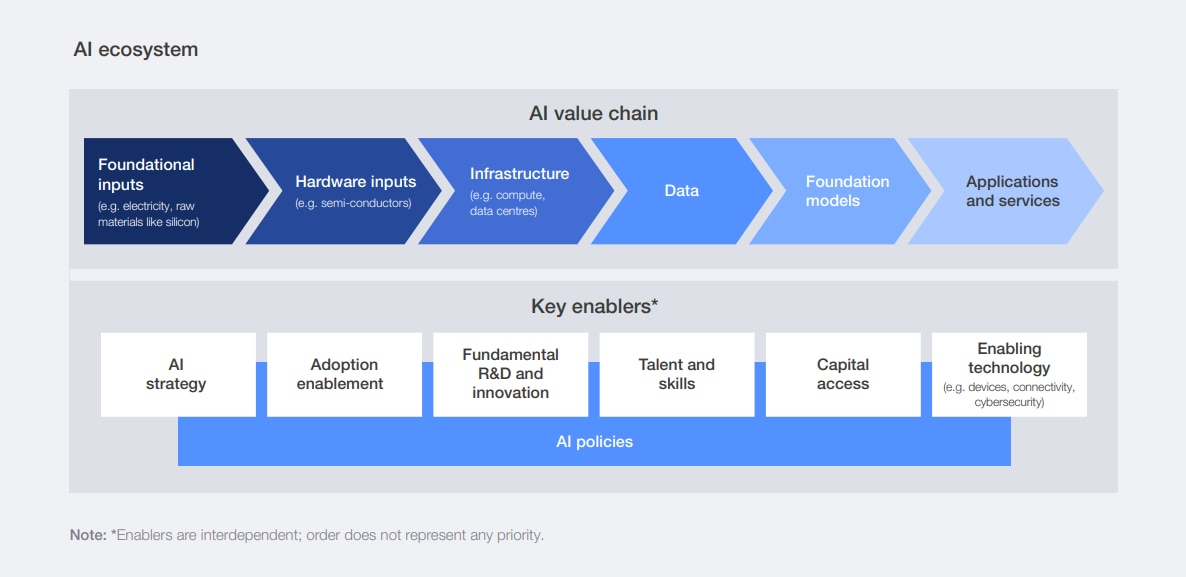
It shows that the AI ecosystem relies on key enablers that reinforce each other and support all elements of the value chain. You can read an overview of the research here.
2. Forum Signal: Telecom operators could become key players in the AI ecosystem
Telecom companies helped build the digital economy but many have captured only a small share of the value created by AI.
A new Forum white paper, developed with Accenture, explores how telecom providers can move beyond connectivity to play a larger role in the AI ecosystem.
The report outlines three strategic pathways:
- Strengthen the core network business using AI to improve performance, automation and cost efficiency.
- Enable AI services for industry, providing infrastructure and platforms that support enterprise AI deployment.
- Support sovereign AI ecosystems, partnering with governments to build trusted infrastructure and national AI capabilities.
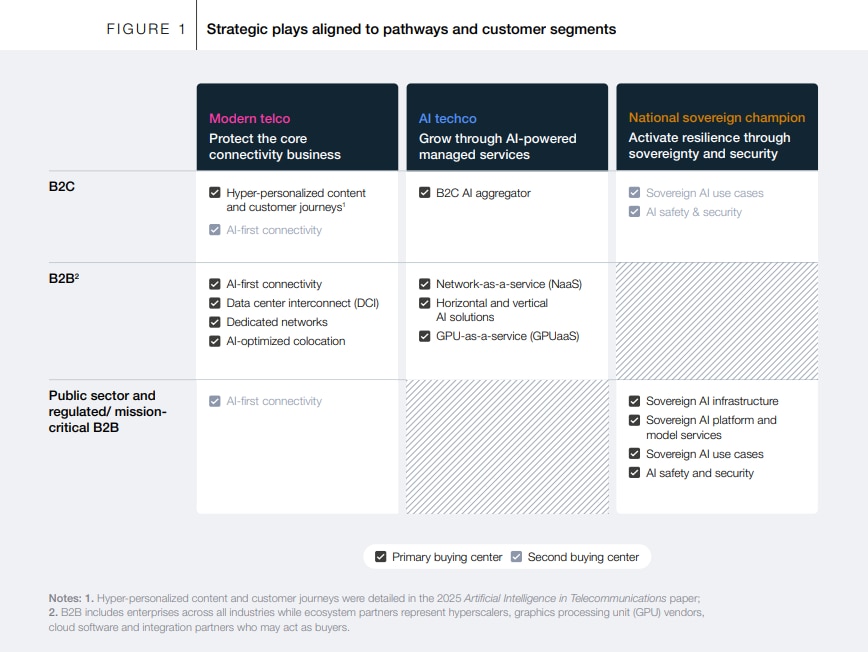
As Börje Ekholm, President and Chief Executive Officer, Ericsson, explores in this article, the next phase of AI will depend on high-performance connectivity, from 5G today to 6G tomorrow. Delivering this will require closer collaboration between telecom providers, governments and research institutions.
3. Market moves: defence debates, sovereignty frameworks and enterprise adoption
AI and defence debates intensify: At the time of writing, Anthropic has filed two lawsuits against the US Department of War in response to the government's decision to label the firm a supply chain risk. The firm had failed to reach an agreement on the US war department's use of its AI models, citing uses of its technology that could “undermine, rather than defend, democratic values”. CEO Dario Amodei met US Secretary of War Pete Hesgeth in February where two key issues were discussed on the use of models like Claude; the mass domestic surveillance of Americans and fully autonomous weapons. Speaking to The Economist, Amodei said Anthropic would do "everything to de-escalate" the situation.
Governments seek clarity on 'AI sovereignty': Researchers from Stanford HAI argue that the debate around AI sovereignty needs clearer definitions. Rather than focusing solely on national ownership of models, they suggest policymakers should identify which layers of the AI stack — compute, models, data or applications — require strategic control. The World Economic Forum has promoted the development of AI capabilities in various regions through the AI Competitiveness through Regional Collaboration initiative. It aims enable all nations to fully leverage the benefits of AI for economic growth, innovation and prosperity.
Enterprise AI still struggling to scale: Despite rapid investment, enterprise adoption remains uneven. OpenAI COO Brad Lightcap recently noted that AI has yet to deeply penetrate core business processes. A new McKinsey report reinforces the gap: 86% of leaders say their organizations are not well prepared to adopt AI operationally.
OpenAI has also recently announced partnerships with McKinsey, Accenture, Boston Consulting Group and Capgemini in an effort to gain traction in the enterprise AI market.
4. AI insight in a chart
5. What's next
Across industries, AI is moving beyond isolated pilots. Organizations are now scaling implementation across business functions and ecosystems, offering a clearer picture of where value is emerging.
Yet the path to scale remains difficult: research suggests around 70% of AI pilots fail to reach production, highlighting persistent operational and governance barriers
A forthcoming Forum report 'Organizational Transformation in the Age of AI' explores how companies are redesigning structures, processes and talent models to translate AI ambition into real-world impact.
Launching on 16 March 2026.
License and Republishing
World Economic Forum articles may be republished in accordance with the Creative Commons Attribution-NonCommercial-NoDerivatives 4.0 International Public License, and in accordance with our Terms of Use.
The views expressed in this article are those of the author alone and not the World Economic Forum.

Forum Stories newsletter
Bringing you weekly curated insights and analysis on the global issues that matter.
More on Artificial IntelligenceSee all

Mihir Shukla
March 16, 2026