The role of insurance in building resilience across the energy-water-climate nexus
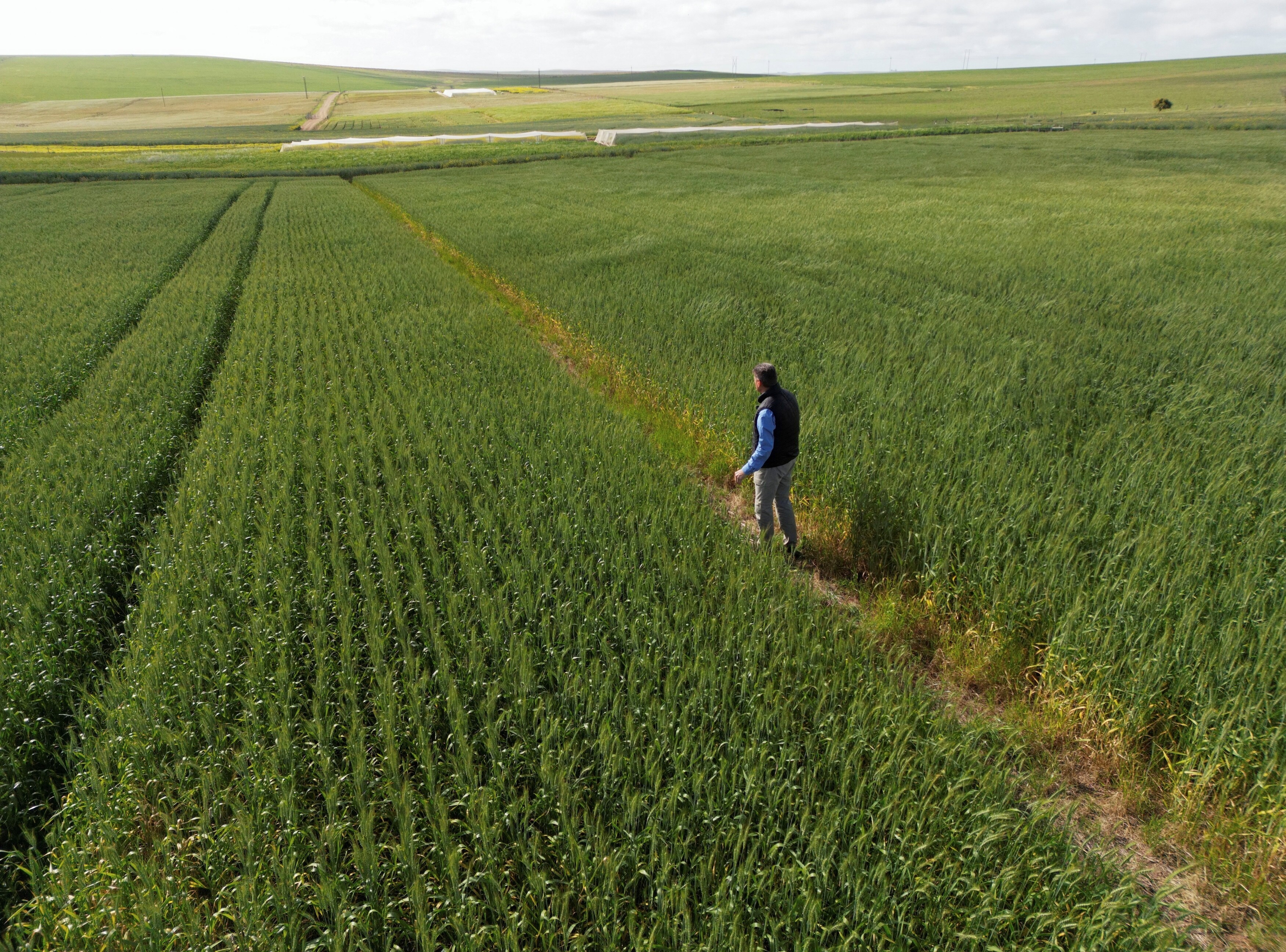
Farmers all over the world need custom insurance options to deal with a changing climate. Image: REUTERS/Shafiek Tassiem
- Global insured losses from natural catastrophe events reached $100 billion in 2025.
- The insurance industry pays for this, but is also a foundational layer that supports the investment needed to offset further climate change harms.
- Parts of the industry are already evolving to embrace the changing global conditions, and proving that insurance can play a foundational role in societal resilience.
Climate change is already forcing changes on the global insurance industry, as the risk of disasters and shock are integrated into calculations.
Climate change is likely to have a significant effect on insurance premiums. Many corporate boards may currently actually be underestimating the impact.
Add to that equation the energy nexus – which explores how land, water and energy systems intersect and the impacts for business and society – and the job of insurers starts to look even more complicated.
A growing number of projects around the world, however, are starting to paint a picture of what an insurance industry built for the climate era may look like. This work is focused on building resilience alongside paying out following disasters. It provides a blueprint that others may follow.
Insurance: Key to funding the energy nexus
When it comes to how this nexus will be financed, most attention to date has been paid to how capital can best be allocated to expedite the transition, in particular, models of blended finance that de-risk private investment. But a significant part of this financing is the de-risking and underwriting of investments through insurance and guarantees.
Without a viable insurance industry, much of this capital allocation would be too risky for many private investors. Providing a backstop like this for private investment is nothing new for the industry, but the complicated nature of insuring against climate shocks adds another layer of complication.
The extreme weather events of recent years are becoming increasingly predictable and therefore more expensive to insure against or potentially uninsurable altogether. This impacts farmers, homeowners as well as all significant business assets. Increased risks will inevitably impact food systems, the affordability of shelter – as well as all forms of energy generation and transmission.
Human activity has already breached multiple planetary boundaries, and these transgressions also have a financial cost.
The global climate risk landscape
The first half of 2025 marked a new inflection point in the global climate risk landscape. According to leading professional services firm Aon, global insured losses from natural catastrophe events reached $100 billion. The 2025 California wildfires alone caused insured losses of between $20 billion and $25 billion.
If such events are repeated at smaller intervals, this endangers homeowners, farmers as well as any business with significant physical assets.
Unlike other forms of finance, the impact of insurance on public and business behaviour is immediate. If a project underestimates its flood exposure, premiums climb. If contractors cut corners on worker safety, coverage shrinks. If governance lapses, investors demand more costly protection. Insurance does not wait for regulators to catch up; it turns risk into financial cost in real time.
Environmental failures alongside the impact of geopolitical insecurity, conflict and mass migration, combined, could pose an existential threat to the insurance industry. It can and must adapt to these changing conditions. By prioritizing innovation and resilience, the industry can continue to provide financial protection globally, in a way that actually supports the transition to a safer and more just world.
5 principles for building resilience through insurance
Rather than eliminating risk, resilience aims to reduce its severity, concentration and amplification. Five principles define effective strategies:
1. Risk must be reduced at its source through land-use planning, building standards, infrastructure design and ecosystem protection; insurance cannot indefinitely absorb rising exposure.
2. Investment must occur before disasters strike, as preventive measures such as flood defences and early-warning systems yield high long-term returns despite limited political appeal.
3. Risk-sharing must be explicit and fair, often requiring transparent public–private partnerships to manage systemic threats.
4. While improved data enhances risk assessment, data cannot replace political decisions about acceptable risk and collective investment.
5. Resilience depends on legitimacy: risk-based pricing can worsen inequality, so social consent, clear communication and equitable adaptation mechanisms are essential.
Below are some examples of how the insurance industry is moving towards adopting one or more of these principles on the ground today.
How the insurance industry is changing for the climate era
Financing resilience
Insurance companies are funding initiatives to make their insured customers more resilient and therefore less likely in need of claiming. This requires high densities of policyholders in specific geographic regions.
Admiral Insurance, for example, is the only major insurance company based in Wales, within the UK, and therefore is able to invest in local resilience programmes that decrease the likelihood of flooding by investing in peatlands. This protects their customers and the planet, while reducing them likelihood of a sudden influx of claims. Insurance mechanisms that value ecosystem services – like wetlands’ flood protection in Wales – can also reward community stewardship and local resilience.
New mechanisms
There is renewed interest in forms of insurance that can best protect vulnerable and low income workers from earnings lost due to external factors such as extreme heat.
Mechanisms such as surety bonds, underwriting standards and reinsurance pricing will increasingly need to include sustainability criteria in order to be priced correctly. Parametric insurance – coverage that is not priced according to the risk profile of individual workers or consumers but is triggered by external variables such as temperature, air quality or flooding – offers another potential route.
Community-based approaches
India represents a context in which 80% of farmers operate without any private insurance, and farm workers, and all other low-paid workers, are generally uninsured. Initiatives such as the Self-Employed Women’s Association in Gujarat or the informal and migrant workers protected by Peoples Courage International, cover workers daily against heat stress, but are reliant on philanthropy as well as worker contributions.
Public-private finance approaches are being developed by organizations such as The Blended Finance Company in Mumbai to try to make such schemes commercially viable. By providing coverage for smallholder farmers, local cooperatives or community energy projects, insurance can make the transition more just and inclusive.
As the energy nexus becomes a crucial principle around which we organize economies, resilience must become a central organizing principle. Insurance has a key role to play in this.
Societal resilience may extend beyond insurance, but the industry stands to be a key pillar of a wider move towards collective resilience. Insurance companies and decision-makers that embrace this approach will not only contribute to the betterment of society as a whole, but it will carve a strategic advantage in the industry for their organizations.
The Global Future Council on Energy Nexus shares ideas and examples through its Energy Nexus Insights series, comprising blogs, articles and infographics; guides for public and private sector decision-makers; and sector analyses.
Don't miss any update on this topic
Create a free account and access your personalized content collection with our latest publications and analyses.
License and Republishing
World Economic Forum articles may be republished in accordance with the Creative Commons Attribution-NonCommercial-NoDerivatives 4.0 International Public License, and in accordance with our Terms of Use.
The views expressed in this article are those of the author alone and not the World Economic Forum.
Stay up to date:
Energy Transition


Forum Stories newsletter
Bringing you weekly curated insights and analysis on the global issues that matter.
More on Financial and Monetary SystemsSee all

Spencer Feingold
March 11, 2026


