Opinion
How to unlock a decade of European growth
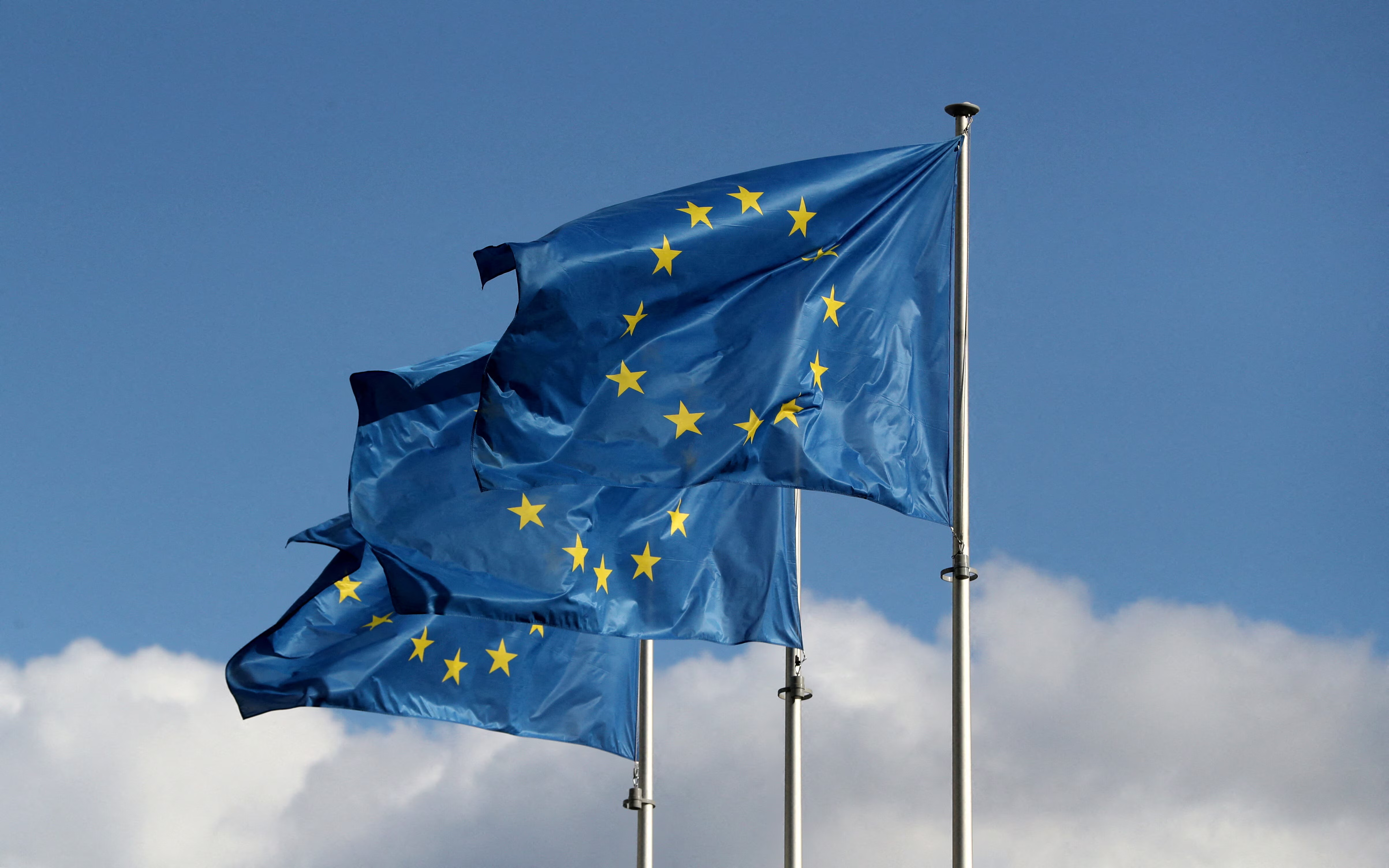
Over the past decades, a maze of EU, national and local rules has severely reduced Europe’s ability to cultivate global champions. Image: REUTERS/Yves Herman
- Europe must pivot towards an agile, results-focused framework to overcome systemic stagnation caused by excessive bureaucracy.
- Prioritizing execution speed and reducing regulatory complexity will enable the continent to compete with the rapid industrial scale of other regions.
- Shifting from complex subsidy schemes to market-based procurement contracts will help foster the next generation of sovereign European champions.
It is a sobering statistic. Since 2022, some 325,000 new jobs have been created in Germany just to deal with increased bureaucracy.
There is hardly any sector in Europe that is not calling for a significant reduction of new regulation and existing red tape so that businesses can focus on growth rather than compliance. These calls are becoming increasingly loud as the continent battles slow growth, trade friction, and intensifying industrial competition from China.
Over the past decades, a maze of European Union (EU), national and local rules has severely reduced Europe’s ability to cultivate global champions or deliver infrastructure projects on time and on budget. But it wasn’t always this way. France, for example, managed to build 34 nuclear reactors in little more than a decade in the 1970s and 1980s as part of the famous Messmer Plan.
Today, however, the picture is very different. The inflation-adjusted cost of building one megawatt of nuclear power in France has increased by 245% since 1978, and their Flamanville-3 reactor took 17 years to complete. In contrast, nuclear construction costs in China have fallen significantly over the past two decades.
China’s ability to deliver at scale and speed is not limited to nuclear. In 2024, China installed 329 GW of solar energy — equivalent to 329 nuclear reactors — and plans to add another 2 TW by 2030.
Towards an agile and results-focused approach
Over the past decades, EU decision-making has been guided by two main principles: proactive and comprehensive regulation of new industries and mobilizing large public investments into designated sectors and initiatives. Neither of them has created a global champion.
To successfully fight stagnation and deliver a decade of growth for its citizens, the EU needs a fundamentally different framework guiding its actions — one that accelerates both decision-making and policy execution, and is guided by market forces rather than a command-and-control approach too often deployed at the EU and national level. In particular, the following three principles should guide the EU’s future policies:
1. Reducing complexity
The EU must prioritize reducing the regulatory burden and bureaucracy that stifle citizens, businesses and strategic projects. Regulation should be “on-demand,” not “always-on,” with policymakers regulating only where there is an evident market failure that threatens consumers or undermines fair competition.
This marks a sharp departure from the current trend toward an aggressive, highly prescriptive regulatory approach, which is increasingly generating market failures rather than fixing them. According to the 2025 State of European Tech report, the share of tech founders who find the policy environment supportive is just 18%, even lower than in 2024. In critical technologies and major industries where Europe is losing ground, the regulatory burden should not materially exceed US and Chinese standards, a gap that currently exists across all key technologies, from AI and fusion to batteries.
2. Execution speed by default
Recent crises have proven that execution speed is a matter of choice, not destiny. The recent case of Germany’s Rheinmetall, which managed to open a new factory in Europe in just 14 months — a process that typically takes up to four years — shows that bureaucracy can be overcome when there is a sense of urgency and political will.
Europe needs radical modernization: we must expand our energy production, upgrade our physical and digital infrastructure, and rapidly rebuild our defence and industrial base. A benchmark for this transition should be the European Commission’s proposal to limit the permitting process for defence projects to 60 days, which stands in stark contrast to the multi-year delays currently standard across the continent.
These bottlenecks are not limited to physical infrastructure; they plague the technology and innovation space as well. It currently takes an average of 273 days to award a Horizon Europe grant. In the fast-moving world of AI, this is a lifetime. We must eliminate this bureaucratic tax on science. We should be able to do it in a month. Furthermore, cutting administrative reporting — which currently consumes one-third of researchers’ time — by 70% would immediately boost Europe’s research capacity without spending a single extra euro.
We must prioritize speed as a key governing principle rather than waiting for another crisis that will prompt emergency permitting regimes.
3. From grants and subsidies to contracts
Especially in the tech sector, companies prefer revenue over grants. A more market-based approach for the EU means supporting emerging technology companies as customers, rather than merely as operators of complex subsidy schemes.
Purchasing agreements for future solutions — such as Advanced Market Commitments — help create real markets and boost technology companies, especially those in deep-tech with long R&D cycles. These agreements provide predictable revenue streams that help attract venture and growth capital.
As part of this shift, European governments should also prioritize sovereign European solutions and SMEs in their procurement processes. Today, SMEs represent 99% of all businesses but receive only 30% of total procurement value.
An urgent call for results
Policy-makers can no longer ignore the urgent call for results. Examples at home and abroad prove that great things can be achieved fast: Poland has built 4,000 kilometers of new fast roads since joining the EU in 2004; Ukraine digitized its entire government in record time; and Tesla’s Chinese plant was built in just 168 days. In this global race, we underestimate others at our own peril.
There is an enormous energy on the continent that wants to build the future. Today, Europe rivals the US in startup creation, with thousands of new, high-growth ventures being launched every year. However, this potential will only translate into global champions and enduring wealth creation if the EU rediscovers its market-based roots, reduces complexity and embraces speed as a key operating principle. Doing so could deliver clear, tangible results and unlock a decade of European growth.
Don't miss any update on this topic
Create a free account and access your personalized content collection with our latest publications and analyses.
License and Republishing
World Economic Forum articles may be republished in accordance with the Creative Commons Attribution-NonCommercial-NoDerivatives 4.0 International Public License, and in accordance with our Terms of Use.
The views expressed in this article are those of the author alone and not the World Economic Forum.
Stay up to date:
Agile Governance


Forum Stories newsletter
Bringing you weekly curated insights and analysis on the global issues that matter.