Working but still poor: The hidden struggle of employed youth in Africa

Rising employment among young Africans must be matched by rising living standards. Image: Unplash/Desola Lanre-Ologun
- About 57% of young Africans are employed, compared with 48% of young people in the rest of the world.
- But African countries with high youth employment shares tend to have higher rates of working poverty, suggesting that young people in the region are not earning enough to improve their lives.
- These challenges can be addressed through greater value addition in agriculture, wider access to better-protected employment, and investments in education.
Employment among African youth does not guarantee economic security, according to a new report produced by the World Data Lab.
African countries with high youth employment shares tend to have higher rates of working poverty, a signal that, despite working, young Africans (15-35) are not earning enough to meaningfully improve their livelihoods. In Africa, one in three employed young people lives in a household with consumption below the international poverty line of $2.15 a day (2017 PPP). In contrast, the ILO estimates the global rate at about 14%.
Where working doesn’t always pay
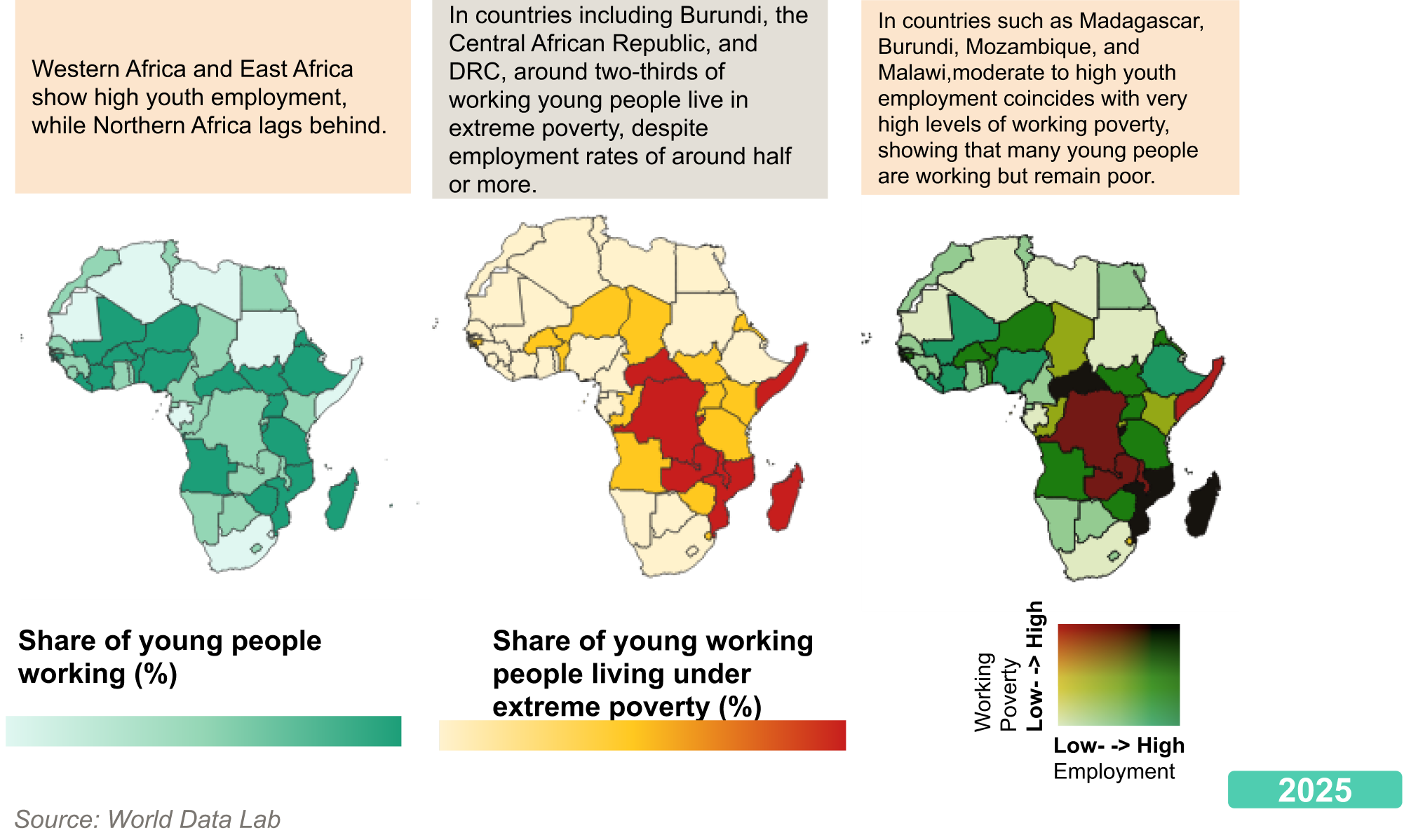
About 57% of young Africans are employed, compared with 48% of young people in the rest of the world. However, unlike their peers elsewhere, working poverty among employed youth in Africa remains high at 34%. Countries such as Burundi and Madagascar clearly exhibit this pattern.
Both report among the highest youth employment shares at above 70%, higher than the continental average of 57%, yet they also have among the highest working poverty levels, with around two-thirds of working youth in Burundi and 90% of employed young women in Madagascar living in extreme poverty, compared to the African average of 34%.
Four types of countries
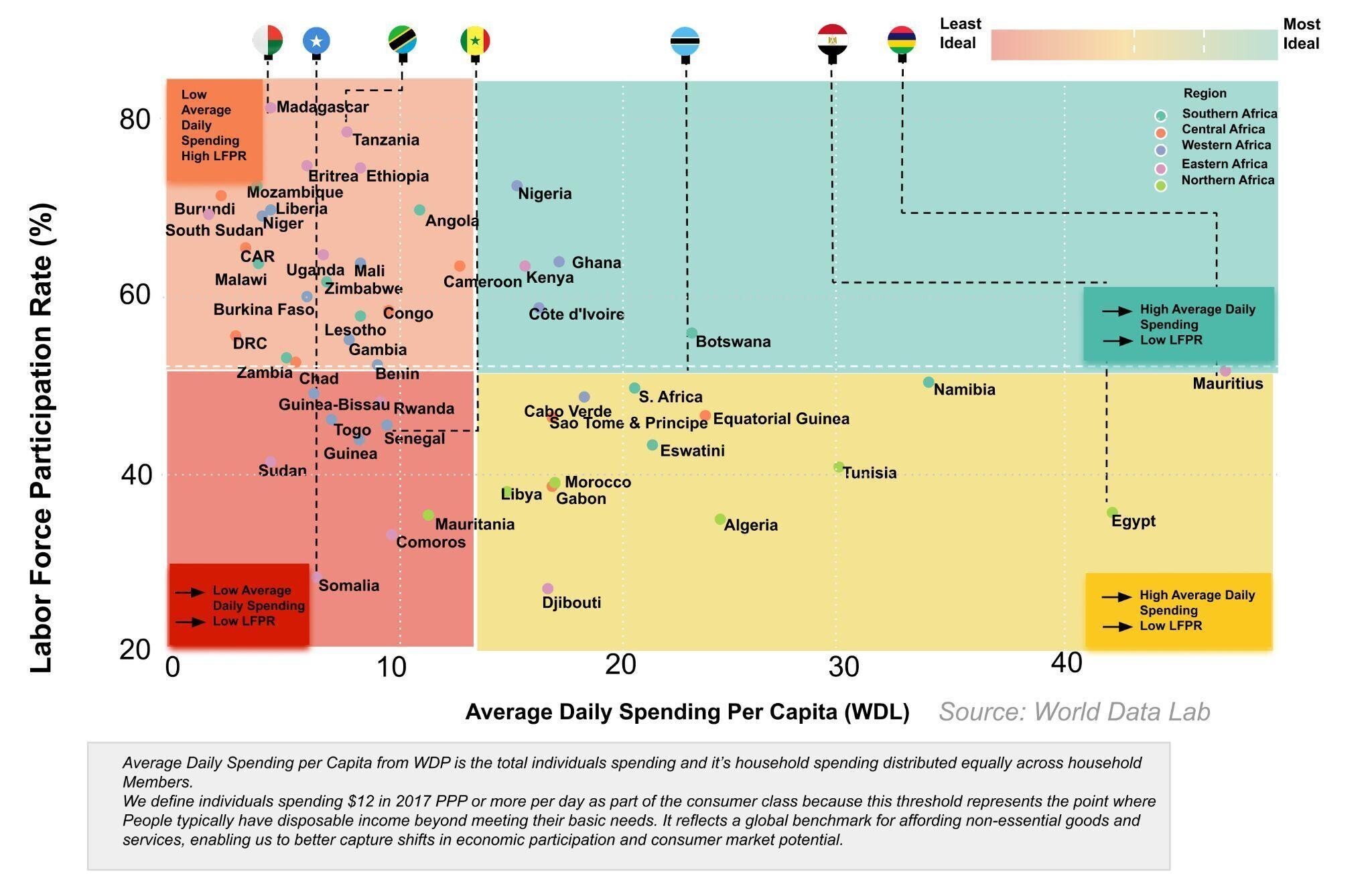
An analysis in the report also examines labour force participation rates (LFPRs) alongside average daily spending levels, categorizing African countries into four quadrants (Figure 2). The analysis uses average daily spending as a proxy for living standards, following established survey literature that shows that in developing countries consumption or spending often better reflects household welfare than income. In low-income settings, households generally save little. Therefore, observed spending is a closer estimate of income over time.
At one extreme are the “working poor” countries, where high youth LFPRs coincide with low spending, a proxy for constrained living standards. This debunks the idea that jobs are a guaranteed pathway out of poverty. Many young people are working, but their work does not always translate into higher living standards, particularly for those in low-productivity agricultural jobs. Countries in this segment include the DRC, Tanzania and Madagascar. At the other end are countries where young people face poverty and exclusion from the labour market (i.e. low LFPR, low spending). Some low-income countries have low LFPRs, often in settings that are conflict-affected and where women have low employment shares. Countries in this segment include Sudan and Somalia.
A more encouraging picture emerges among the modernizers (high LFPR, medium spending). These African countries are in the ideal segment of relatively high employment while also showing moderate spending capacity. These are transition economies that have been successful in modernizing, including Mauritius, Namibia and Botswana. Notably, LFPRs for some strong performers, such as Namibia, remain relatively low, hovering near 60%, as these countries also place a major emphasis on education. Kenya also sits in this category, with somewhat high LFPR and moderate average daily spending compared to other African countries.
Finally, some countries combine moderate spending levels with persistent labour-market exclusion (low LFPR, medium spending). Africa is home to several countries that reached middle-income status more than two decades ago. However, many countries, especially in North Africa (Egypt, Algeria and Tunisia), have never maximized women’s LFPR, which explains relatively low aggregate LFPR rates of about 40% to 60%.
Why some African countries see higher rates of youth working poverty
Countries with lower youth formal employment shares tend to have higher rates of working poverty among young people at the country level. For instance, countries in Central Africa, such as DRC and the Central African Republic, have among the lowest formality rates in Africa at below 8% each, and also high rates of young working people living in extreme poverty according to the international poverty line, with around two-thirds of working young people living in extreme poverty. Kenya also has a low youth formality rate of about 9%.
In Africa, across all sectors, more jobs are informal, at 90%, relative to the global average of over 60%, particularly in agriculture. In this sector, informality in youth jobs is 4.8 times higher than in the rest of the world and, in select countries analyzed, tends to be linked to lower pay. Where income data are reported, young people working in services earned about 2.6 times more than those in agriculture in 2024. Countries with higher levels of extreme working poverty among young people also tend to have a larger share of youth working in agriculture. The majority of informal workers face poverty, lack income stability and struggle to access credit.
Furthermore, even though the services sector is set to overtake agriculture as the primary youth employer by 2033, young workers are often moving to low-productivity informal activities within the sector.
Countries with higher youth extreme working poverty levels also tend to have a larger share of employed young people with low levels of education, a signal that young people are leaving school too early to work. Burundi illustrates this pattern strongly. It has some of the highest levels of youth living in extreme poverty, and simultaneously, young people tend to enter the workforce early, with 57% of young women and 47% of young men aged 15-21 already employed. By ages 29-35, employment rates in Burundi are nearly universal for both men (95%) and women (95%).
The data shows there is room to address challenges in working poverty among African youth through greater value addition in agriculture, wider access to stable and better-protected employment, and investments that allow young people to complete more years of schooling before entering the workforce. These shifts are essential to ensure that rising employment among young Africans is matched by rising living standards, especially for groups most affected by working poverty.
Don't miss any update on this topic
Create a free account and access your personalized content collection with our latest publications and analyses.
License and Republishing
World Economic Forum articles may be republished in accordance with the Creative Commons Attribution-NonCommercial-NoDerivatives 4.0 International Public License, and in accordance with our Terms of Use.
The views expressed in this article are those of the author alone and not the World Economic Forum.
Stay up to date:
Africa


Forum Stories newsletter
Bringing you weekly curated insights and analysis on the global issues that matter.