MC14 in Yaoundé: What the WTO delivered, what it did not, and why it matters
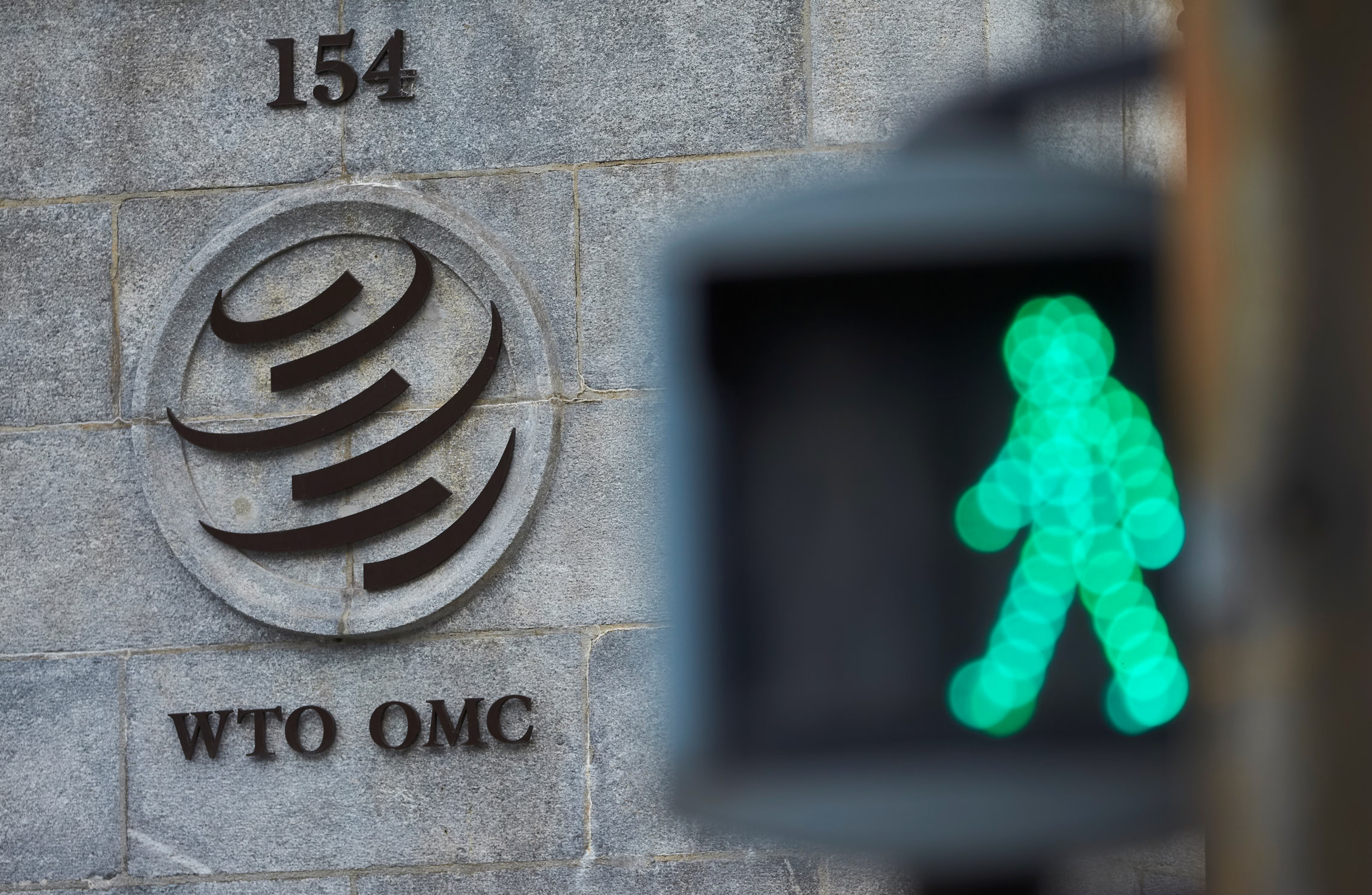
The multilateral system faces sustained strain as WTO members struggle to reach full institutional consensus. Image: REUTERS/Denis Balibouse
- MC14 concluded with mixed results, as members failed to reach a comprehensive multilateral trade declaration.
- The expiration of the digital trade moratorium creates new regulatory complexities for the global economy.
- Progress moved towards plurilateral agreements among coalitions rather than achieving full consensus across all members.
The Ministerial Conference is the World Trade Organization’s highest decision-making body, convening every two years. Its 14th session (MC14), held from 26 to 30 March 2026 in Yaoundé, Cameroon, took place at a pivotal moment marked by rising geopolitical tensions, economic fragmentation and rapid digital transformation. Nearly 2,000 trade officials took part in what was only the second time a WTO Ministerial has been hosted on the African continent.
The outcome was mixed against the ambitions set going in. MC14 closed without an overall ministerial declaration and without agreement on its core priorities. The Chair, Cameroon’s Minister of Trade Luc Magloire Mbarga Atangana, acknowledged that “we ran out of time.” WTO Director-General Ngozi Okonjo-Iweala confirmed that work towards a “Yaoundé Package” of agreements will continue in Geneva, with the General Council meeting in May 2026 as the next focal point.
From the expiration of the digital trade moratorium to progress on investment facilitation, here is a breakdown of the hits, the misses and the strategic implications of MC14.
Digital trade
The most consequential outcome at MC14 was one of failure: the multilateral moratorium on customs duties on electronic transmissions expired on 30 March 2026, for the first time since its introduction in 1998. Some members blocked renewal, despite broad support from most. The moratorium covered software, audiovisual content, digital media and a wide range of cross-border digitally delivered services.
In response, 66 WTO members representing approximately 70% of global trade agreed to move forward with interim implementation of a plurilateral E-Commerce Agreement, covering digital trade facilitation, consumer protection, e-payments, data protection and a commitment among participants not to impose duties on electronic transmissions. The ECA enters into force once 45 members ratify it. Some members did not join, choosing to preserve domestic regulatory flexibility, a significant absence given its centrality to the global digital economy. The partial nature of this arrangement matters. A plurilateral agreement covering a coalition of members is a practical step forward, but it replaces multilateral certainty with a more complex, fragmented landscape.
For business, the implications are immediate. The lapse of the moratorium removes a long-standing baseline that has supported the growth of digital trade. Even without immediate tariff changes, companies face increased uncertainty and compliance complexity. The interim arrangement provides continuity for participating members but also signals a more fragmented regulatory landscape.
Find out more about the state of global digital trade in this community paper.
WTO reform
WTO reform was framed as an existential priority ahead of MC14. In spite of that, no Ministerial Declaration and no work plan were agreed. The deeper constraint is structural: consensus-based decision-making and advancing institutional reform across a membership fractured by geopolitical competition proved impossible within the conference’s timeframe. This is not merely a procedural gap. The WTO’s ability to adapt to the realities of 21st century trade depends on its capacity for institutional renewal. That capacity was not demonstrated in Yaoundé. Work continues in Geneva, but without the political mandate a Ministerial Declaration would have provided.
Dispute settlement
There was, however, incremental progress on dispute settlement. The Multi-Party Interim Appeal Arbitration Arrangement expanded to 61 members, representing roughly 60% of global trade. Participants reaffirmed their commitment to restoring a fully operational, permanent system. For business, this remains critical. A predictable dispute settlement system underpins confidence in cross-border trade. While interim, the arrangement provides companies operating across participating economies with a degree of legal certainty. It does not, however, resolve the underlying structural gap.
Investment facilitation
A joint ministerial declaration was issued by 129 members of the Investment Facilitation for Development Agreement (IFDA). Furthermore, support for incorporating the IFDA into the WTO framework was nearly universal, with 165 of 166 members reportedly in favour. Barring consensus, the Agreement remains outside the formal WTO legal architecture, limiting its enforceability. The near-universal support for the Agreement is a genuine signal; the inability to formalize it is an equally genuine constraint.
Targeted outcomes and development
MC14 delivered a limited set of outcomes, including a commitment to continue fisheries subsidies negotiations towards MC15. It also adopted decisions on the integration of small economies and on operationalizing special and differential treatment provisions in Sanitary and Phytosanitary (SPS) and Technical Barriers to Trade (TBT) agreements. These outcomes are meaningful for the development agenda, particularly for least-developed countries, though they represent incremental rather than transformative progress. A more comprehensive outcome, particularly on emerging agricultural trade issues, would have strengthened the development dimension of MC14 by addressing food concerns on public stockholding, domestic support and market access for developing countries. Without this, progress remains incremental and key imbalances persist.
The multilateral system is not collapsing, but it is under sustained strain.
”Implications for business and policy-makers
The geopolitical pressures that constrained MC14, including industrial policy competition, supply chain fragmentation, subsidies disputes and strategic decoupling between major economies, are unlikely to ease before the next Ministerial. If anything, they are likely to intensify. This is the environment in which the WTO must demonstrate its relevance.
The multilateral system is not collapsing, but it is under sustained strain. Progress is increasingly happening through coalitions of willing members rather than full consensus, and the rules that govern key areas of trade such as digital commerce, investment and dispute resolution are becoming more fragmented. For business, this means higher compliance costs, greater planning uncertainty, and a greater premium on active engagement with the emerging plurilateral frameworks now driving rule-making.
At the same time, a parallel reality is becoming more visible. Trade is not only shaped by rules, but by the physical movement of goods through increasingly constrained corridors and strategic choke points. Disruptions in shipping lanes, ports and logistics networks are now central to trade risk, yet these issues sit largely outside the WTO’s mandate. They are being addressed through a combination of national policies, regional initiatives and coordination among industry and other international organizations. This creates a gap between where trade rules are negotiated and where key vulnerabilities in the system are managed.
The Yaoundé Package remains on the table in Geneva. Whether it can be finalized at the upcoming WTO General Council Meeting will be an early test of whether the political will exists to convert near-agreement into formal commitments. The WTO’s long-term credibility depends, in part, on that question being answered.
Don't miss any update on this topic
Create a free account and access your personalized content collection with our latest publications and analyses.
License and Republishing
World Economic Forum articles may be republished in accordance with the Creative Commons Attribution-NonCommercial-NoDerivatives 4.0 International Public License, and in accordance with our Terms of Use.
The views expressed in this article are those of the author alone and not the World Economic Forum.
Stay up to date:
Trade and Investment


Forum Stories newsletter
Bringing you weekly curated insights and analysis on the global issues that matter.