Beyond access: Why real AI literacy will define the future

The challenge before us is no longer access alone. It is AI literacy. Image: Envato
- A new digital divide is emerging between those who consume AI and those who understand it.
- The joint European Commission and OECD AILit Framework establishes a global standard for AI literacy.
- Equipping educators and embedding these principles into classrooms remains the critical next step for society.
For more than two decades, efforts to expand access to technology, connectivity and digital skills have helped narrow the digital divide for millions of learners around the world. Today, a new divide is emerging – one that may prove just as consequential.
As artificial intelligence becomes embedded in how we learn, communicate, create and make decisions, the future gap may not be between those who have access to AI and those who do not. It may be between those who understand how to question, evaluate, direct and shape AI systems and those who simply consume their outputs.
The challenge before us is no longer access alone. It is AI literacy.
That’s why the launch of the AI Literacy (AILit) Framework is such an important milestone. Developed as a joint initiative of the European Commission and the OECD, with support from CodeAI, and leading international experts, the framework provides a shared vision of the knowledge, skills and attitudes learners need to thrive in a world increasingly shaped by AI. At a moment when education systems are grappling with how to prepare young people for rapid technological change, the framework offers a common language for understanding what it means to be AI literate.
The need for that shared understanding has never been greater.
The reality of everyday AI adoption
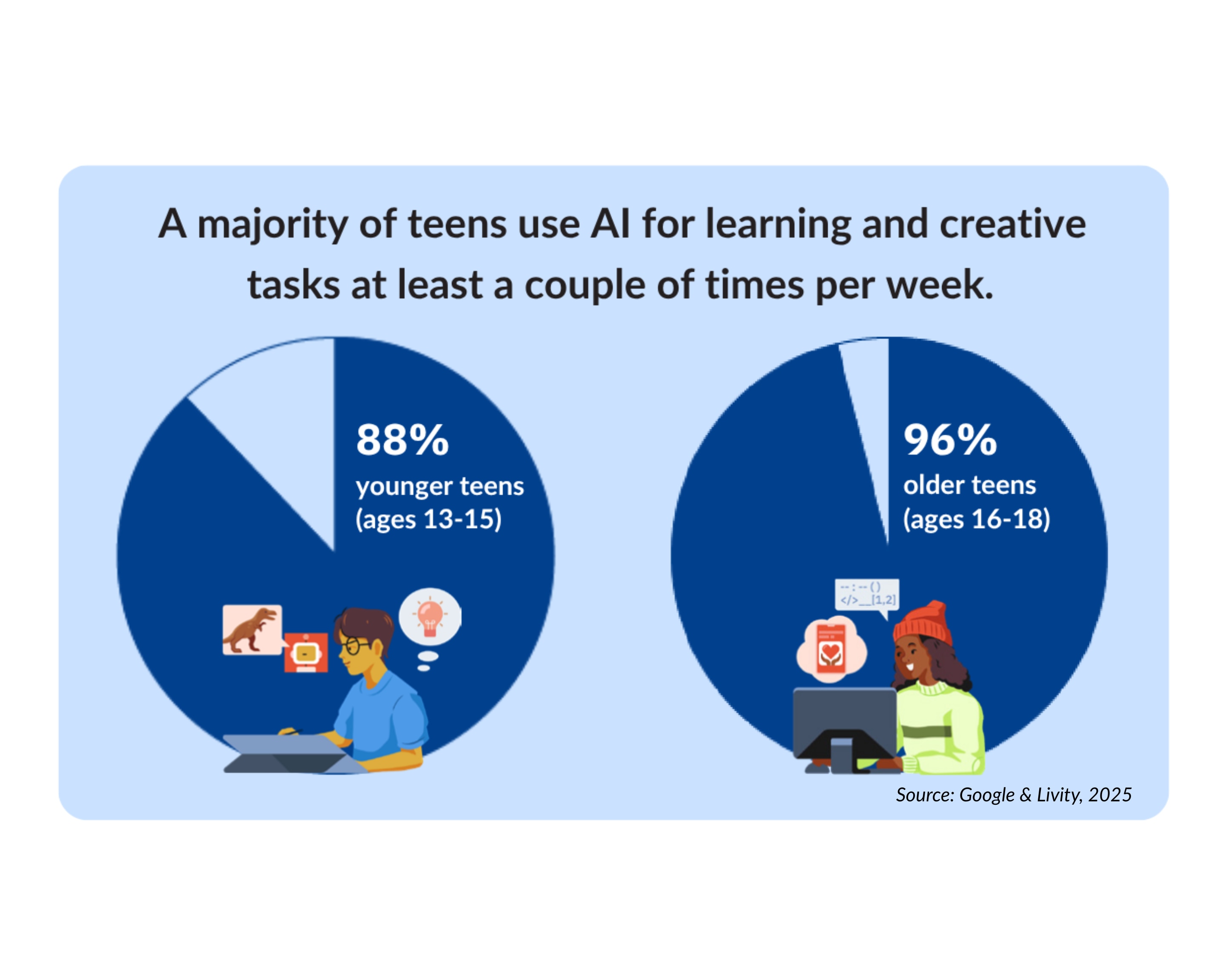
Young people are already living in a world shaped by AI. They encounter AI systems while searching for information, completing schoolwork, translating content, creating media and interacting online. A 2025 survey of European teenagers found that 88% of younger teens aged 13–15 and 96% of older teens aged 16–18 use AI tools for learning and creative tasks at least several times a week. Across Europe, young people aged 16–24 are using generative AI at nearly twice the rate of the general population. AI is not a future technology for today's learners – it is part of their everyday reality.
Yet widespread use does not necessarily mean understanding.
Many young people can generate content with AI, but fewer understand how these systems produce results, where they make mistakes, how they influence decision-making, or what ethical considerations accompany their use. Increasingly, learners are interacting with systems that can shape perspectives, influence behaviour and affect opportunities. A recent Common Sense Media study found that 72% of surveyed US teenagers had used AI companions – systems specifically designed to engage users in meaningful conversations. These technologies are becoming deeply integrated into young people’s lives, often without clear guidance on how to evaluate or navigate them responsibly.
As Joseph South, Chief Innovation Officer at ISTE+ASCD, points out, treating AI as a binary choice misses the mark. “Approaching AI as a yes or no proposition for young people doesn't recognize how pervasive it already is in their world,” he notes, emphasizing that we have a “moral obligation to make its invisible influence visible to them” to protect their agency.
Defining true AI literacy
AI literacy is often misunderstood as simply learning how to use AI tools. In fact, it is much broader. AI literacy encompasses the technical knowledge, durable skills and future-ready attitudes that enable learners to engage with AI thoughtfully, create responsibly, manage its role in their lives and help shape its future. It includes understanding how AI works, evaluating its outputs critically, recognizing its limitations, identifying bias, considering ethical implications and exercising human judgement when interacting with intelligent systems.
These capabilities are rapidly becoming as foundational as digital literacy itself.
The public increasingly recognizes this need. According to a 2025 European Commission survey, 63% of respondents agreed that everyone will need to be AI-literate by 2030. The question is no longer whether AI literacy matters. The question is how education systems can support it effectively and equitably.
The challenge is particularly acute because educators themselves are navigating this transition in real time. Evidence from the OECD’s 2024 Teaching and Learning International Survey found that only one in three teachers currently uses AI on average, while three out of four report lacking the knowledge and skills needed to teach with AI. While students are rapidly adopting these technologies, many education systems are still developing the frameworks, guidance and professional learning necessary to help educators support them.
This gap highlights a shifting vulnerability in education. Tanner Jackson, Head of AI Products at ETS, warns that the core challenge has moved from equity of infrastructure to equity of understanding: “Without stronger AI literacy, we risk creating a new divide where student outcomes depend on an educators’ ability to wield AI with purpose and depth.”
For several years, education leaders around the world have grappled with a fundamentally complex question: What does it actually mean to be AI literate?
Without a shared understanding of AI literacy, efforts to prepare learners risk becoming fragmented. Some schools may focus narrowly on technical skills, while others emphasize digital citizenship, ethics or productivity tools. All of these elements matter, but none alone is sufficient.
A global framework for a shared challenge
The AILit Framework seeks to address this challenge by defining the core competencies learners need to navigate an AI-enabled world. Rather than focusing solely on technical proficiency, it recognizes that AI literacy also requires critical thinking, ethical reasoning, creativity, agency and informed participation in society.
Following the release of a draft in May 2025, an international consultation informed key content and structural revisions. These updates reflect teachers’ and educators’ priorities and address real-world opportunities and challenges in digital education. More than 2,000 stakeholders from 100+ countries provided feedback to shape the final version.
The framework builds on years of international efforts to define what meaningful AI literacy should look like for learners worldwide. In 2023, TeachAI – a global coalition of education leaders, policy-makers, researchers, civil society organizations and technology companies – helped bring attention to the need for a shared understanding of AI literacy. By convening diverse stakeholders around a common vision for the knowledge, skills and dispositions learners need in an age of AI, TeachAI helped lay important groundwork for the broader international efforts that followed, including the development of the AILit Framework.
As AI systems become more powerful, the capabilities that matter most remain deeply human: curiosity, judgement, creativity, empathy, ethical reasoning and the ability to ask meaningful questions. AI can generate answers, but humans must decide which answers deserve trust. AI can identify patterns, but humans must determine which outcomes align with our values. AI can augment human capability, but only if people maintain agency over how it is used.
From definition to classroom implementation
The challenge now is implementation. Defining AI literacy is an essential first step, but learners will benefit only when these principles are embedded in curricula, teacher preparation, assessment and learning experiences that reach every classroom.
Achieving this will require action from education leaders, policy-makers, employers, technology companies and civil society organizations. By exploring the framework, piloting its use, sharing evidence and lessons learned, and investing in educator and learner capacity, stakeholders can help ensure that AI literacy becomes a universal opportunity, equipping every learner not just to use AI, but to shape its role in society.
Don't miss any update on this topic
Create a free account and access your personalized content collection with our latest publications and analyses.
License and Republishing
World Economic Forum articles may be republished in accordance with the Creative Commons Attribution-NonCommercial-NoDerivatives 4.0 International Public License, and in accordance with our Terms of Use.
The views expressed in this article are those of the author alone and not the World Economic Forum.
Stay up to date:
Artificial Intelligence


Forum Stories newsletter
Bringing you weekly curated insights and analysis on the global issues that matter.