Charting the renminbi's evolving role in the global economy
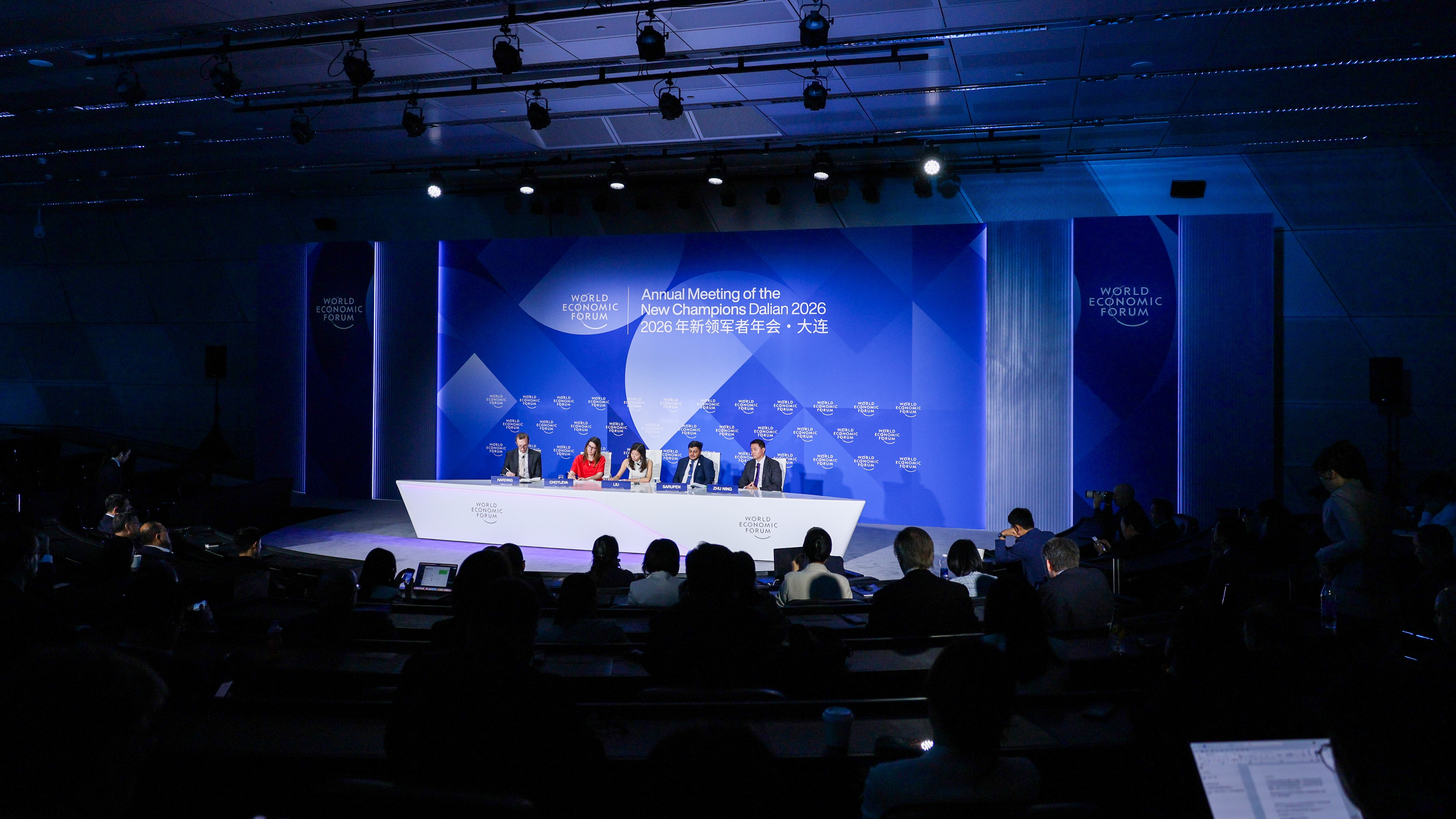
The 'Renminbi and the World' session at the Forum's Annual Meeting of the New Champions 2026, Dalian, China. Image: World Economic Forum
- Renminbi internationalization describes the shift of China's currency from domestic tool into a global currency for trade, investing and finance.
- At the recent World Economic Forum's Annual Meeting of the New Champions, experts examined how far China's currency has travelled – and what obstacles remain.
- "This is a very long-term process which has started some 20 years ago," one expert said.
Last month, at the World Economic Forum's Annual Meeting of the New Champions in Dalian, China, leaders and experts gathered to discuss a range to issues impacting the global economy including the evolving role of China's currency.
In recent years, the currency, known as the renminbi (RMB) with the yuan being the principal unit of account, has grown from being a domestic tool into a global currency for trade, investing and loans. The evolution has been referred to as renminbi internationalization.
At the Forum's event, one session in particular, Renminbi and the World, brought together economists and policymakers to take stock of where RMB internationalization stands.
"This is a very long-term process which has started some 20 years ago," said Zhu Ning, Deputy Dean and Professor of Finance at the Shanghai Advanced Institute of Finance. "We are probably seeing the fruit-bearing process in the past 12 months or so."
Renminbi internationalization: a shift in purpose
Zongyuan Zoe Liu, Senior Fellow at the Council on Foreign Relations, stressed that the character of renminbi internationalization has fundamentally changed.
"If we compare 2009 versus now, the biggest change for renminbi internationalization is that it has transformed from more of a prestige project to a very important strategic and resilience project," Liu said.
Measured against the three functions of money, Liu offered a mixed assessment. On means of exchange, she was broadly positive: more than 60% of China's cross-border trade now settles in renminbi, and 99% of China-Russia trade is conducted in local currency.
On store of value, RMB internationalization has "not made significant progress," she said, pointing to capital controls as one constraint.
But the third function – unit of account – Liu identified as the area of greatest future potential, noting China's efforts to price commodities such as oil futures in Shanghai, lithium in Guangzhou and rare metals in renminbi.
Reading the RMB data
Diana Choyleva, Founder and Chief Economist of Enodo Economics, introduced an important caveat to headline metrics. While SWIFT data shows the yuan's share of global payments has been volatile – peaking at 4.74% in mid-2024 before falling back towards 2.75–3.1% in early 2026 – she argued this may understate actual usage.
"With so much more of the trade in yuan moving off the dollar rails," she said, activity is migrating to China's Cross-Border Interbank Payment System (CIPS) payments system and bilateral digital currency platforms where there is "no visibility" in conventional data.
"We no longer have a credible yardstick with which to measure the use of the yuan for cross-border trade," she said.
This data gap matters for assessing the broader picture. A recent Forum report, Deepening Divides: The Cost of a More Fragmented Financial System, highlights the pressures building on global payment infrastructure as geopolitical tensions drive parallel systems – a dynamic the session repeatedly returned to.
A South African perspective
For Ashor Sarupen, Deputy Minister of Finance of South Africa, the relevant question is not whether the renminbi displaces the dollar but whether the global system becomes less dependent on any single currency.
"The critical thing is not to create single points of dependency, but rather to focus on diversification," he said. "The future is not necessarily bipolar between two hegemons and currencies – it's about interoperability, transparency and predictable rules on currency exchange."
South Africa's practical steps reflect that position. The South African Reserve Bank and the People's Bank of China (PBOC) have operated a bilateral currency swap agreement since 2015. Standard Bank became the first African bank authorized to offer transactions through CIPS in late 2025 – though Sarupen noted it remains early days.
"We haven't drawn on the currency line, but the swap agreement is in place," he said.
The exchange rate question
The session also examined the renminbi's recent appreciation. Zhu Ning identified supporting factors – China's trade surplus, economic resilience and relative stability compared with other major economies – but cautioned against expecting a rapid move.
He cited the lessons of Japan's Plaza Accord experience and the risk that sharp appreciation could damage export competitiveness, a vital component of Chinese GDP.
Crossing the river by feeling the stones and the gradual approach has been the spirit of China's policymakers.
”Liu noted that the PBOC had maintained the currency's stability even as markets anticipated depreciation following US President Donald Trump's re-election. The move was a deliberate choice, she argued, tied to the resilience rationale.
Meanwhile, Choyleva placed the exchange rate question in a longer frame: "Over the next decades, the cost of dollar funding outside and inside the US will increase substantially," she suggested, a trend that could progressively improve the renminbi's competitive position for cross-border transactions regardless of exchange rate movements.
The safe asset gap
An audience question about safe asset supply – where foreigners wishing to hold renminbi can park it in low-risk instruments – drew out the panel's most forward-looking exchange. Choyleva pointed to China's expanding fixed income market as the natural next phase: companies settling trade in renminbi will want short-term RMB instruments to hold between transactions.
Liu argued that China's distinctive advantage lies not in replicating the US Treasury market but in green finance. "China's unique advantage in terms of providing a financial benchmark is going to be in green bonds and the green transition," she said, citing the industrial capacity backing that market. This transition – from settlement currency to treasury and investment currency – is the defining challenge of the next phase of RMB internationalization.
With the renminbi accounting for just under 2% of global official reserves against the dollar's 58%, and China holding more than 30% of global manufacturing capacity, the panel noted, the gap between economic weight and currency status remains large. Whether – and how fast – that gap narrows is a question the Dalian session suggested will define the next decade of global finance.
License and Republishing
World Economic Forum articles may be republished in accordance with the Creative Commons Attribution-NonCommercial-NoDerivatives 4.0 International Public License, and in accordance with our Terms of Use.
The views expressed in this article are those of the author alone and not the World Economic Forum.

Forum Stories newsletter
Bringing you weekly curated insights and analysis on the global issues that matter.
More on Financial and Monetary SystemsSee all

Tobias Lindström Battle and Isabela Bartczak
October 13, 2026


