Turning Carbon into Value: Report Charts Carbon Capture and Utilization Pathways for Growth and Emissions Abatement
- Carbon Capture and Utilization enables businesses to convert captured CO₂ into valuable products. Building more confidence in the abatement potential of the technology will be key to scaling it up.
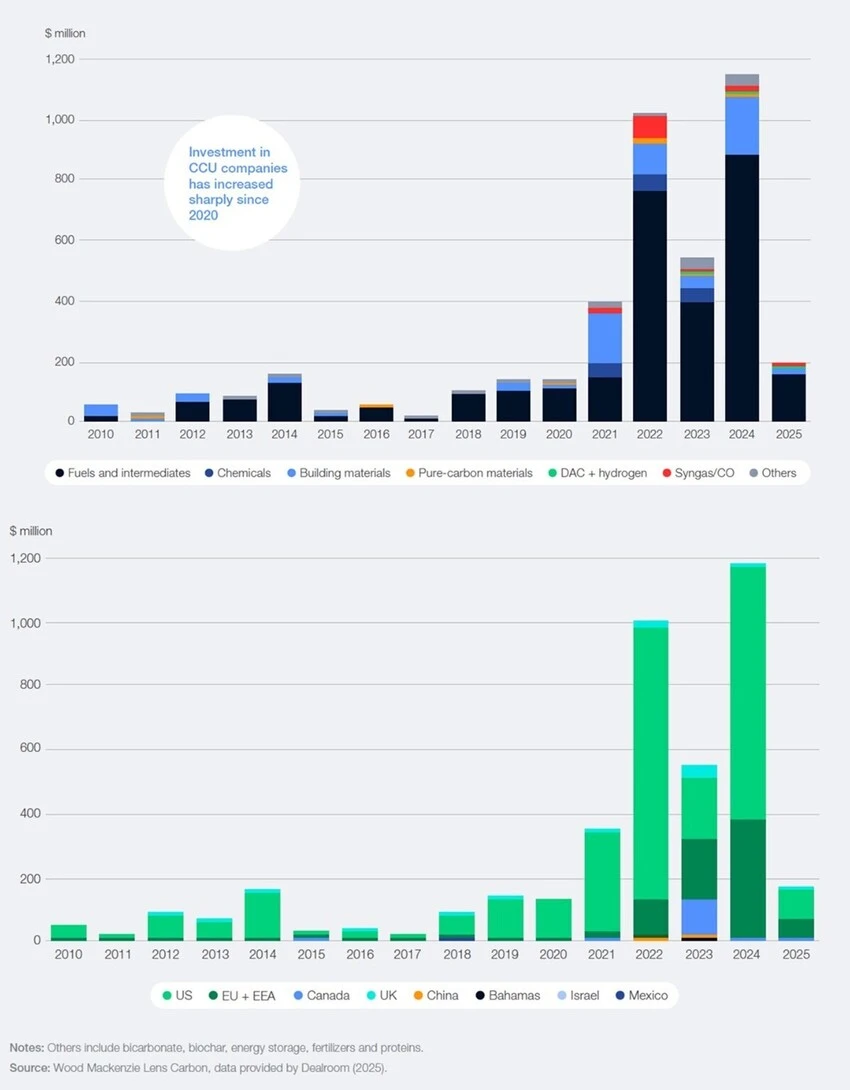
- Emerging CCU pathways are concentrated in fuels, chemicals, and building materials - with fuels alone representing 11.5 Mtpa CO₂ of the 15 in development by 2030. Investment diversification beyond fuels will be critical for CCU to reach its full economic and emissions-abatement potential.
- Collaborative partnerships and more cohesive policies are needed to remove market barriers for CCU scaling.
- Follow the Sustainable Development Impact Meetings 2025 here and on social media using #SDIM25. Read the report here.
New York, USA, 22 September 2025 – A new World Economic Forum report launched today reveals how carbon capture and utilization (CCU) could enable industries to transform captured CO₂ into sustainable fuels, chemicals and building materials – unlocking economic opportunities, jobs and industrial decarbonization. Yet planned projects cover just 6% of what is needed by 2040 to meet global climate targets.
The report, Defossilizing Industry: Considerations for Scaling-up Carbon Capture and Utilization Pathways, stresses that carbon pricing, mandates and tax credits are vital to overcome cost barriers, while stronger evidence of CCU’s effectiveness is essential to building confidence and scaling the technology.
Produced in collaboration with Wood Mackenzie and insights from more than 30 industry leaders, CCU project developers, innovators and policy experts, the report outlines steps to move CCU from pilot initiatives to practical and broader industrial decarbonization strategies.
“Scaling CCU could be an economic opportunity while offering an additional path to abate CO2 emissions,” said Fernando Gómez, Head of the Future of Materials at the World Economic Forum. “With credible policy signals, long-term investment and cross-sector partnerships, CO₂ could mature from a liability into an asset creating new market value while accelerating industrial decarbonization.”
CCU converts CO₂ into valuable products such as fuels, chemicals and building materials, extending carbon’s use in the economy and reducing reliance on fossil resources. While proven uses like urea production for agriculture exist, most emerging pathways remain commercially immature, constrained by fragmented policies, outdated financing and integration challenges. Currently, activity is concentrated in regions with supportive funding or regulation – Western Europe, the Gulf States, China, Australia, the US and Canada – where first-of-a-kind non-urea projects are advancing.

The report identifies three key areas of action:
- Technology-neutral incentives to reward both permanent and shorter-term climate solutions.
- Long-term and blended financing to close early-stage funding gaps and support first-of-a-kind projects.
- Cross-industry collaboration to accelerate integration, aggregate demand and enable CCU to scale.
“Our data shows that without stronger policy support and market creation, CCU will remain a missed opportunity,” said Simon Flowers, Chairman and Chief Analyst, Wood Mackenzie. “But with the right enabling conditions, it can make a measurable impact in industrial emissions and stimulate new competitive value chains.”
The report also spotlights innovators – including winners of the World Economic Forum’s UpLink CCU Challenge – developing breakthroughs from electrochemical CO₂ conversion to mineralization for building materials. These start-ups are key to advancing technology readiness, but need government and industry support to secure offtake of their products, and open pathways for larger companies and the public sector to adopt wide adoption of CCU solutions.
The findings will inform discussions at the World Economic Forum Sustainable Development Impact Meetings 2025, where leaders from business, government and civil society will explore strategies to accelerate CCU, unlock new value streams and drive industrial decarbonization.
About the Sustainable Development Impact Meetings 2025
The Sustainable Development Impact Meetings 2025 will take place from 22 to 26 September in New York, USA, bringing together over 1,000 global leaders from diverse sectors and geographies. Held ahead of the World Economic Forum Annual Meeting 2026, these meetings are part of the Forum’s year-round work to accelerate progress on growth, resilience and innovation through multistakeholder dialogues and action.
Notes to editors
Read Forum Stories also in Spanish | Mandarin | Japanese
Learn about the Forum’s impact
Follow the Forum on social media: X | Instagram | LinkedIn | Facebook | TikTok | Weibo | Threads | WhatsApp | YouTube | WeChat
Check out the Forum’s Strategic Intelligence Platform and Transformation Maps
Watch Forum videos at wef.ch/videos | YouTube
Get Forum podcasts at wef.ch/podcasts | YouTube
Subscribe to Forum news releases
The World Economic Forum, committed to improving the state of the world, is the International Organization for Public-Private Cooperation. The Forum engages the foremost political, business and other leaders of society to shape global, regional and industry agendas. (www.weforum.org).