

Financial statements
Revenue and costs, balance sheet 2022–2026
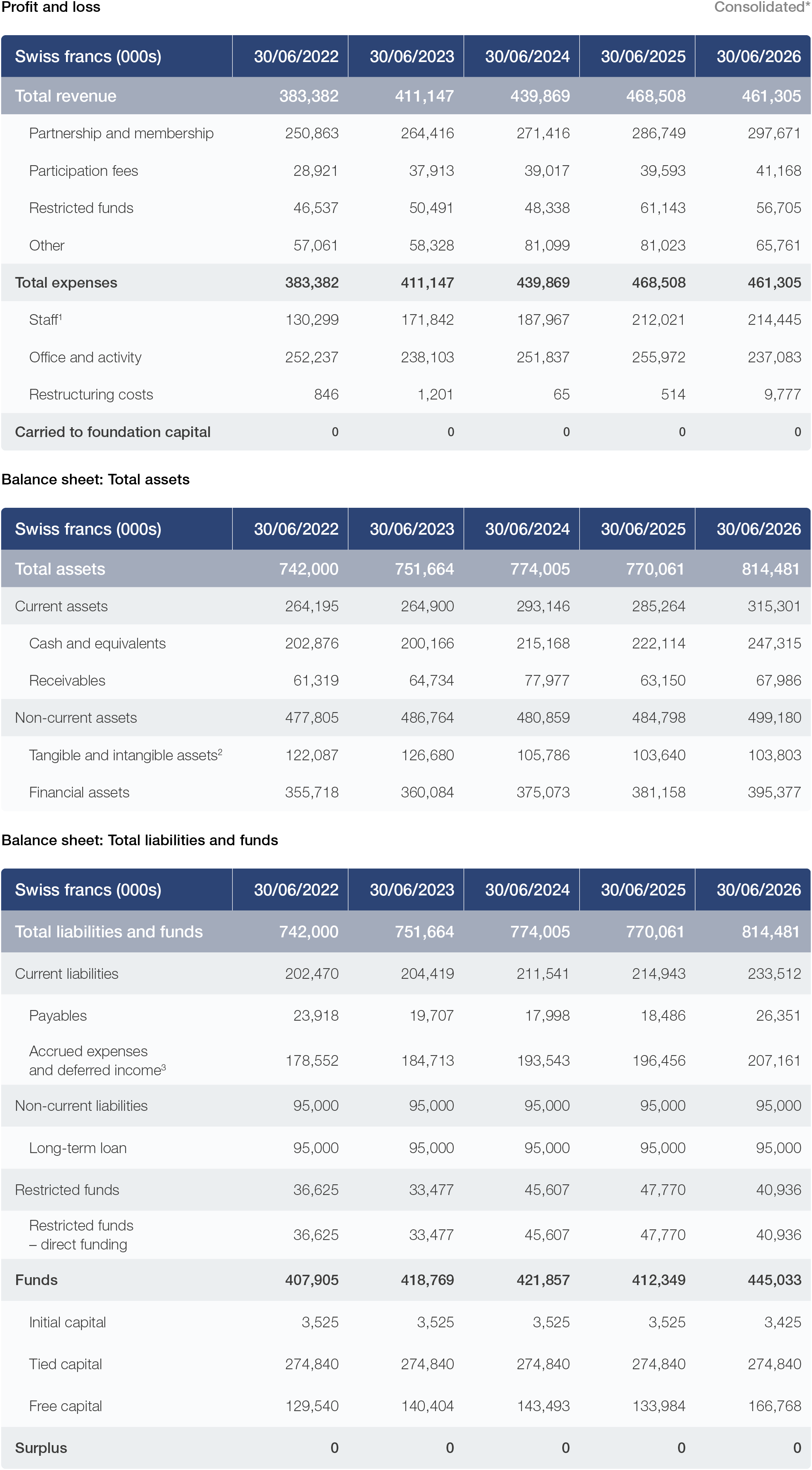

1 Staff costs include salaries, social costs and other staff expenses
2 Tangible assets: land, property, equipment, IT hardware and software. Intangible assets: IT development
3 Accrued expenses: provision for activity costs, provision for staff. Deferred income: membership, partnership and registration income deferral
*The consolidated figures above include figures from the World Economic Forum and the World Economic Forum LLC as of 1 January 2017. Also, as of 1 July 2019, consolidation includes the World Economic Forum Japan and other related foundations (Young Global Leaders Foundation, Schwab Foundation for Social Entrepreneurship, Global Shapers Community Foundation). The World Arts Forum Foundation was deconsolidated in 2026.
Notes to the financial statements
Presentation
The World Economic Forum is an independent, not-for-profit organization founded in Switzerland, integrating leaders from business, governments, academia and society at large into a global community committed to improving the state of the world.
The World Economic Forum connects leaders from business, government, civil society, international organizations, academia and the next generation to make sense of global challenges and move the world forward together.
As an independent, not-for-profit organization founded in Switzerland, the Forum provides valuable foresight and creates trusted spaces, both physical and digital, where diverse perspectives can be heard and relationships built, allowing a common understanding to emerge.
The Forum hosts a range of meetings, which provide space for trust-based dialogue, collaboration and public engagement. Through its centres and communities, it convenes stakeholders, generates insights and helps translate insights into action.
The World Economic Forum is based in Geneva, Switzerland. It has representative offices in San Francisco and New York City (United States), Beijing (China), Mumbai (India) and Tokyo (Japan). The financial statements will be approved by the Board of Trustees on 18 August 2026.
Significant accounting policies
Basis of preparation
The presentation of the consolidated financial statements of the World Economic Forum (hereafter “the Forum”, the “Foundation”, “the organization”) is based on the global model of recommendations made by Swiss GAAP FER (Accounting and Reporting Recommendations – in compliance with the conceptual framework, core FER and other Swiss GAAP FER). The presentation provides a true and fair view of the organization’s assets, financial position and results. The financial statements have been prepared on a going concern basis.
The consolidated financial statements are presented according to the principles of historical cost and presented in CHF (Swiss francs). The consolidated financial statements also comply with Article 83a of the Swiss Civil Code and the Foundation’s statutes.
The presentation and evaluation principles are the same as in previous fiscal years. There have been no significant changes in the hypotheses or estimates used in the annual consolidated financial statements.
The main accounting rules used in the preparation of the Forum’s consolidated financial statements are described below.
Consolidation of Swiss Foundations
After reviewing the existing contractual relationships between the Forum and the Swiss Foundations, the organization concluded that it has control over the Swiss foundations. As a result, the Swiss foundations have been part of the scope of consolidation since 2020.
Method of consolidation
The consolidated financial statements include the accounts of the Forum and the entities it controls, as listed in the scope of consolidation. Control exists when the Forum is exposed to, or has rights to, variable returns from its involvement with the entity and has the ability to affect those returns through its powers over the entity.
Entities included in the scope of consolidation
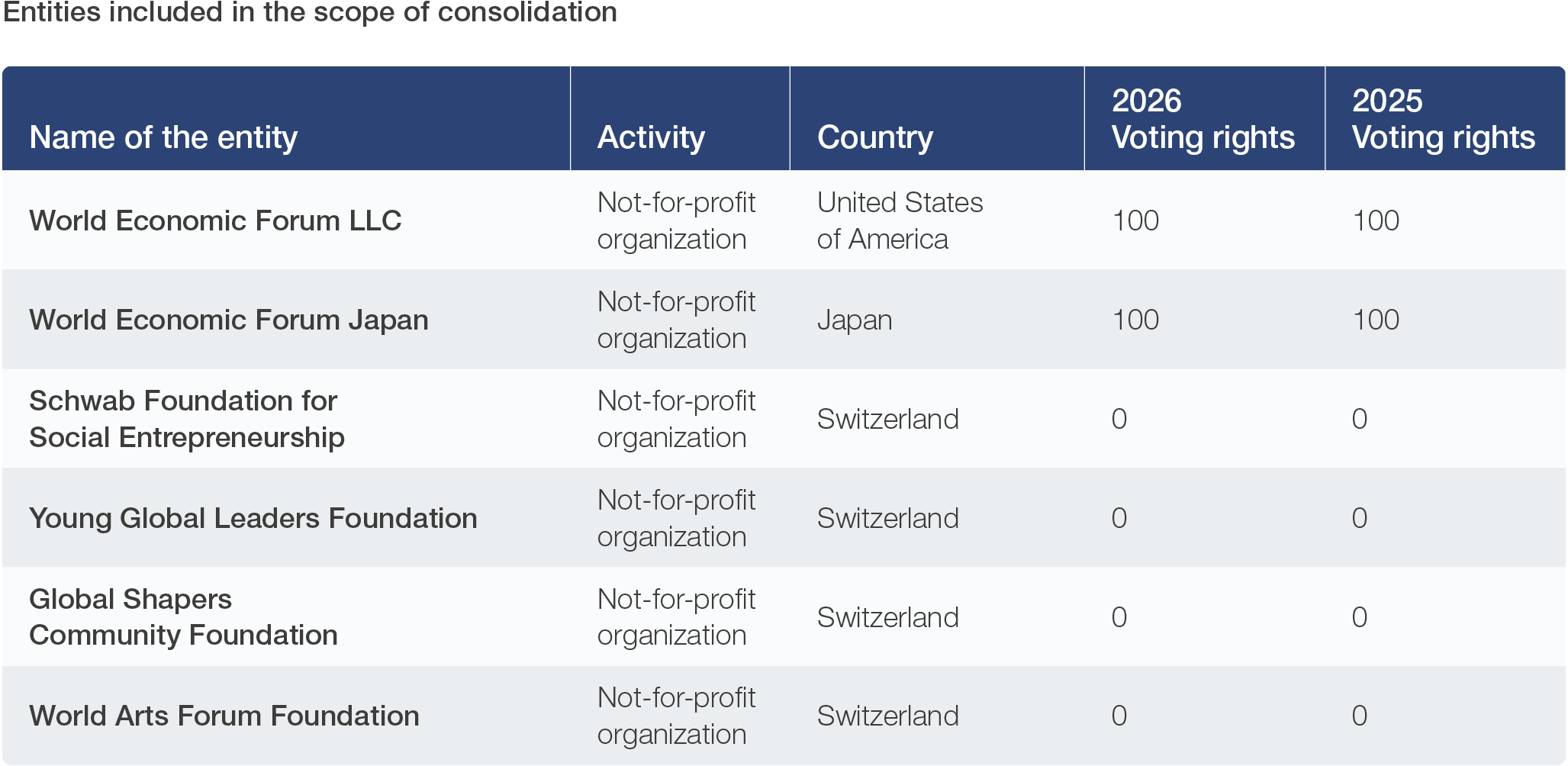

The Forum fully consolidates entities in which it exercises exclusive control, either directly or indirectly.
The assets and liabilities of its controlled entities, together with the expenses and income, are included in full in the annual consolidated accounts.
Any minority interests in the net funds and the results are presented separately in the consolidated balance sheet and the consolidated profit and loss statement. Under the unity principle, the minority interests are included in the funds.
Intercompany balances, expenses and income are eliminated upon consolidation.
The consolidated financial statements have been prepared for the first time for the year ended 2017.
The World Economic Forum LLC has been consolidated for the period in which the Forum exercises its control, thus since 1 January 2017.
The World Economic Forum Japan was registered and affiliated in 2019 by the World Economic Forum and thus was consolidated for the first time for the year ended 2019.
The financial statements for the year ended 30 June 2026 for the Schwab Foundation for Social Entrepreneurship, the Young Global Leaders Foundation and the Global Shapers Community Foundation, as included in these consolidated financial statements, are based on information provided by each entity. They have not yet been approved by their respective Boards of Foundation as of the date of approval of these consolidated financial statements.
Change to the scope of consolidation
Following the resolution of the World Arts Forum’s Board to terminate the convention agreement with the Forum, the World Arts Forum was deconsolidated in 2026 and now falls outside the Forum’s consolidated financial statements.
Foreign currency
The elements included in the Forum’s financial statements are measured in the currency that best reflects the economic reality of the transaction. The accounts are presented in CHF, which is the Forum’s functional currency.
Transactions in foreign currencies
Transactions in foreign currencies are converted to the functional currency at the opening rate of the current month and provided by the Swiss Administration for foreign currencies. At the closing date, balance sheet items denominated in foreign currencies, with the exception of the Funds, are revaluated to the functional currency using the spot exchange rate on the last day of the month, as provided by the Swiss Federal Administration. Exchange gains and losses arising from the settlement of transactions and from the re-evaluation in foreign currencies are posted to the profit and loss statement.
Conversion into Swiss francs
The consolidated accounts are prepared and presented in CHF. The controlled entities express their financial statements in local currency. The individual items in the profit and loss statements, as well as the cash flow statements of the foreign entities, are converted into the functional currency at the average exchange rate for the year published by the Swiss Administration for foreign currencies. The balance sheet items (with the exception of the Funds) are converted into the functional currency at the spot rates published by the Swiss Administration for foreign currencies. The conversion differences resulting from the translation of the balance sheet items have no effect on the profit and loss statements and are recognized in the Funds along with the translation differences on the profit and loss statement arising from the difference between the average and the year-end exchange rate.
Significant accounting judgements, estimates and assumptions
The preparation of the Forum’s financial statements requires management to make judgements, estimates and assumptions that affect the reported amounts of revenue, expenses, assets and liabilities, and the accompanying disclosure of contingent liabilities. Uncertainty about these assumptions and estimates could result in outcomes requiring a material adjustment to the carrying amounts of assets or liabilities, which would be recognized in future periods.
i) Judgements
In the process of preparing those financial statements, management made the following judgements:
ii) Estimates and assumptions
The key assumptions concerning the future and other key sources of estimation uncertainty at the reporting date, that have a significant risk of causing a material adjustment to the carrying amounts of assets and liabilities within the next financial year, are described below. The organization based its assumptions and estimates on parameters available when the financial statements were prepared. Existing circumstances and assumptions about future developments, however, may change due to market changes or circumstances arising that are beyond the organization’s control. Such changes are reflected in the assumptions when they occur.
Impairment of non-financial assets
Impairment exists when the carrying value of an asset or cash generating unit exceeds its recoverable amount. The fair value of the category “buildings” is determined by an expert every five years, based on available data from binding sales transactions conducted at arm’s length for similar assets, or on observable market prices, less the incremental costs of disposing of the asset.
Allowance for doubtful account
The organization computes its provision for allowance on doubtful accounts based on the ageing of its trade receivables. All trade receivables at the balance sheet date older than 180 days are fully provisioned, including some invoices for which the probability of collection is low and that pose a risk to debt. Systematic risks, in addition to external factors, can arise, which may change assumptions and future developments. These are beyond the Forum’s control.
Cash and short-term cash deposits
This item represents assets in current accounts and short-term cash deposits. These transactions are recorded at the exchange rate prevailing at the time of the transaction. These items are revalued at the year-end at the closing rate.
Receivables
Receivables are recorded at the amount originally invoiced. Bad debt allowance is established based on a review of open items at the end of the period, in accordance with the allowance for doubtful accounts. Amounts that are definitively unrecoverable are written off.
Prepaid expenses/accrued revenues
This position includes the prepaid expenses relating to the following accounting period, as well as accrued revenue.
Investments securities
Securities are valued at acquisition cost less impairment. Provisions for unrealized losses are booked if required. Gains are recognized when securities are disposed of and are booked under financial income.
Realized gains and losses on disposals of investment securities are recognized in financial income and expenses, respectively, using the weighted average cost method.
Property, plant and equipment
Property, plant and equipment are recorded at historical cost, less accumulated depreciation. The depreciation method is straight-line and based on the following useful lives, by category of assets:
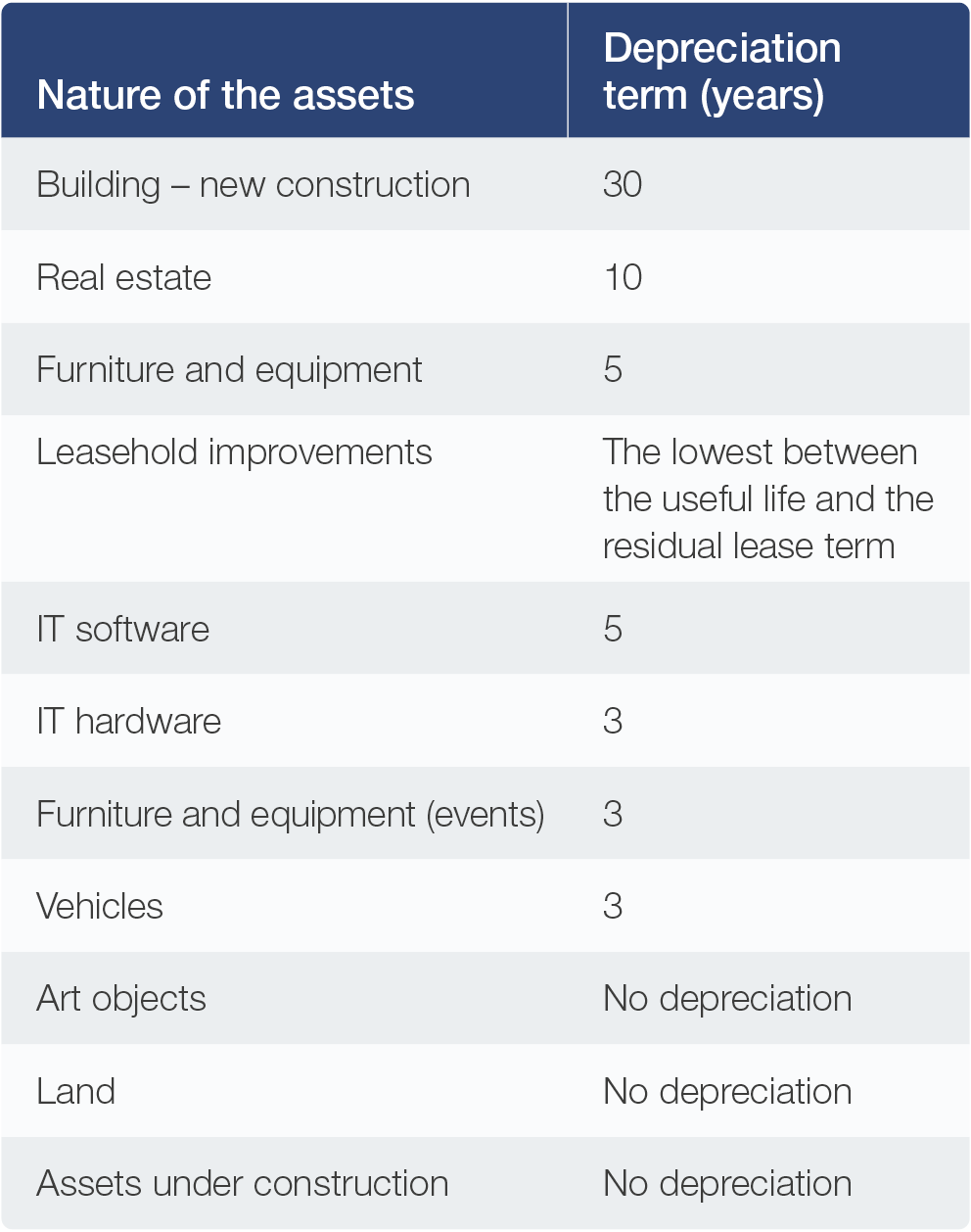

Expenses for repairs and maintenance are booked to the profit and loss statement under “expenses for equipment”. Expenses for major renovation are capitalized and amortized over the life of the element replaced, but never beyond the remaining useful life of the underlying asset. Costs of research for ongoing projects are not capitalized but expensed when incurred.
The Foundation tests each asset at the balance sheet date, and any impairment is recognized if necessary.
The tests are performed in a cyclic manner on the basis of 10 years for art objects and 5 years for land and buildings.
Intangible assets
Research costs are expensed as incurred. Development expenditures on an individual project are recognized as an intangible asset, also called “ICT”, when the organization can demonstrate the following:
- The intangible asset is identifiable and controlled by the organization
- The ability to measure the expenditure reliably during development
- How the asset will generate future economic benefits over several years
- The availability of resources to complete the asset
The Forum capitalizes costs for product development projects. Initial capitalization of costs is based on management’s judgement that technological and economic feasibility is confirmed, usually when a product development project has reached a defined milestone according to an established project management model. In determining the amounts to be capitalized, management makes assumptions such as determining the percentage of time spent by some of its employees and consultants on development activities that are eligible for capitalization or the expected future cash generation and benefits of the projects.
Intangible assets are included at their historical value, reduced by depreciation. The depreciation method is straight-line and based on a standard useful life of 2 to 3 years. Amortization of the asset begins when development is complete, and the asset is available for use. The carrying value of the intangible assets is tested for impairment annually.
Accrued liabilities
This item includes expenses payable relating to the current period, for which the invoice was not received at year-end and will only be paid in the following period.
Provisions
A provision is booked when the Foundation has a probable obligation that is based on a past event, and its amount and/or its due date are uncertain but can be estimated. This obligation gives rise to a liability.
Loans and derivatives
Loans from credit institutions are recognized at their nominal value. Debt issuance costs are amortized over the term of the debt. They are classified as current liabilities unless the settlement of the liability is deferred for at least 12 months after the reporting date.
The risk surrounding the fluctuation of foreign exchange rates and interest rates is hedged using derivative financial instruments. Following the Swiss GAAP FER framework, the organization uses the off-balance sheet method whereby the hedging instruments are disclosed in the notes without being recognized in the balance sheet. Financial derivatives become favourable (assets) or unfavourable (liabilities) as a result of fluctuations in market interest rates or foreign exchange rates relative to their terms. The fair value of publicly traded derivatives, securities and investments is based on quoted market prices at the reporting date.
Revenue
Revenue is recognized when there is persuasive evidence that an arrangement exists, and risks and rewards are transferred. The amounts are posted to the statement of income, net of taxes.
Pension plan
The Foundation covers the costs relating to the professional pension for all its workers, as well as their assignees, under the legal prescription. The pension plan is covered by Swiss Law in accordance with the Forum’s statutes.
The pension obligation and the plan assets are managed by a legally independent pension fund. The organization, the management and the financing of the pension plans are governed by the law (LPP), together with the deed of foundation and the regulations applicable to pensions in force.
Transactions with related parties
According to Swiss GAAP RPC 15, the following foundations are considered related parties:
- Schwab Foundation for Social Entrepreneurship
- Young Global Leaders Foundation
- World Arts Forum Foundation
- Global Shapers Community Foundation
- World Economic Forum LLC
- World Economic Forum Japan
- Members of the Board of Trustees
- Members of the Managing Board
- Members of the Executive Committee
- Members of the Audit and Risk Committee
- Fonds de prévoyance en faveur du personnel du World Economic Forum
Agreements were signed with some of these related parties, such as the Schwab Foundation for Social Entrepreneurship, Young Global Leaders Foundation, World Arts Forum Foundation and Global Shapers Community Foundation, stating that the World Economic Forum will cover any deficit.
All other transactions between the parties are conducted at arm’s length.
Following the resolution of the World Arts Forum’s Board to terminate the convention agreement with the Forum, the World Arts Forum Foundation is not considered a related party in 2026.
Donations
Institutional donations:
- These are funds that are committed by a written donation agreement to the Forum and are recorded in full in the profit and loss statements as donations in the year the commitment is made. All donations received where use is limited by restrictions, donor-imposed purpose or time restrictions have been classified as restricted funds and are recognized as income up to the level of expenses incurred on the project during the year under the category “Restricted funds”. The Forum can also voluntarily designate funds for specific purposes or for internal projects.
- Foreign currency exchange gains and losses realized between the date of the written donation agreement and the date of the actual receipt of cash and those unrealized at the date of the statement of the financial position are recorded in the profit and loss statement.
Individual donations:
- These are accounted for on a cash basis, given their relative size and significance.
Risk management policy
Risk assessment
To satisfy the requirements of an internal control system, the Forum operates a continuous review of risk and control through various independent institutional review and governance organs such as the Board of Trustees, Governing Board, Audit and Risk Committee and Statutory Audit under Swiss Law.
Internally, the Forum is governed by the Managing Board under the leadership of the President and CEO, Alois Zwinggi.
Internal functions such as the Engagement Leadership Team and Technology Steering Group safeguard the suitability and eligibility of partners and members and review project activities.
Management of exchange risk exposure
The Swiss franc is the functional currency of the Foundation. The Forum receives its revenue in Swiss francs and US dollars. Most expenses are in Swiss francs, and a minority are in euros and US dollars. The exchange risk exposure is very low on the organization’s day-to-day activities, and the gains and losses generated are posted in the profit and loss statement. Nevertheless, the exchange risk is high, given that the Forum borrowed the equivalent of CHF 95 million in US dollars. As a result, the organization entered into a cross-currency interest swap to hedge its exposure.
Management of interest rate risk
The Foundation has high exposure to interest rate fluctuations, as it pays floating interest rates on its two separate debts. Nevertheless, the organization entered into a cross-currency interest rate swap to hedge its exposure, leading the Foundation to pay a fixed rate.
Management of liquidity risk
The Foundation is exposed to this risk in the event of a default by certain counterparties or refinancing problems. The liquidity is proactively supervised to ensure that the Foundation can cover its obligation at all times.
Market risks
The Foundation has a low exposure to market risks given the diversity of its revenues.
Change of accounting policies
There was no change of Swiss GAAP RPC, either effective or published, during the year. Annual Report 2025–2026 Annual Report 2025–2026 Financial statements Financial statements