International Women’s Day: Progress made, but gender equality still out of reach

Women are closer to equality than ever - but global parity is still 123 years away. Image: Unsplash/ThisisEngineering RAEng
Listen to the article
- 8 March is International Women’s Day, celebrating women’s achievements and calling for gender equality.
- The UN theme for 2026 is ‘Rights, justice, action - for all women and girls’.
- At the current pace, gender parity is still 123 years away, according to the World Economic Forum’s Global Gender Gap Report 2025.
"Women and girls have never been closer to equality, and never closer to losing it."
So says UN Women as it prepares for the 70th session of the Commission on the Status of Women (CSW70) at the UN headquarters in New York from 9-19 March.
With less than five years to achieve the Sustainable Development Goals (SDGs) by 2030, SDG 5 – which calls for the world to "Achieve gender equality and empower all women and girls" – is central to achieving the others.
But, according to the World Economic Forum's latest annual Global Gender Gap Report, it will take another 123 years to reach gender parity.
The continued fight for women’s rights is marked by the UN each year on 8 March – International Women’s Day (IWD) – and the theme this year is: 'Rights. Justice. Action. For ALL women and girls', with a laser focus on fixing broken justice systems at CSW70.
"Justice systems are under strain. Conflict, repression, and political tensions are weakening the rule of law. The result – women and girls have just 64% of the legal rights of men," says UN Women.
"Women are turned away, not believed, revictimized, or priced out of legal support. Equality never arrives."
A history of International Women’s Day
IWD, now celebrated as a national holiday by countries across the globe, began life as National Women’s Day in the United States back in February 1909. The following year, in Copenhagen, Denmark, women’s rights activist Clara Zetkin called for an International Women’s Day to further their demands for equal rights.
International Women’s Day was marked for the first time in March 1911 – and the date was fixed as 8 March in 1913.
On 8 March 1914, there was a women’s suffrage march in London, calling for women’s right to vote, at which high-profile campaigner Sylvia Pankhurst was arrested.
The UN celebrated it for the first time in 1975, and in 1996, it announced its first annual theme: "Celebrating the Past, Planning for the Future".
On the centenary in 2011, the sitting US president, Barack Obama, called for March to be known as Women’s History Month. He said: “History shows that when women and girls have access to opportunity, societies are more just, economies are more likely to prosper, and governments are more likely to serve the needs of all their people.”
UN Women has a timeline of women's rights from 1848 to 2026 here.
CSW70 is the UN's largest annual forum dedicated to gender equality and women’s rights - and its outcomes influence laws, policies, funding and accountability across countries and generations.
You can follow the full programme of events here.
What is the state of global gender parity?
Many countries across the Europe and Central Asia region have improved their gender equality legislation, particularly laws addressing violence against women, says UN Women. But a new report shows there are still significant gaps in ensuring real access to justice for women and girls.
UN Women and the UN's Department of Economic and Social Affairs jointly publish an annual update on the progress towards SDG5.
In the latest – The Progress on the Sustainable Development Goals: The Gender Snapshot 2025 – they warn that if current trends continue, 351 million women and girls will still be living in extreme poverty in 2030 and the SDG 5 will not be achieved.
But investing in closing the gender digital divide could benefit 343.5 million women and girls, lifting 30 million women and girls out of poverty by 2050 and boosting GDP by $1.5 trillion by 2030.
The Forum’s Global Gender Gap Index 2025 showed that no economy had yet reached gender parity, but each of the top 10 ranked economies has closed at least 80% of their gender gaps.
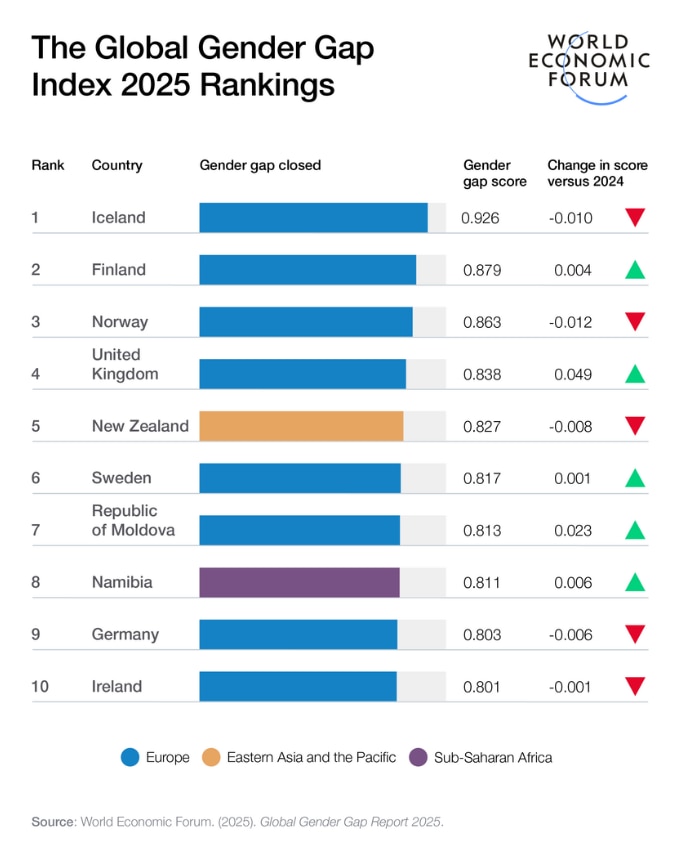
The index benchmarks 148 countries across four key dimensions (Economic Participation and Opportunity, Educational Attainment, Health and Survival and Political Empowerment) and tracks progress towards closing gender gaps over time.
The Health and Survival gender gap has closed by 96.2%, the Educational Attainment gap by 95.1%, the Economic Participation and Opportunity gap by 61.0% and the Political Empowerment gap by 22.9%.
How to close the global gender gap?
Last year marked the 30th anniversary of the UN's Beijing Declaration and Platform for Action – the blueprint for women’s and girls’ rights adopted by 189 governments in 1995.
This year, the UN is calling for justice for all women and girls, with nine actions to end violence against women and make workplaces safer:
- End impunity.
- Hold perpetrators accountable. Every. Time.
- Listen to survivors. Act early. Enforce rights!
- Build justice systems women can reach, navigate, and trust.
- Fund legal aid.
- Remove discriminatory laws.
- Confront bias head on anywhere decisions are made.
- Invest in prevention, protection, and repair.
- Stand with the women and organizations pushing systems to change – because justice only moves when people demand it and we are all better off in a just society.
Advancing women’s employment could add $12 trillion to global GDP and boost some countries' economic output by as much as 35%, the Forum finds.
At the Annual Meeting at Davos in 2024, the Forum launched its Global Gender Parity Sprint 2030 as a platform to bring together governments and organizations to accelerate global efforts towards achieving economic gender parity over the next five years.
The Sprint focuses on inspiring action across sectors through heightened visibility, impactful initiatives to advance gender parity in the workforce, senior leadership and pay, and new evidence at the frontier of the tech, green and care transitions.

As part of the Sprint, the Forum’s Gender Parity Accelerators are tackling these challenges in 17 economies, including Argentina, Australia, Bahrain, Chile, Colombia, Costa Rica, Dominican Republic, Ecuador, Egypt, Guatemala, Honduras, Japan, Jordan, Kazakhstan, Kenya, Mexico and Panama.
These accelerators have so far supported more than 1 million women in accessing economic opportunities and are mobilizing resources to address systemic barriers to gender parity.
You can read more about the impact of the Gender Parity Accelerators here.
This article has been updated.
Don't miss any update on this topic
Create a free account and access your personalized content collection with our latest publications and analyses.
License and Republishing
World Economic Forum articles may be republished in accordance with the Creative Commons Attribution-NonCommercial-NoDerivatives 4.0 International Public License, and in accordance with our Terms of Use.
The views expressed in this article are those of the author alone and not the World Economic Forum.
Stay up to date:
SDG 05: Gender Equality


Forum Stories newsletter
Bringing you weekly curated insights and analysis on the global issues that matter.
More on Equity, Diversity and InclusionSee all

Martin Jacob
February 17, 2026


