This is why saving the ocean isn’t just an environmental imperative

The ocean economy has grown rapidly in the last 25 years, doubling in real terms from 1995-2020, according to the OECD. Image: Unsplash/Ivan Bandura
- The third UN Ocean Conference takes place in France from 9-13 June.
- The event focuses on the implementation of Sustainable Development Goal 14.
- Data shows that protecting the ocean is not just an environmental imperative but also an economic one.
More than 30% of the world’s fish stocks are overexploited, and ocean health is declining faster than ever, according to the United Nations (UN). Against this urgent backdrop, the third UN Ocean Conference (UNOC) will bring together global leaders, scientists and innovators in Nice, France, from 9-13 June 2025.
Co-hosted by France and Costa Rica, the summit aims to accelerate action and unite all stakeholders behind Sustainable Development Goal (SDG) 14: Life Below Water. As UN Secretary-General António Guterres has warned: “Our failure to care for the ocean will have ripple effects across the entire 2030 Agenda.” The conference theme – ‘Accelerating action and mobilizing all actors to conserve and sustainably use the ocean’ – directly reflects the mandate of SDG 14 to safeguard marine resources.
The World Economic Forum is supporting the UNOC’s organizers by facilitating private sector engagement, with a focus on working towards a regenerative blue economy. Ahead of this pivotal summit, here’s what you need to know and why it matters.
The first two UNOCs
UNOC was established to accelerate public-private collaboration and boost action to implement SDG14 – “Accelerating action and mobilizing all actors to conserve and sustainably use the ocean.” The first conference, co-hosted by Sweden and Fiji, took place in New York in 2017.
It made a 14-point call for action and saw three key outcomes, according to the SDG Knowledge Hub:
- An intergovernmentally agreed Call for Action
- A registry of 1,328 voluntary commitments
- Key messages from its partnership dialogues.
The second conference, co-hosted by Portugal and Kenya in Lisbon, Portugal, aimed to build on this momentum. UN Special Envoy for the Ocean, Peter Thomson, said at the time it would “be about providing solutions to those problems”.
It resulted in a Political Declaration that urged urgent action to tackle existing and future threats, while acknowledging collective failure up until that point to achieve several SDG 14 targets.
The world’s largest ecosystem … and central to the global economy
So why does it matter? The ocean is the world’s largest ecosystem, but it is facing a series of significant threats and challenges.
From ocean acidification to plastic pollution and overfishing, the range of issues is broad. As a result, action requires close collaboration between a wide range of stakeholders to manage this myriad of threats.

But the ocean is more than just a natural resource — it’s a life-support system for the planet. It regulates climate, produces oxygen, stores carbon and supports biodiversity.
Protecting it is not only a matter of sustainability, but of survival.
Addressing ocean degradation benefits both nature and human wellbeing. The ocean plays a major role in global food security, trade, and livelihoods, and its protection must go hand-in-hand with inclusive economic development.
Take jobs, for example. OECD data from 2025 shows that over 100 million full-time equivalent jobs are sustained by the global ocean economy. And while there was a drop as a result of the COVID-19 pandemic, this is a consistent picture since the mid-1990s.
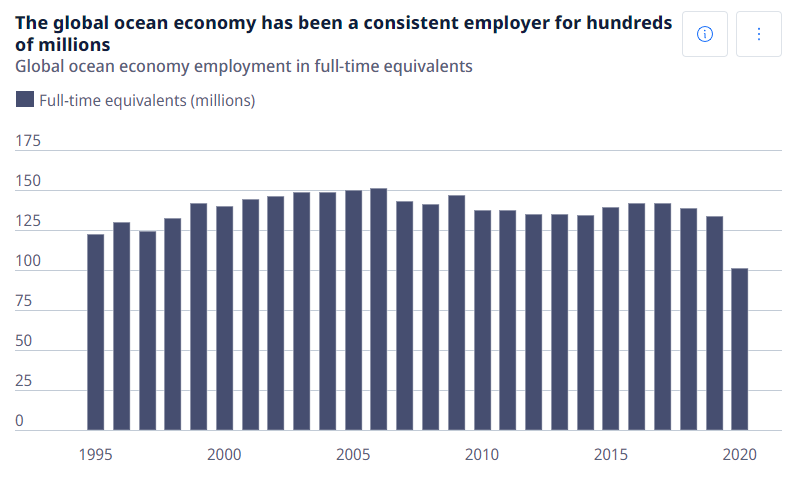
Add to this its role in global trade – an estimated 90% of world trade is transported by ship – and its critical contribution to food security for millions, and the ocean’s significant impact on the global economy becomes clear.
A growing ocean economy
The ocean economy has grown rapidly in the last 25 years, doubling in real terms from 1995-2020, according to the OECD.
The key drivers of this growth are countries in Asia and the Pacific, with Eastern Asian nations accounting for 56% of the expansion alone. Tourism is a key industry driving the ocean economy, but offshore wind and marine renewables are a growing sector.
The biggest employer, by far, is tourism.
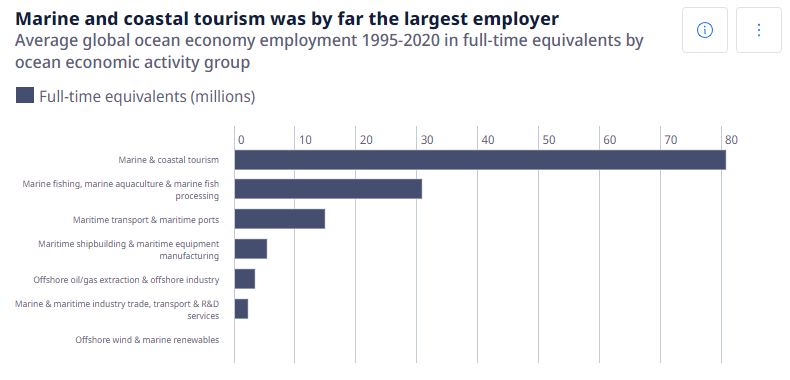
However, ocean-based industries must now pivot to ensure they support rather than deplete marine ecosystems. The OECD warns that growth in the ocean economy could slow or even reverse if policy action isn’t taken.
The risk of inaction
Taken together, the threats facing the ocean, the progress made so far, and its vital role and potential in the global economy all underscore the urgent need for action.
Today's ocean economy represents a multi-trillion-dollar investment frontier, spanning multiple sectors that depend on a healthy marine environment: renewable energy, coastal infrastructure, ports, maritime transport, sustainable fisheries, and aquaculture. The cost of inaction is simply too high and is increasing.
—Alfredo Giron, Head, Ocean Action Agenda
”Indeed, this is why the Forum’s Friends of Ocean Action – a coalition of ocean leaders – aims to fast-track solutions to these pressing challenges. Ahead of this year’s UN Conference, the community set a call to Bring it All Together for the Ocean, focusing on synergies to boost progress towards SDG14..
Ultimately, ocean conservation is about securing a healthy future for both people and the planet. If we’re going to make waves in protecting the ocean and tapping into its economic potential, it’s only going to happen through global collaboration and cooperation.
Don't miss any update on this topic
Create a free account and access your personalized content collection with our latest publications and analyses.
License and Republishing
World Economic Forum articles may be republished in accordance with the Creative Commons Attribution-NonCommercial-NoDerivatives 4.0 International Public License, and in accordance with our Terms of Use.
The views expressed in this article are those of the author alone and not the World Economic Forum.
Stay up to date:
SDG 14: Life Below Water


Forum Stories newsletter
Bringing you weekly curated insights and analysis on the global issues that matter.
More on Climate Action and Waste Reduction See all

Temidayo Akenroye and Hushneara Begum
April 10, 2026


