Markets cautious in wake of US-China trade framework, and other finance news to know
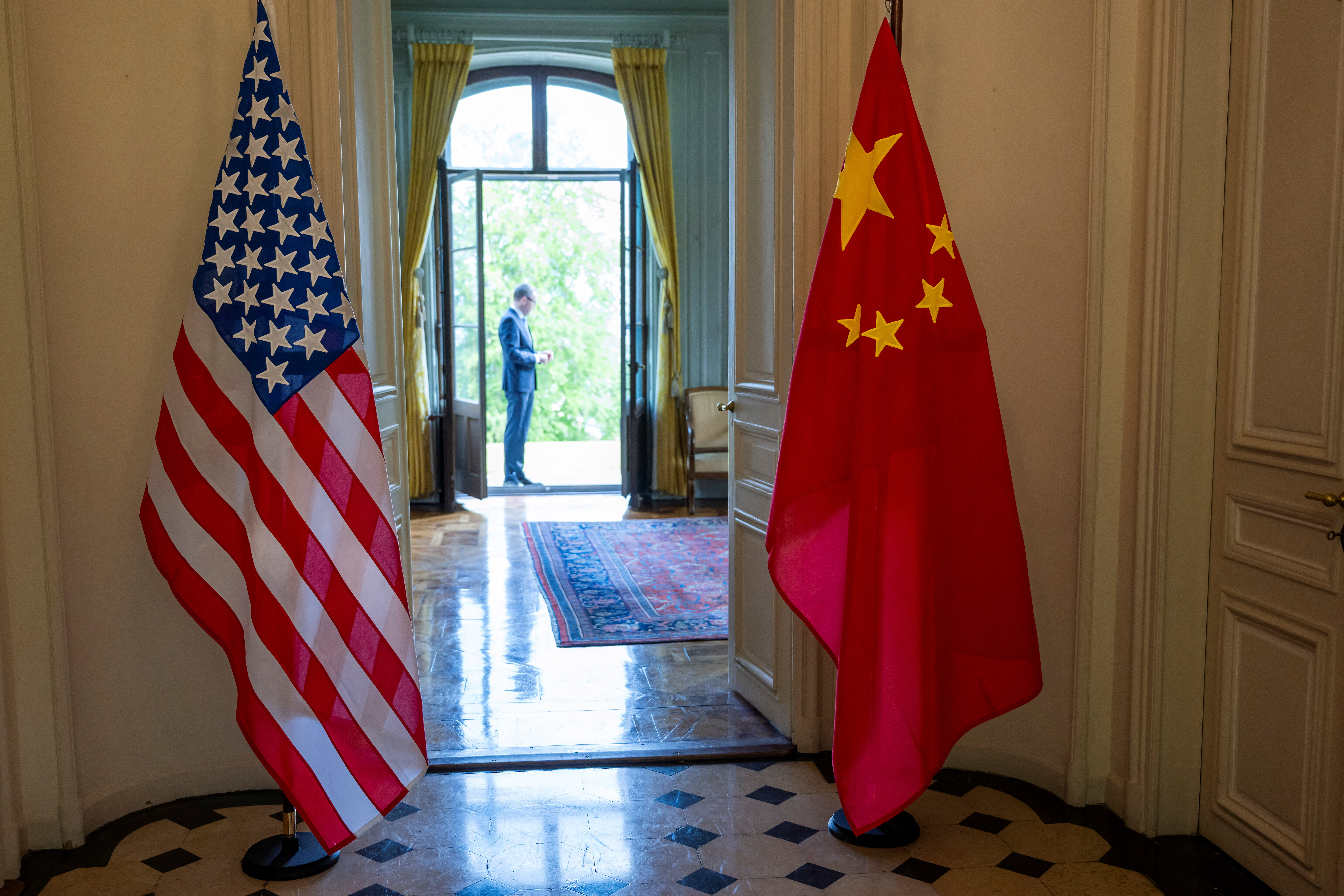
For more on the World Economic Forum's work in finance, visit the Centre for Financial and Monetary Systems. Image: REUTERS
- Catch up on the key stories and developments shaping the financial world.
- Investors react with caution to US-China trade framework update; China deflation worsens; Gold overtakes euro in global reserves ranking.
- For more on the World Economic Forum's work in finance, visit the Centre for Financial and Monetary Systems.
1. Markets cautious in the wake of US-China trade news
After two days of negotiations in London, the United States and China announced on 11 June that they had agreed on a framework for trade discussions - offering a tentative step towards easing tensions between the world’s two largest economies.
US President Donald Trump declared the trade deal "done", hours after negotiators from Washington and Beijing reached the framework agreement aimed at reviving a fragile trade truce.
He highlighted on his social media platform that China will supply critical magnets and rare earths upfront, while the US will honour agreements, including allowing Chinese students to study in American colleges. Trump stated, “We are getting a total of 55% tariffs, China is getting 10%.”
Global markets responded with caution amid a lack of concrete detail from the US-China announcement. According to CNBC, US Commerce Secretary Howard Lutnick stated that the current US tariff rate on Chinese imports, set at 55%, would not change, despite the absence of a finalized trade agreement.
But sentiment improved in the US following a cooler-than-expected inflation report, which suggested that tariff pressures may not yet be feeding through to consumer prices.
European stocks were down and Asia-Pacific markets mixed. And while the UK FTSE 100 saw its highest-ever close on 11 June, the British economy contracted by 0.3 of a percentage point in April, with exports to the US at an all-time low.

“Even though details are scant, as long as the two sides are talking, I think markets will be happy,” said Carol Kong, a currency strategist at Commonwealth Bank of Australia. “But it will still be very hard and take a long time to reach a comprehensive trade agreement.”
2. China’s producer deflation worsens amid trade tensions and housing slump
China’s producer price index plunged 3.3% year-on-year in May, marking the steepest decline in nearly two years, while consumer prices extended their fall as the economy struggled with weak demand and ongoing trade tensions with the US.
The data underscores mounting deflationary pressures driven by a prolonged housing downturn and fierce competition in sectors like automotive and coffee. Policymakers are expected to introduce further stimulus to counteract slowing growth, with retail sales and factory activity showing signs of strain.
Despite a slight uptick in core inflation, economists warn that persistent overcapacity will likely keep deflationary risks elevated through this year and next.
Bloomberg offers insights on why this deflation cycle persists:
- Weak consumer spending amid income pressures and job insecurity
- Prolonged housing market slump weighing on confidence and prices
- Regulatory tightening causing layoffs and salary cuts in tech and finance sectors
- Increased manufacturing output outpacing demand, leading to price cuts
- Intensifying price wars in key industries like automotive
- Cautious government stimulus avoiding heavy debt-fuelled measures
- Ongoing US tariffs dampening export growth and adding to price pressures.
Reuters reports that hefty discounts extend to luxury goods, with second‑hand stores marking items down by up to 90% - reflecting shifting consumer behaviour and signalling deeper deflationary trends.
3. More finance news to know
US regulators have extended the deadline for new data reporting rules for private fund advisers - just one day before they were set to take effect. The rules are intended to strengthen oversight of the rapidly growing sector, which has underperformed large-cap US stocks for the first time in nearly 25 years amid a slowdown in private equity deal-making.
Investors are turning to silver and platinum as alternatives to gold and as hedges against a weakening US dollar, pushing both metals sharply higher, reports the Financial Times. With gold up 25% this year and seen by some as overvalued, silver has jumped to a 13-year high and platinum to a four-year peak, each gaining over 10% this month.
However, gold remains a dominant force in global reserves, having overtaken the euro as the world’s second-most important reserve asset, according to the European Central Bank. Bullion made up 20% of official holdings last year - surpassing the euro’s 16% and trailing only the US dollar at 46% - driven by record central bank purchases and soaring prices.
India’s National Stock Exchange has won approval to launch electricity futures, following similar clearance this month for the Multi Commodity Exchange. The contracts aim to help power utilities manage costs more efficiently, as distribution companies face $9.5bn in unpaid dues from expensive long-term deals and infrastructure losses.
Crypto assets could soon pose a serious threat to global financial stability, Klaas Knot, the outgoing chair of global watchdog the Financial Stability Board has warned. Speaking in Madrid, Knot said stablecoin issuers now hold substantial amounts of US Treasuries - a development that "must be monitored closely" - as regulatory pressure builds in both the US and Europe, reports Bloomberg.
Oil edged lower after surging over 4% on 11 June, driven by rising tensions in the Middle East and US trade policy shifts. Brent slipped toward $69, while West Texas Intermediate fell below $68, after Iran threatened US bases and Washington evacuated some embassy staff from Iraq.
4. Read more on Forum Stories
With backing from the European Commission and ECB, Bulgaria may soon join the eurozone - potentially by January 2026. As the bloc prepares to welcome its 21st member, the Forum's Digital Editor Spencer Feingold explores how this signal a broader shift in the euro’s global role.
In the following video, learn more about tokenization and its role in simplifying investing:
Can better sustainability data future-proof your business? With 85% of executives moving ahead on sustainability disclosures, unified reporting is becoming a strategic priority. But amid regulatory delays - like the EU’s postponed CSRD rollout - how can companies maintain clarity and resilience in a volatile global market?
License and Republishing
World Economic Forum articles may be republished in accordance with the Creative Commons Attribution-NonCommercial-NoDerivatives 4.0 International Public License, and in accordance with our Terms of Use.
The views expressed in this article are those of the author alone and not the World Economic Forum.
Related topics:

Forum Stories newsletter
Bringing you weekly curated insights and analysis on the global issues that matter.
More on Financial and Monetary SystemsSee all

Matt Strahan and Daniel Murphy
April 9, 2026


