Leaders will soon be managing AI agents – these are the skills they'll need, according to experts

Employers expect 39% of key skills required in the job market will change by 2030. Image: Getty Images
- Artificial intelligence experts predict a future where humans will be managing AI agents as 'digital workers'.
- But what skillset will those managers need when working with AI?
- From prompting to trust, training to soft skills, three experts share their views.
"Very soon, I think the valuation metric for a good manager will be: How many digital workers can you manage? That's a different skill set. It's about how you can prompt your agents to do the best work they can do.”
So says Wang Guanchun, Chairman and CEO of Laiye, a Chinese company that creates AI agents or 'digital workers' to carry out tasks including lead generation and candidate screening.

He was speaking at the World Economic Forum's 'Summer Davos' event in China, in a session on Building an Agentic Economy.
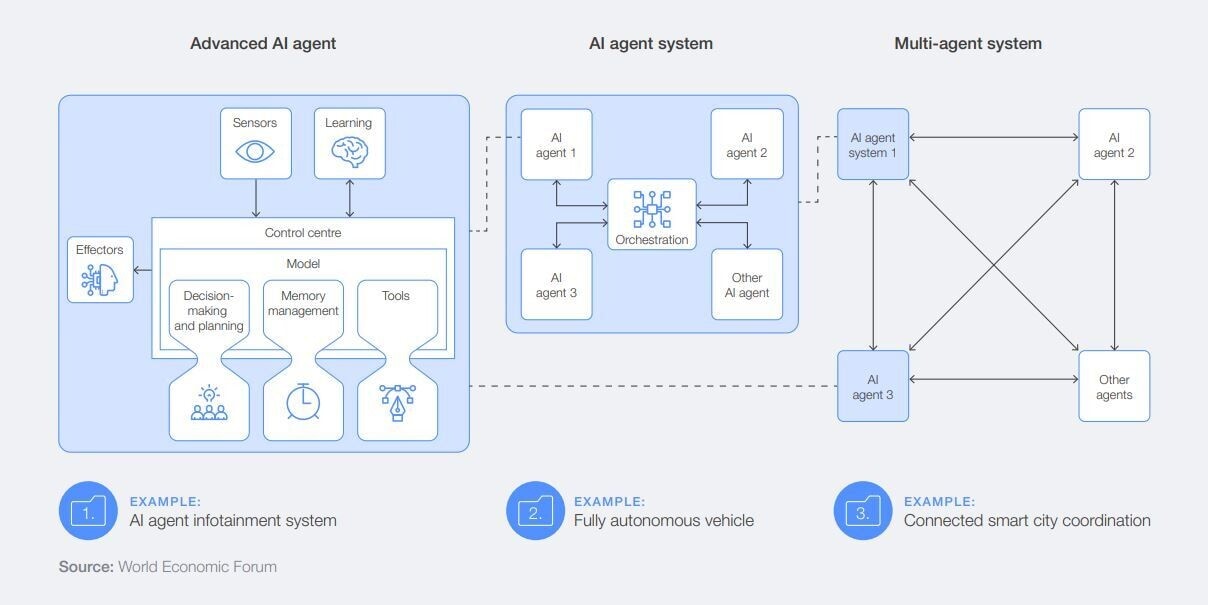
Although they use generative AI, AI agents are different because they can actually perform tasks, rather than merely producing something.
So, for example, AI agents can write code or book your next holiday – chatting to an AI agent working for a travel company to secure the best deal.
In future, 'multi-agent systems' will be able to collaborate and communicate to get things done, and we may also see 'embodied agents'.
Nvidia CEO Jensen Huang said in October 2024 that he hopes the company will one day employ 50,000 people, working with 100 million agents.
"AIs will recruit other AIs to solve problems. AIs will be in Slack channels with each other, and with humans," Huang said. "We'll just be one large employee base, if you will – some of them are digital and AI, and some of them are biological."
But if we're already entering an era where we'll be managing those AI agents and systems, what skills will we need?
We spoke to three experts to find out.
How the Forum helps leaders make sense of AI and collaborate on responsible innovation
Checking after prompting is vital
The founder and CEO of Women in Tech Global, Ayumi Moore Aoki, says prompting is the core skill for managing AI: learning to define your question in a way that can be easily comprehended.
"But most importantly, you have to verify the answer. Don't take anything that's just given to you as if it were the truth. Check the answer and check the data where the answer was from. I know it's a lot of work, but honestly, it's so important."

Even in her own research work, Moore Aoki says she finds AI tools are hallucinating.
"I would say, 'give me the top academic papers in this field and the references'. But if you click on it and you go look at the data, it doesn't exist. It was false.
"So you have to check every single step ... I try to find the source of the data and interpret it myself. Sometimes our data is dirty, you can make it say so many different things, so finding the core and making your own decisions about it, your own reflections, is super important."
There is a huge risk from not checking sources, she adds.
"Misinformation can lead to drastic consequences because if you are making decisions with wrong information, then things can get bad."
Learning boundaries of trust
Babak Hodjat is the CTO AI at Cognizant, which has just open-sourced The Neuro AI Multi-Agent Accelerator to enable businesses to scale collaborative agent networks.
"I think the most important skill is going to be getting over our fear and being able to express what we expect from these systems and also to learn that boundary of trust. So how much and when can we trust these systems?
"As these systems get better and better, our challenge is going be that we might over-trust them. And so that's one of the skills we'll have to learn and teach our kids – where is that boundary."
More broadly, we have to be very careful about how we define these systems, "what threshold we set for what we are comfortable allowing the agent to decide autonomously and what we're not comfortable with", Hodjat explained.
"We also need to make sure that we have safeguards. And good governance over these systems so that, as they're operating in unknown situations, we can monitor them and make sure that they're doing what we expect them to do and they're aligned with our values."
Agents are only as good as their training
An AI agent is essentially just "a piece of code", says Jarah Euston, CEO and Co-Founder of AI-powered labour platform WorkWhile, which connects frontline workers to shifts.
"It may not have the same understanding, empathy, awareness of the politics of your organization, of the fears or concerns or ambitions of the people around that it is serving.
"So managers have to be aware that the agent is only as good as how you've trained it. I don't think we're close yet to having agents that can operate without any human oversight.
"As a manager, you want to leverage the AI to make you and your team more productive, but you constantly have to be checking, iterating and training your tools to get the most out of them."
Not paying enough attention to the AI agent can be counterproductive, she warns: "If the tool isn't effective, people will stop using it, so the biggest risk is the potential loss of productivity because your organization no longer trusts or believes in the agent or the AI.
"You also have to be patient. And you have to keep changing, experimenting, testing and iterating."
Soft skills will be even more important
Employers expect 39% of key skills required in the job market will change by 2030, according to the Forum's Future of Jobs Report 2025, including AI management.
Technological skills are expected to become increasingly vital over the next five years, outpacing the growth of all other skill categories. Leading the way are AI and big data, followed closely by networking, cybersecurity and overall technological literacy.
The so-called 'soft skills' of creative thinking and resilience, flexibility and agility are also rising in importance, along with curiosity and lifelong learning.

Empathy is one skill AI agents can't learn, says Women in Tech's Moore Aoki, and she believes this will advantage women.
"AI is just prediction, there's no ghost behind the machine. It's just a formula of prediction. Whatever results they give, the human has to decide whether that answer is ethical, if it really represents society and if it represents the culture and the values of the company.
"This discernment and decision-making can be done only by humans, right? And I think women are good in making these decisions because they have empathy."
License and Republishing
World Economic Forum articles may be republished in accordance with the Creative Commons Attribution-NonCommercial-NoDerivatives 4.0 International Public License, and in accordance with our Terms of Use.
The views expressed in this article are those of the author alone and not the World Economic Forum.

Forum Stories newsletter
Bringing you weekly curated insights and analysis on the global issues that matter.


