How leveraging plastics policy in the Global North could mitigate against pollution in the South
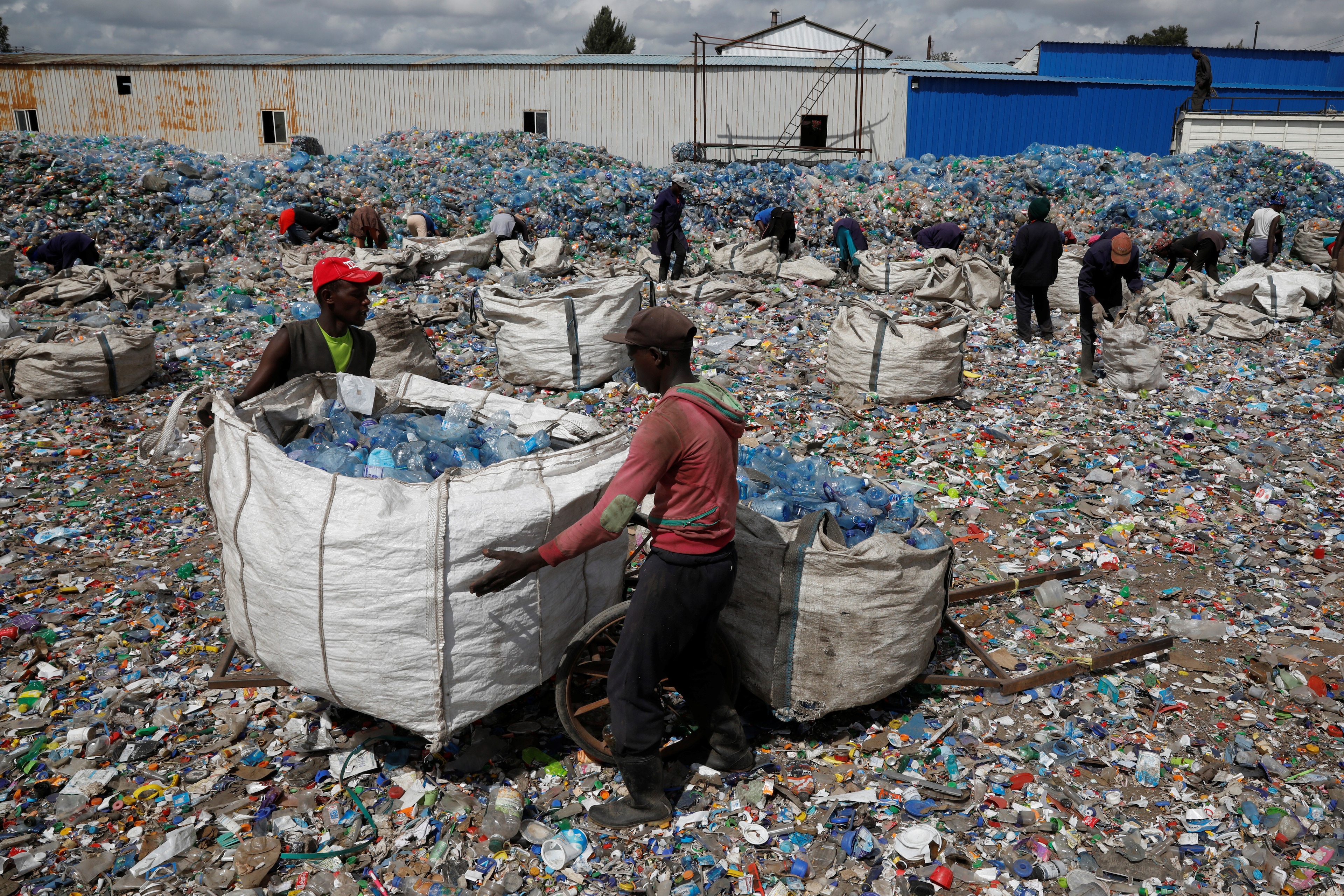
Employees sort bottles at a plastic recycling factory near Nairobi, Kenya. Image: Reuters/Baz Ratner
- Donating 10% of Extended Producer Responsibility fee on plastic pollution could help fund waste and recycling infrastructure in developing countries.
- Qualifying international approved projects would have to implement solid traceability standards capturing material flows and the role of waste workers.
- An EPR-funded global scheme would work in tandem with other plastics-related treaty mechanisms and private initiatives.
The international community is negotiating a new UN Plastics Treaty to end plastic pollution, with the sixth Intergovernmental Negotiating Committee session scheduled for August. A central piece of the treaty is Article 11, financial provisions that are meant to arrange how developed countries will provide financial resources, capacity-building and technology transfer to developing countries.
The stakes are high: Without adequate financing, many low-income countries simply cannot develop the waste infrastructure needed to stem plastic leakage. Yet, reaching consensus on a funding mechanism has proven difficult, and there is a real risk that finalizing the details could be pushed off to future Conferences of the Parties after the treaty is signed. Such delays would be costly.
Every year of inaction means millions more tons of plastic flowing into communities and ecosystems. The treaty’s success, therefore, hinges on finding creative ways to bridge the funding gap now, even as the formal mechanisms are still being negotiated.
Leveraging extended producer responsibility
One immediately available solution is to tap into the resources generated by Extended Producer Responsibility (EPR) schemes in high-income countries. EPR programmes make producers (e.g. brands and manufacturers) financially responsible for the post-consumer waste their products generate, often through fees or tradeable certificates that fund recycling and waste management. Dozens of countries have EPR systems, from long-standing systems in Germany and Japan to newer laws in South Africa and the Philippines, usually focused on packaging and single-use plastics.
The United Kingdom’s Packaging Recovery Note and Export Note (PRN, PERN) system offers a compelling example of the scale of funding available. In the UK, producers must purchase PRNs (tradeable certificates) for every ton of plastic packaging they put on the market to meet recycling targets. In 2024 alone, the value of plastic PRNs bought by brands was around £338 million, according to the National Packaging Waste Database.
EPR fees are essentially private-sector money already being spent on compliance with recycling obligations. We propose channelling 10% of the value of these EPR certificates into a dedicated fund for certified plastic waste management projects in emerging countries. In the UK’s case, such an allocation would equate to roughly £33-34 million per year directed to emerging economies’ waste infrastructure.
Importantly, this mechanism could be replicated across multiple high-income nations. France, Belgium, the Netherlands and others are piloting similar packaging EPR certificate systems. Were each group to allocate 10% of their EPR revenues to the Global South, the resulting multiplier effect would be evident.
Crucially, this idea does not require waiting for new tax legislation or the creation of a formal UN fund (which could take years). Governments can act in partnership with industry to earmark a share of existing EPR fees or credits for overseas projects. By doing so, developed nations and global brands can demonstrate their commitment to treaty goals now, jump-starting progress, instead of stalling until a complex multilateral fund is operational. It’s a proactive step that complements the treaty process.
Integrity and impact in emerging countries
Any mechanism directing funds to emerging countries must ensure the money is used effectively and transparently. Fortunately, we can draw on proven models from international climate finance. The Clean Development Mechanism (CDM) under the Kyoto Protocol showed how high-income countries could invest in emissions-reducing projects in emerging nations and count the resulting offset certificates toward their own targets.
Similarly, under a plastics-focused scheme, countries contributing a slice of EPR funds abroad could potentially count those gains (e.g. tons of waste collected and managed and/or recycled) toward their national action plans under the new treaty.
A common question is: How do we ensure that producers actually contribute and that the money reaches the communities and workers who need it most? First, governments can enforce a mandatory allocation into approved international projects, just as they currently require PERNs (Plastic Export Recycling Notes) or equivalent certificates. This makes the contribution non-optional, while still leveraging familiar systems.
To become an approved international project, traceability should be a mandatory requirement, introduced through a phased approach that supports projects in adopting it over time. Scalable technologies already exist to generate a robust digital trail from the point of plastic collection, capturing not only material flows but also the role of waste workers.
Traceability must include both material and social data to ensure accountability at every level. While a global data standard combining both does not yet exist, it is not a barrier to action. Adapting national EPR policy – focusing on pollution control in emerging economies – would rather catalyze the generation of a global data standard.
A number of organizations are already advancing this space, and the World Economic Forum’s circular innovation initiative is actively convening these efforts. Additionally, independent third-party certification, such as Verra’s Plastic Waste Reduction Standard and Zero Plastic Oceans Social Plus standard, can further ensure that only credible, results-based projects qualify for funding.
Finally, transparency can be enhanced through public registries and regular reporting by fund administrators. Projects would be required to publish annual impact reports, including how much waste was managed, how many workers were employed, and how funds were distributed.
Joining forces against plastic pollution
It’s worth emphasizing that an EPR-funded global mechanism would not exist in isolation. It complements other financial solutions under discussion and in practice. For example, the treaty negotiations can consider a “plastic polymer levy” – essentially a small fee on the production of new (virgin) plastic resin. This fee would be collected upstream from polymer producers, while EPR fees are collected downstream from product manufacturers and retailers, making the two tools naturally synergistic.
Additionally, our proposed mechanism would amplify and scale voluntary private-sector investments already underway. In recent years, alliances of companies and investors have begun dedicating funds to fill critical gaps, from corporate pledges to eliminate plastic leakage, to impact investors backing recycling start-ups.
However, these voluntary efforts, while important, remain far below what’s needed. By contrast, leveraging a fraction of mandatory EPR payments provides a sustained, significant funding stream, driven by regulation but implemented in partnership with industry. It can co-exist with other innovative financing approaches, such as the World Bank’s outcome bond, or venture funds for circular economy infrastructure. Such efforts would build a financing ecosystem where public, private and blended capital reinforce each other and decrease the risk together.
The upcoming UN negotiations offer a pivotal chance to move this idea from proposal to reality. While delegates hash out the details of Article 11’s official funding mechanism – a process that could stretch on even after the treaty’s text is agreed – they should also embrace parallel solutions that can start delivering impact immediately.
Allocating 10% of the EPR market value to certified projects in developing countries is a viable and scalable option that can be implemented right now. Early adopters can signal a strong commitment to the treaty’s vision, inspire confidence among developing country partners, and generate real-world case studies of success. If a coalition of forward-thinking nations announces such EPR-backed funding commitments at the talks, it would send a powerful message that the world is ready to invest in solving the plastic crisis without delay.
Don't miss any update on this topic
Create a free account and access your personalized content collection with our latest publications and analyses.
License and Republishing
World Economic Forum articles may be republished in accordance with the Creative Commons Attribution-NonCommercial-NoDerivatives 4.0 International Public License, and in accordance with our Terms of Use.
The views expressed in this article are those of the author alone and not the World Economic Forum.
Stay up to date:
Plastic Pollution
Related topics:


Forum Stories newsletter
Bringing you weekly curated insights and analysis on the global issues that matter.
More on Circular EconomySee all

Pedro Gomez, Hernan J.F. Saenz and III
March 12, 2026


