From hustle culture to systems change: How youth in the Global South can lead social innovation
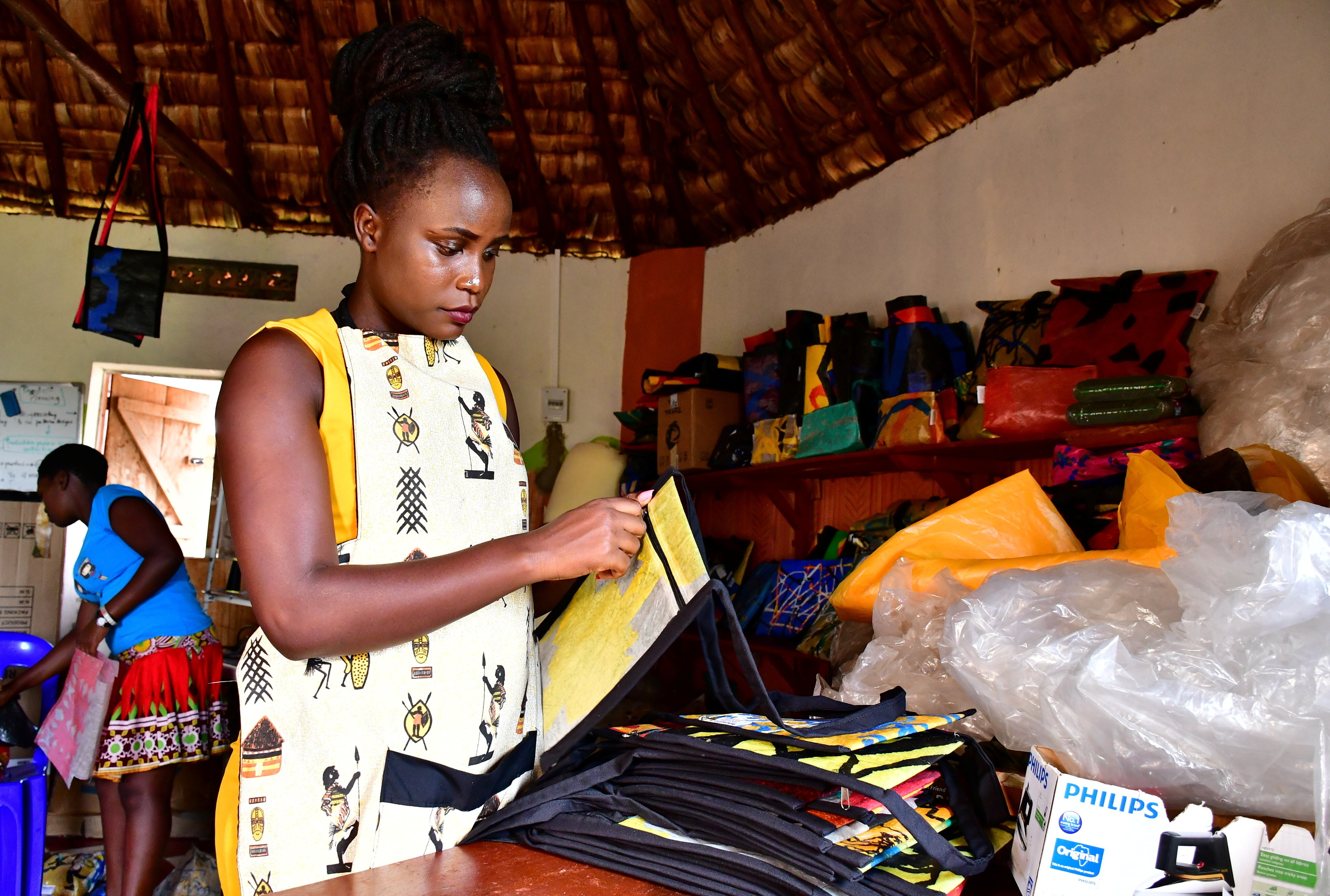
Ugandan 'wastepreneur' Faith Aweko checks a handbag made from transformed polythene waste. Image: Reuters/Abubaker Lubowa
- Young people in the Global South can spearhead social innovation – if they are appropriately supported.
- Individual entrepreneurship alone isn't sufficient – it requires capital, context-sensitive education and community.
- Youth must be allowed to design the broader institutions that shape the conditions for social innovation.
The future of the Global South rests on the shoulders of its young people. Over 85% of the world’s youth live across Africa, Asia, Latin America and the Middle East. Yet in these vibrant, rapidly transforming regions, young people outside urban centres often encounter a wall of compounding barriers: unemployment, fragile infrastructure, an education system that is not time-relevant with respect to market needs, and deepening climate risks.
We often talk about the “demographic dividend” as a given, a latent advantage. But dividends aren’t automatic, they require deliberate investment. And crucially, they require a mindset shift: Youth must be repositioned not as passive beneficiaries of well-meaning programmes, but as architects of innovation and resilience – particularly social innovation that addresses the very systemic challenges they face.
Beyond hustle culture
In today’s world, there is a widespread tendency to equate entrepreneurship with empowerment. But we now know that without a strong enabling ecosystem such as policy support, infrastructure, mentorship and funding, telling young people to simply "start something" often leads to burn-out and disillusionment. Especially in rural and semi-urban areas, entrepreneurship without context, capital or community is rarely sustainable.
Research and real-world experience make it clear: Innovation thrives not just on individual drive, but on the scaffolding around it. From community labs in Indonesia to rural incubators in Kenya and youth hubs in Brazil, we are seeing how physical and digital infrastructure can radically shift what is possible. When young people have access to last-mile connectivity, maker tools and local-language learning content, ideas move from aspiration to prototype and become financially viable business models in the long run.
In India, the role of geography has proven to be deeply influential. Local economies often grapple with skill mismatches and a lack of safe, accessible spaces for experimentation; gaps that are not abstract but structural. Adding to this is the gender lens that acutely limits access to communities impacted by intersectionality. Addressing these requires reimagining education to embed entrepreneurial thinking, critical inquiry and real-world problem-solving from an early stage. Such reforms, particularly in non-urban regions, can help bridge systemic inequities and create more equitable innovation ecosystems.
One of the most persistent frictions in youth-led innovation is access to finance. Capital – whether philanthropic, private, or public – tends to cluster in urban centres. It chases scale, not nuance. Yet models from Africa’s youth innovation grants to Latin America’s social investment funds tell a different story: When you localize funding, and empower and trust young people with agency, innovation flourishes. The key is to fund context, not just ideas. Policy-makers, multilaterals and private sector players must move beyond traditional risk filters and design for regional equity in innovation finance.
A new narrative for social entrepreneurship
In many parts of the Global South, social entrepreneurship is still seen as idealistic, even fringe. Efforts like Nigeria’s NYSC or South Africa’s Youth Employment Service are early examples of institutional pathways that normalize innovation as service and career. Governments can go further by offering income protections, robust infrastructure, peer networks and legitimacy to social entrepreneurs. Civil society and media must do their part too, advocating for and amplifying stories of youth transforming their communities not just through code or capital, but through care.
Across the Global South, there is a recurrent pattern: high educational attainment sitting uneasily alongside rising youth unemployment, particularly in rural districts. In India, this contradiction is particularly pronounced. Similar phenomena are evident in Nigeria, Colombia and Indonesia, where shared structural challenges reflect broader trends across the Global South.
What is inspiring is the response: Kenyan youth are shaping climate-smart agriculture, Colombian collectives are building peace economies, and South-East Asian initiatives are demystifying entrepreneurship by teaching it in local languages. These are not isolated sparks, they’re blueprints waiting to be adapted and scaled.
From entrepreneurs to system designers
To unlock the full potential of youth innovation in the Global South, the role of young people must be reframed – not just as entrepreneurs launching ventures, but as designers of new systems that shape how economies, communities and institutions function. From influencing local governance models to rethinking how services are delivered, young change-makers are increasingly engaged in civic innovation, participatory budgeting and co-creating public services rooted in community realities. This shift moves beyond the startup narrative to one where young people shape the very frameworks that govern innovation and inclusion.
Support for youth innovation, then, must be holistic. Beyond capital and infrastructure, there is a growing need for what might be termed emotional infrastructure: systems of care, mentorship, and mental health support that acknowledge the emotional labour of being a change-maker. Particularly in underserved regions, young people often carry the additional weight of community expectations, economic stress, and the psychological toll of tackling systemic problems. Creating enabling environments means investing in safety nets that are not only financial but also social and emotional.
Realizing the potential of youth-led innovation requires convergence across policy, finance, education and social support. Governments must move from tokenistic participation to structured co-creation, embedding youth voices in national strategies and institutional design. Financial institutions need to value contextual innovation, supporting not just high-growth models but slow, community-embedded and community-led initiatives that prioritize resilience and long-term impact over short-term returns. Education systems should prepare young people not only to solve problems, but also to redesign the systems that produce those problems.
When backed with the right mix of capital, care and collaborative power, young people shift from being passive recipients of change and aid to architects of new possibility. By equipping youth to shape institutions, not just enterprises, we move closer to a future that is inclusive, just and deeply resilient.
Don't miss any update on this topic
Create a free account and access your personalized content collection with our latest publications and analyses.
License and Republishing
World Economic Forum articles may be republished in accordance with the Creative Commons Attribution-NonCommercial-NoDerivatives 4.0 International Public License, and in accordance with our Terms of Use.
The views expressed in this article are those of the author alone and not the World Economic Forum.
Stay up to date:
Youth Perspectives
Related topics:


Forum Stories newsletter
Bringing you weekly curated insights and analysis on the global issues that matter.
More on Economic GrowthSee all

Larry Fitzgerald Jr and Kelvin Beachum Jr
April 6, 2026