Logistics Emergency Team: 20 years of coordinating humanitarian aid
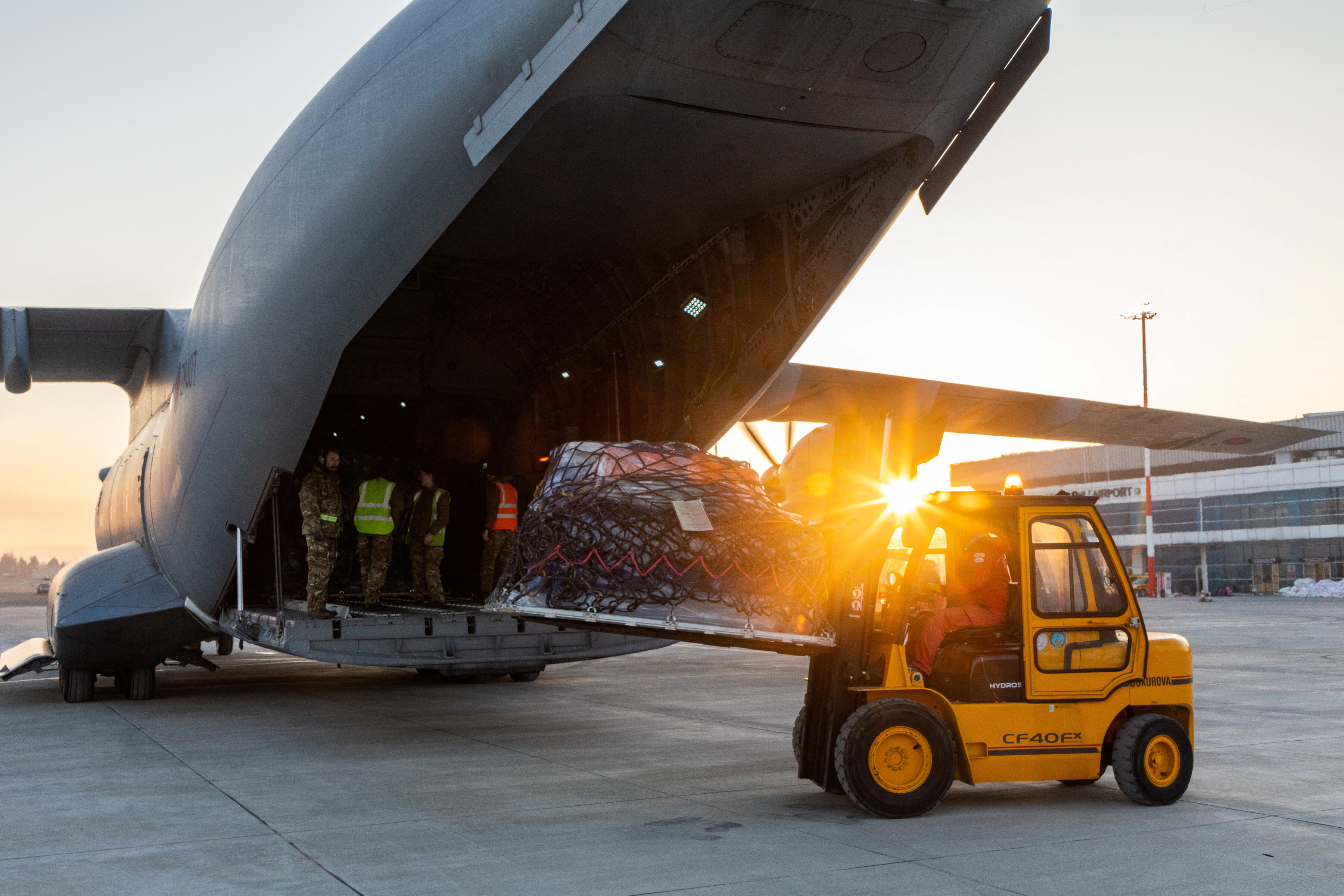
September marks 20 years since the Logistics Emergency Team was established to support humanitarian aid efforts across the globe. Image: RAF via REUTERS
Sean Doherty
Head, International Trade and Investment; Member of the Executive Committee, World Economic Forum- September marks 20 years since the Logistics Emergency Team was established to support humanitarian aid efforts across the globe.
- More than 305 million people require humanitarian aid, according to the latest data.
- Worsening humanitarian crises around the world further highlight the need for public-private sector coordination in aid efforts.
The world faces an unprecedented humanitarian crisis. With conflicts raging in Ukraine, Gaza and Sudan, among other places, and climate disasters striking with increasing frequency, the need for coordinated aid delivery has never been more urgent.
The latest data shows more than 305 million people are in need of aid, requiring $47.4 billion in funding.
One pioneering partnership involved in the complex relief operations worldwide is the Logistics Emergency Team (LET), which turns 20 this year. Here's what to know about the LET and the importance of fostering public-private partnerships to deliver aid.
Origins of the partnership
In 2005, the United Nations Cluster Approach was introduced to bring together fragmented relief efforts. Included in the initiative was the World Food Programme (WFP)–led Logistics Cluster, which recognized that strong coordination is necessary for any successful emergency response.
For the past 20 years, leveraging the capabilities of WFP as the largest humanitarian agency in the world, the Logistics Cluster has been the backbone of humanitarian operations, coordinating supply chains, filling common gaps and enabling other organizations responding to an emergency to reach people in need.
That same year, the World Economic Forum convened four of the world’s leading logistics companies—Agility, UPS, Maersk and DP World—to create the Logistics Emergency Teams (LET). LET was the first public–private partnership of its kind in the humanitarian space, with the four companies joining forces to provide pro bono support to the humanitarian sector upon request from the Logistics Cluster.
The LET was designed with a simple but powerful logic: by supporting the Logistics Cluster, private sector expertise and assets could support the entire humanitarian system.
"Maersk is proud to work alongside our industry peers and international organizations, contributing our assets and expertise to the LET," said Lene Bjørn Serpa, Director and Head of Corporate Sustainability at A.P. Moller - Maersk. "Effective logistics support is critical in an emergency, and the LET is a prime example of how public-private partnerships can support more effective disaster response and preparedness activities and bring critical humanitarian aid where it is needed the most."
Research shows that without coordination and collaboration, humanitarian logistics can remain fragmented and inefficient. In fact, a 2018 study by Help Logistics Ag, Kuehne Logistics University and Save the Children International found that up to 73% of humanitarian spending is tied to supply chains.
"When disaster strikes, logistics saves lives," said Nikki Clifton, President, Social Impact and The UPS Foundation. "The UPS Foundation is proud to work with our LET partners to help vulnerable communities prepare, respond, and recover. Together, we are accelerating relief and improving access to essential resources until recovery becomes resilience."
The LET model in action
Operating as a force multiplier for humanitarian response, the LET works with the Logistics Cluster to provide warehousing, transport, customs clearance expertise and logistics specialists to fill critical gaps in humanitarian supply chains.
The partnership deploys upon request from the Logistics Cluster, which today leads a global community of more than 1,150 partner organizations, with 50% being national actors.
"At DP World, we know resilient communities build resilient business," said Ayla Bajwa, Group Senior Vice President, Group Sustainability, DP World. "That’s why we partner with fellow LET companies—to combine our global strengths and deliver fast, coordinated humanitarian response. Together, our supply chains become lifelines when it matters most."
One of the LET's most innovative contributions is EDUARDO, the Emergency Dashboard Utility for Airfreight Resource and Delivery Options, which uses Google flight data to identify available cargo capacity for humanitarian operations. During the Türkiye-Syria earthquake response in 2023, EDUARDO was accessed 510 times in its first month, demonstrating its critical value in rapid response scenarios.
"Logistics is the backbone of every emergency response. But it’s partnerships that power the response," said Stefano Peveri, Global Logistics Cluster Coordinator. "The LET brings together the agility, assets, and expertise of the private sector to scale humanitarian operations, ensuring aid reaches those who need it most, when it matters most."
Behind the statistics and logistics operations are real people whose lives have been transformed by the LET's work. Here are just some of the ways the Logistics Emergency Team has responded to crises over the past 20 years:
- Gaza crisis response
Since the opening of the Jordan corridor in November 2023, the LET has been instrumental in the Gaza humanitarian response. The partnership provided a fully equipped and staffed warehouse in Amman, Jordan, strategically positioned to consolidate aid before dispatch into Gaza. Since the warehouse opened in July 2024, 28,915 cubic meters of cargo from 21 humanitarian organizations have been processed for consolidation.
- Ukraine crisis support
In February 2022, the LET companies activated their presence around Ukraine to provide warehouse space and ground transportation for humanitarian supplies. The partnership's existing regional infrastructure and local knowledge proved invaluable in streamlining aid distribution to affected areas. The LET provided crucial customs clearance information and facilitated the humanitarian supply chain along the Poland-Ukraine border.
- Türkiye-Syria earthquake response
Following the devastating 7.8 magnitude earthquake that struck Türkiye and Syria in February 2023, killing over 50,000 people, the LET rapidly deployed comprehensive support. The LET companies provided customs clearance, local transportation market assessment and in-country transportation as well as funding to the Logistics Cluster for the overall response. LET members facilitated an airlift from the UN Humanitarian Response Depot in Brindisi, Italy, to Adana, Türkiye, and offered access to local logistics experts and mobile storage units.
Expanding reach and innovation
The humanitarian sector faces persistent challenges including funding gaps, security concerns and importation delays. The hurdles are even more acute today given the systemic changes taking place in the global humanitarian system.
Yet as humanitarian crises become more complex and protracted, the LET continues to evolve its approach. The partnership, for instance, has expanded its scope from natural disaster response to include complex emergencies and disaster preparedness.
Moreover, the Logistics Emergency Team represents more than efficient logistics – it embodies the power of sustained collaboration between the public and private sector to address humanity's greatest challenges. In an era where humanitarian needs continue to grow while resources remain constrained, the model pioneered by LET offers a proven pathway for maximizing impact through strategic collaboration.
After 20 years of coordinated response, the partnership continues to demonstrate that when corporate expertise meets humanitarian purpose, the result is not just aid delivery, but lives saved and hope restored for millions around the world.
License and Republishing
World Economic Forum articles may be republished in accordance with the Creative Commons Attribution-NonCommercial-NoDerivatives 4.0 International Public License, and in accordance with our Terms of Use.
The views expressed in this article are those of the author alone and not the World Economic Forum.
Related topics:

Forum Stories newsletter
Bringing you weekly curated insights and analysis on the global issues that matter.
More on Global CooperationSee all

Cecilia Cannon and Marie McAuliffe
April 8, 2026