Research reveals 9 essential plays to govern AI responsibly in a multipolar world

The AI Governance Alliance's new playbook delivers nine actionable strategies. Image: Getty Images/iStockphoto
Karla Yee Amezaga
Initiatives Lead, AI and Data Governance, Centre for AI Excellence, World Economic Forum- Governments are charting different paths for AI governance, creating both incentives and complexities for companies to scale AI responsibly.
- Organizations that advance responsible AI practices will build stakeholder trust and outpace competitors.
- The AI Governance Alliance's new playbook delivers nine actionable strategies to address internal barriers and external ecosystem challenges blocking responsible AI implementation.
Artificial intelligence (AI) is emerging as a driver of innovation and a flashpoint of competition in an increasingly multipolar world.
Governments are charting different paths for AI governance: the European Union, Japan and South Korea are establishing regulatory frameworks. The United States and China are rolling out national action plans, while the African Union, Brazil and Egypt are strategically updating national AI strategies to align governance frameworks with their ambitions.
For business leaders, this complex and fragmented AI governance landscape is both a challenge and an opportunity. Investors, customers, partners and employees are no longer content with promises of innovation; they expect confidence that AI systems will be accurate, predictable and beneficial to society. Increasingly, trust is the true limit of AI innovation. The ability to demonstrate resilient, responsible AI practices is, therefore, the key differentiator between organizations that inspire confidence and those that fall behind.
Responsible AI practices remain nascent
Despite increased awareness and measurable benefits of responsible AI practices by organizations, research finds that 81% of companies remain in nascent stages of its implementation. Unaddressed, this governance gap can put AI investments in jeopardy and leave risks to the company and the public unmitigated.
Over the past two years, the Resilient AI Governance and Regulation working group of the World Economic Forum’s AI Governance Alliance, with support from Accenture as its knowledge partner, has mapped key challenges that business leaders face in implementing responsible AI with the goal of identifying actionable strategies to address roadblocks.
One category of challenges emerges from within organizations. This may include contending with legacy systems and security frameworks, ill-defined accountability structures and protocols, unassessed third-party AI tools and limited visibility into enterprise-wide AI usage. Then, there are roadblocks arising from the ecosystem external to the organization, such as navigating regulatory fragmentation and volatility, legal ambiguities and unclear responsibility allocation across the AI value chain.
As AI capabilities advance and AI use cases scale across the workforce, the need for public-private partnerships to overcome these challenges to responsible AI implementation - and the risks in not doing so - is heightened. Without coordination, misaligned responsible AI approaches can slow the deployment of innovations and result in unintended consequences, such as loss of human expertise, biases in decision-making and social harms.
Such negative externalities underscore the urgency of fostering responsible AI practices by organizations within national borders and across jurisdictions. This entails moving beyond compliance-driven mandates towards adaptive, collaborative governance frameworks that encourage innovation while safeguarding society.
A new playbook to advance responsible AI
To address internal and ecosystem challenges that organizations face in responsible AI implementation, the AI Governance Alliance has led a global, multistakeholder effort resulting in Advancing Responsible AI Innovation: A Playbook.
This first-of-its-kind guide outlines nine key plays across three dimensions to help organizations turn principles into practice. It also highlights the role of government leaders in fostering a strong ecosystem built on public-private partnerships and international cooperation.
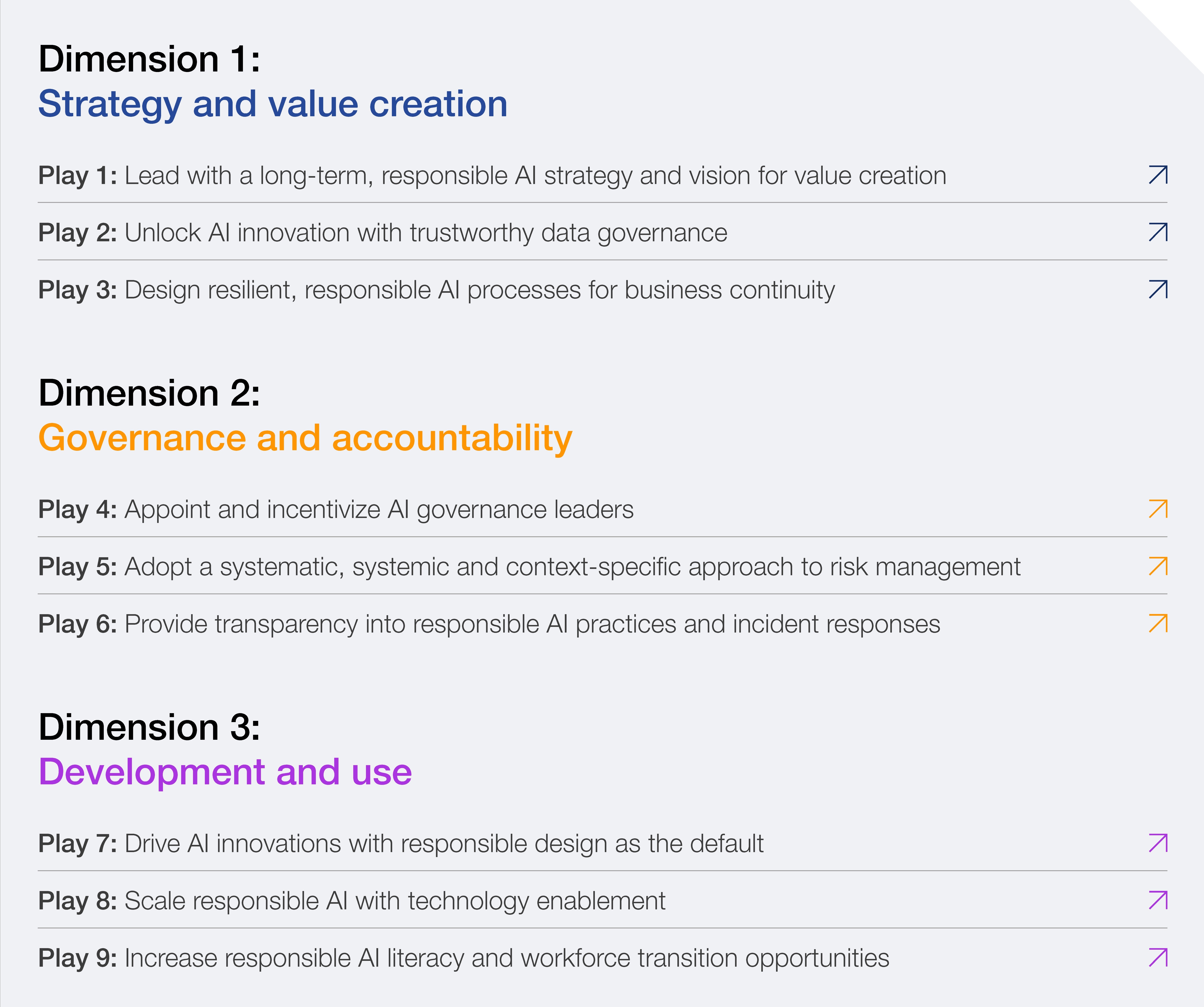
Reactions to the value and impact of the playbook
According to Cathy Li, Head of the Centre for AI Excellence at the World Economic Forum, "the playbook provides a practical roadmap for public-private engagement to enable corporate responsible AI practices across business contexts and jurisdictions."
Arnab Chakraborty, Chief Responsible AI Officer at Accenture, shared that the company “is proud to serve as knowledge partner to the Forum and the Alliance on this initiative."
He also highlighted how the playbook "provides business leaders with a play-by-play approach, backed by real-world case studies, to implement responsible AI practices that unlock the full value potential of AI.”
For Andrew Levy, Accenture's Chief Corporate and Government Affairs Officer, "these practical insights ensure that policymakers and regulators have a roadmap to foster confident AI innovation and investment at an ecosystem level."
How the Forum helps leaders make sense of AI and collaborate on responsible innovation
Members of the Resilient AI Governance and Regulation working group of the AI Governance Alliance also shared thoughts on the impact of this publication and the value it provides for organizations and jurisdictions.
Amir Banifatemi, Chief Responsible AI Officer at Cognizant, highlighted the practicality of the playbook for CEOs: “By operationalizing responsible AI and demonstrating it with evidence, organizations can scale faster, meet cross-border requirements and convert trust into competitive advantage.”
The playbook redefines or reframes responsible AI from being just a compliance requirement to a strategic driver for sustainable innovation — showing that ethical AI practices not only manage risk but also build competitive advantage.
”Daniel Duke Odongo, Director of Product and Member of the Executive Team at Ushahidi, shared that “one of the most vital principles reflected in this playbook is transparency as a foundation of trust.”
Idoia Salazar, Professor at the Universidad CEU San Pablo (Spain) and President of OdiseIA, emphasized how the playbook helps “organizations unlock the full potential of AI technologies, while minimizing risks through real-world applications and actionable frameworks.”
Responsible AI is not just good governance; it is the foundation of global competitiveness. Advancing Responsible AI Innovation: A Playbook provides a practical roadmap to use now: for organizations to mature their responsible AI practices, for governments to foster enabling governance ecosystems and for both to collaborate across borders. While each of the plays outlines coordinated steps and complementary actions for organizations and governments, the recommendations should be considered in the broader context of critical efforts led by other stakeholders, such as academia and civil society. Leaders who seize this opportunity will mitigate risks and shape the future of AI as a driver of sustainable innovation and shared prosperity.
Don't miss any update on this topic
Create a free account and access your personalized content collection with our latest publications and analyses.
License and Republishing
World Economic Forum articles may be republished in accordance with the Creative Commons Attribution-NonCommercial-NoDerivatives 4.0 International Public License, and in accordance with our Terms of Use.
The views expressed in this article are those of the author alone and not the World Economic Forum.
Stay up to date:
Artificial Intelligence
Related topics:


Forum Stories newsletter
Bringing you weekly curated insights and analysis on the global issues that matter.
More on Emerging TechnologiesSee all

Jeremy Jurgens
April 2, 2026


