AI’s new dual workforce challenge: Balancing overcapacity and talent shortages

Automation is driving AI overcapacity in traditional roles where AI-critical skills are still lacking for post holders. Image: REUTERS/Dado Ruvic/Illustration
- Automation is driving overcapacity in traditional roles, while demand for AI-critical skills outpaces supply, rendering legacy workforce models obsolete.
- Success depends on reskilling at scale, redesigning roles for human-AI collaboration, embedding workforce planning into core strategy and using the range of HR levers to smooth transitions.
- Companies that integrate agentic AI with workforce empowerment can boost efficiency, resilience and competitiveness, while those stuck in pilot mode risk falling behind.
Generative and agentic artificial intelligence (AI) are transforming the global workforce at a pace not seen since the industrial revolution. What was once experimentation has become structural disruption.
Productivity gains from AI are triggering overcapacity in legacy roles, while simultaneously exposing acute shortages in AI-critical skills. This paradox is not distant; it is unfolding today.
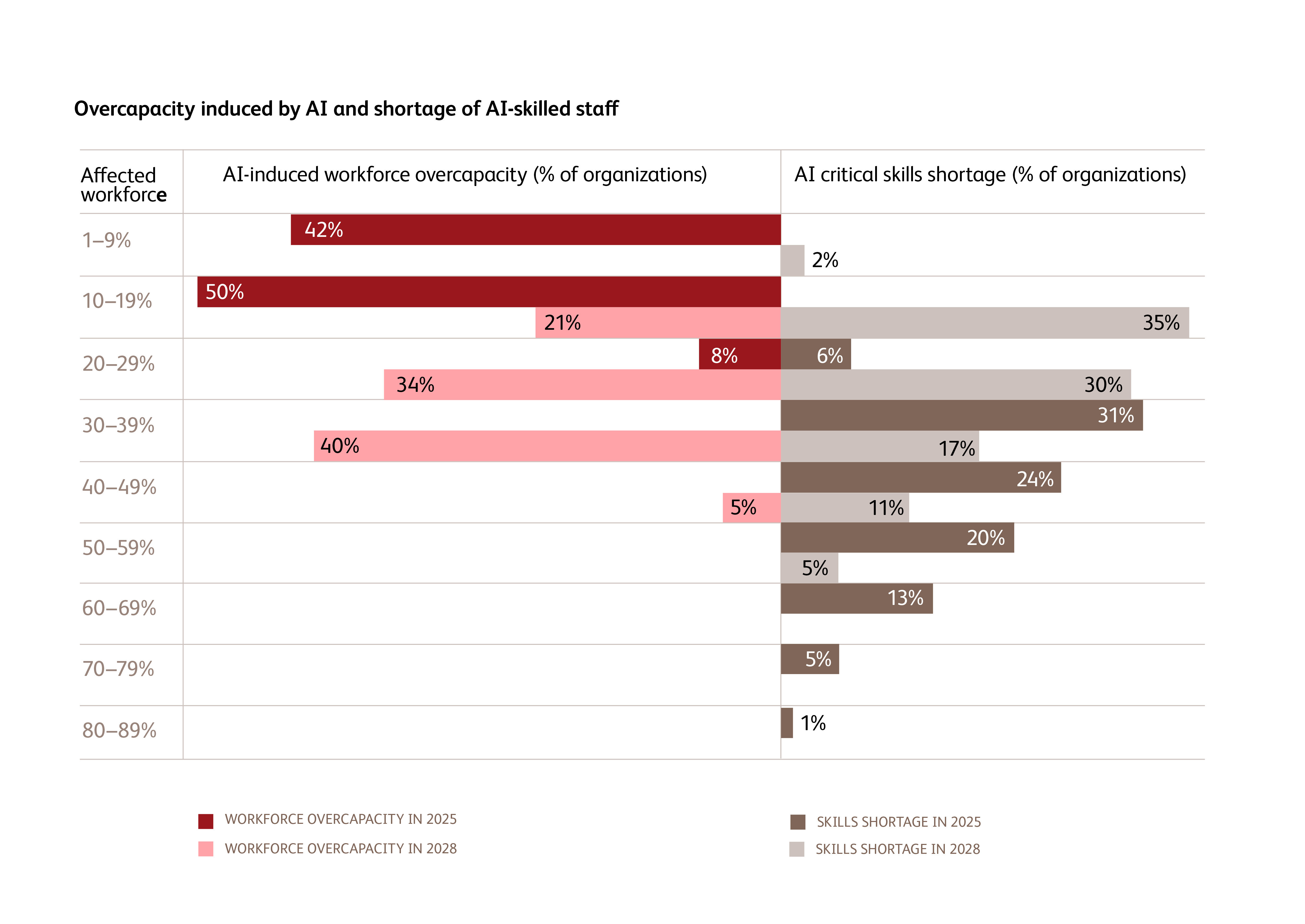
In a global survey of 1,010 C-suite executives, 92% reported up to 20% workforce overcapacity. By 2028, nearly half of leaders expect more than 30% excess capacity, indicating a sharp structural shift.
At the same time, 94% of leaders face AI-critical skill shortages today, with one in three reporting gaps of 40% or more. While shortages are expected to ease, nearly half of leaders still anticipate gaps of 20-40% in critical roles by 2028.
This dual challenge – workforce redundancy and AI skills scarcity – redefines the future of work. It calls for leaders to rethink workforce planning not as an HR exercise but as a strategic lever for resilience, competitiveness and a systematic workstream in every AI strategy.
The workforce paradox: overcapacity and scarcity
AI’s impact on the workforce is twofold:
1. Overcapacity in legacy roles
- Half of leaders already report 10-20% overcapacity primarily due to automation.
- By 2028, 40% expect 30-39% excess capacity and 34% expect 20-29%, making structural redundancy unavoidable.
- Functions most at risk: customer support, back-office operations, transactional finance and administrative roles.
2. Acute shortages in AI-critical talent
- Today, 94% of leaders face shortages, with around one-third reporting gaps of 40-60% in AI-critical roles.
- By 2028, shortages are expected to ease but 44% of leaders still anticipate 20-40% gaps.
- New demand is concentrated in AI governance, prompt engineering, agentic workflow design and human-AI collaboration specialists.
This paradox highlights why static workforce plans and legacy role taxonomies are no longer viable.
4 imperatives for leaders
To navigate this paradox, executives must move beyond pilots and reactive workforce adjustments. The study highlights four priorities:
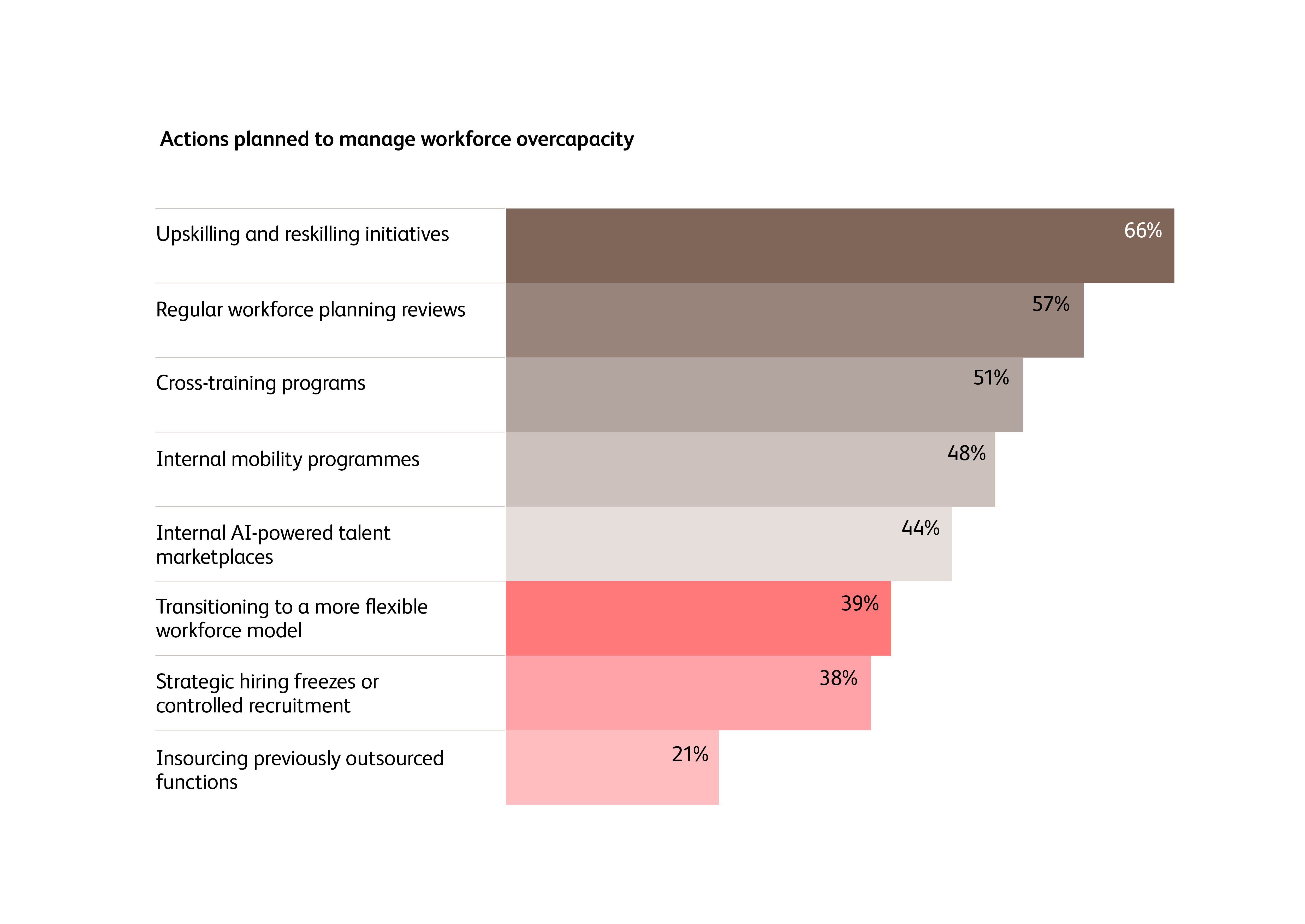
- Reskilling and upskilling: Companies must treat reskilling as a core investment, not a side project. Over half of leaders are already implementing structured upskilling programmes but many lack the scale needed. Training employees to collaborate with AI – designing prompts, supervising agents and interpreting outputs – is essential.
- Redesigning roles around human-AI collaboration: Work is shifting from execution to orchestration. Humans are becoming designers, verifiers and supervisors of intelligent agents. This requires redesigning job descriptions, decision rights and accountability frameworks. Nearly 52% of leaders rank job redesign as their top workforce priority.
- Embedding workforce planning into strategy cycles: Only 46% of organizations currently integrate workforce planning into their AI roadmaps. Without aligning skill forecasts and AI adoption plans, companies risk stalled transformations. Scenario planning over a five-year horizon should become standard practice.
- Leveraging the full spectrum of HR levers: To ease transitions with minimal disruption, leaders should adopt a portfolio approach, combining redeployment, attrition, reskilling and cross-training to boost adaptability and internal mobility. Many now use AI-powered talent marketplaces to match employees with new opportunities, while others shift to flexible models such as part-time or freelance roles. Additional levers include hiring freezes, selective recruitment and even insourcing to maximize existing talent.
Case study: BMW’s ‘AIconic’ system
A powerful example of this dual challenge and its solutions can be found in the car manufacturer BMW. In late 2024, the company launched AIconic, a multi-agent AI system in its purchasing function. Today, it already supports 1,800 active users and has handled over 10,000 searches.
The system integrates 10 specialized AI agents that streamline tender analysis, supplier data management and quality checks. What makes BMW’s approach transformative is its roadmap: the company is evolving AIconic from a passive search assistant into a proactive decision-maker, capable of recommending supplier actions, monitoring risks and generating automated reports.
Crucially, BMW is pairing technology adoption with workforce empowerment. As the company notes: “Our multi-agent system AIconic significantly increases employee efficiency and productivity while setting new standards for AI usage.
To maximize AI solutions, the BMW Group provides digital training and special AI innovation spaces for employees at all levels. In doing so, employees acquire digital literacy and share their new skills throughout the organization.
BMW’s experience shows that AI is not simply about efficiency. It is about re-architecting roles, workflows and accountabilities to enable humans and AI agents to co-create value.
Why this matters: resilience, efficiency and competitiveness
AI is not only a productivity lever, it is reshaping enterprise resilience. Only the organizations that act to manage and adapt their workforce to the AI age decisively can achieve:
- Efficiency gains: 55% of leaders expect significant cost and productivity improvements from agentic AI.
- New revenue streams: 43% anticipate AI-enabled services and business models.
- Stronger resilience: 40% expect agentic architectures to boost adaptability in volatile markets.
The age of agentic AI demands bold action. Those who move now will not only mitigate disruption but also unlock resilience, competitiveness and sustainable growth for the decade ahead.
Don't miss any update on this topic
Create a free account and access your personalized content collection with our latest publications and analyses.
License and Republishing
World Economic Forum articles may be republished in accordance with the Creative Commons Attribution-NonCommercial-NoDerivatives 4.0 International Public License, and in accordance with our Terms of Use.
The views expressed in this article are those of the author alone and not the World Economic Forum.
Stay up to date:
Artificial Intelligence


Forum Stories newsletter
Bringing you weekly curated insights and analysis on the global issues that matter.
More on Jobs and the Future of WorkSee all

Kathryn Diaz
March 26, 2026


