These are the Nobel Prize winners of 2025 – and why their work matters
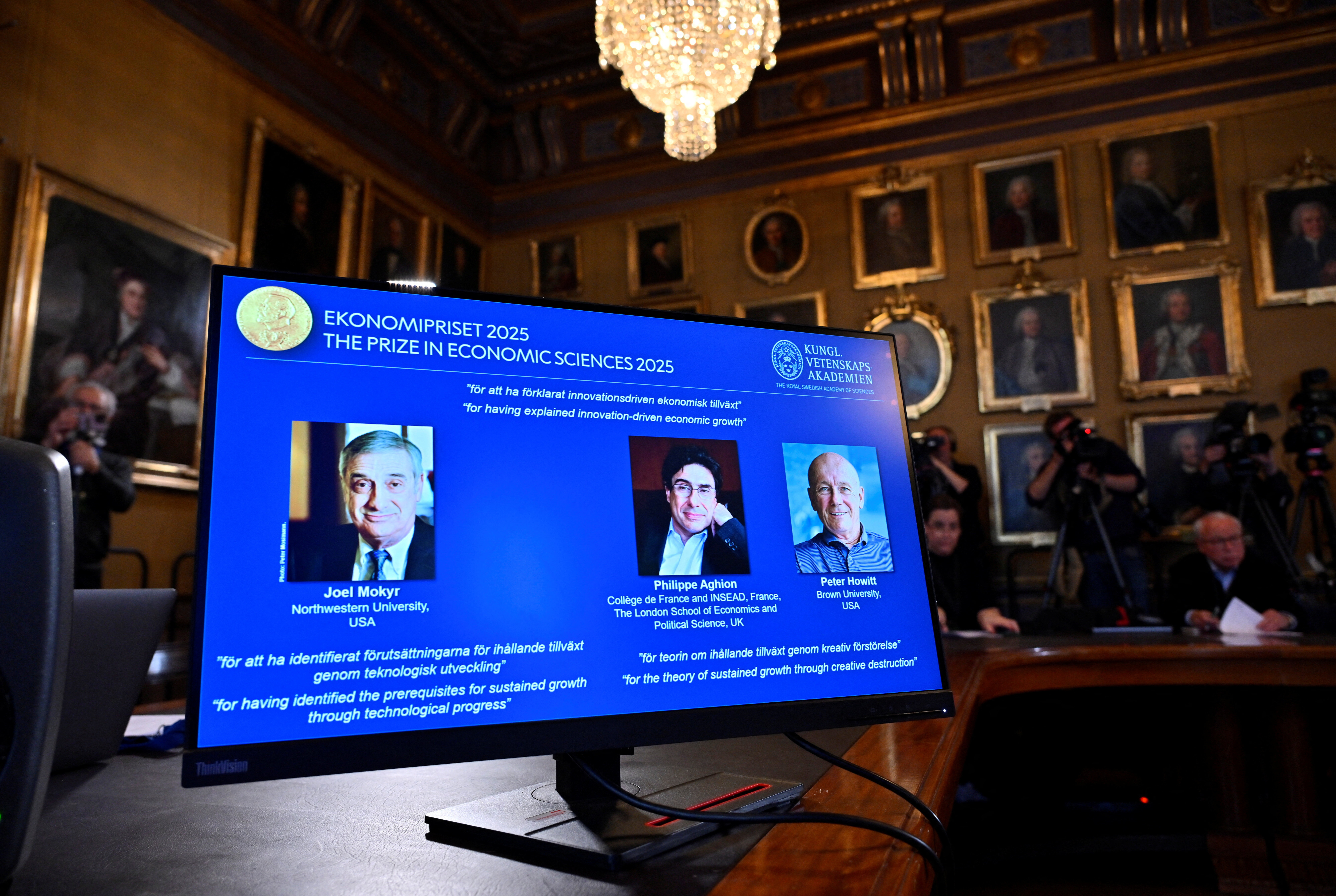
Northwestern University's Joel Mokyr, Philippe Aghion of Collège de France and INSEAD, and Peter Howitt of Brown University. Image: via REUTERS
- The 2025 Nobel Prize winners have now all been announced – including three economists recognized for showing how technology drives sustained economic growth.
- Another three were awarded the Physics Prize for their achievements in quantum mechanics – 100 years after the discipline was first developed.
- From economics to peace, here's what you need to know about this year's Nobel laureates – and why their work matters.
The 2025 Nobel Prize winners exemplify how scientific breakthroughs can address some of the world’s most pressing challenges.
In a year designated as the International Year of Quantum Science and Technology, one of the prizes went to three pioneering physicists for their work in quantum mechanics, which has paved the way for quantum innovation to shape economies and industries.
The potential economic value for the trio of quantum computing, quantum sensing, and quantum communication and security could reach between $900 million and $2 trillion by 2035, according to the World Economic Forum's Embracing the Quantum Economy report.
These advances come at a time when, as highlighted in the World Economic Forum’s Chief Economists’ Outlook, rising geopolitical tensions are casting a long economic shadow, with 82% of experts expecting geoeconomic fragmentation to intensify over the next year.
Here's what you need to know about Nobel Prize winners across all six categories for 2025, and how the work of these laureates impacts our world right now.
The Nobel Prize in Economics 2025
The Economics prize was awarded to three academics whose research has illuminated the crucial mechanisms behind sustained economic growth through innovation.
Northwestern University's Joel Mokyr was recognized for identifying the prerequisites for sustained growth through technological progress, while Philippe Aghion of Collège de France and INSEAD, alongside Peter Howitt of Brown University, were honoured for their theory of sustained growth through creative destruction, where new and better products force out older ones.
Their groundbreaking research demonstrates how innovation creates a self-generating process of economic progress, but only when societies have scientific explanations for why technologies work and remain open to new ideas and change.
Artificial intelligence is perhaps the greatest example of this process of technological innovation and disruption today, although its economic impact remains highly uncertain. The Forum's latest Chief Economists' Outlook found that 68% of economists now expect AI to become commercially disruptive within the next year, up sharply from 45% in April, while 69% rate disruption in innovation and technology as high or very high.
The report finds AI-driven innovation has unleashed a surge of investment: over 100 new 'unicorns' (private start-ups with valuations over $1 billion) have emerged in the past two years, pushing the global total close to 500.
John Hassler, Chair of the Committee for the prize in economic sciences, said: “The laureates’ work shows that economic growth cannot be taken for granted. We must uphold the mechanisms that underlie creative destruction, so that we do not fall back into stagnation."
The Nobel Peace Prize 2025
The Nobel Peace Prize for 2025 was awarded to "a brave and committed champion of peace – to a woman who keeps the flame of democracy burning amid a growing darkness".
Maria Corina Machado was awarded the prize for her "tireless work promoting democratic rights for the people of Venezuela and for her struggle to achieve a just and peaceful transition from dictatorship to democracy".
As the leader of Venezuela's democracy movement, Machado has emerged as one of the most extraordinary examples of civilian courage in Latin America, according to the Norwegian Nobel Committee, unifying a once deeply divided political opposition around the demand for free elections and representative government.
Her recognition comes at a critical moment for world peace and democracy. This was top of mind at the beginning of the year when the Global Risks Report 2025 identified state-based armed conflict as the 'top current risk' globally, with 23% of respondents ranking it as 'most likely to present a material crisis in 2025'.
The Forum's analysis revealed a world experiencing deepening geopolitical tensions, with democracy itself under assault. Societal polarization ranked as the fourth most severe two-year risk, with misinformation and disinformation topping the 2027 outlook.
The report also warned that 'multilateralism faces its most difficult period since the UN's founding, with erosion of human rights and civic freedoms ranking among the top 10 risks over the next two years.' Venezuela's shift from a relatively democratic and prosperous nation to one marked by political repression and economic decline symbolizes this broader global challenge that is highlighted by this year's Peace Prize.
The Nobel Prize in Literature 2025
The US writer and critic Susan Sontag called Literature laureate László Krasznahorkai the “master of the apocalypse” after reading the Hungarian author’s second book, The Melancholy of Resistance.

And the Nobel Prize itself was awarded for Krasznahorkai's “compelling and visionary oeuvre that, in the midst of apocalyptic terror, reaffirms the power of art”.
It is not Krasznahorkai's first literary award, having won prizes including the prestigious 2015 Man Booker International Prize, but nevertheless, the author said he was “very happy, I’m calm and very nervous altogether”, when he learnt about his Nobel.
The transformative power of the arts and culture is the focus of the Forum's Cultural Table initiative, which aims to bridge business and culture, sparking collaborations that push boundaries, challenge convention and unlock creative solutions to the world’s most pressing issues.
The Nobel Prize in Chemistry 2025
Three scientists share the chemistry Nobel Prize for the development of metal-organic frameworks (MOFs).
Susumu Kitagawa, Richard Robson and Omar Yaghi have developed a new form of molecular architecture, one that could help tackle global issues like water scarcity and the climate crisis.
Their molecular constructions feature large spaces through which gases and other chemicals can flow, and these MOFs can be used to separate harmful PFAS from water, capture carbon dioxide, or harvest water from desert air, among other applications.
With water scarcity an increasing concern, pollution a top 10 risk to the world over the coming decade, and CO2 capture a crucial component of an effective energy transition, their discovery holds “enormous potential,” says Heiner Linke, Chair of the Nobel Committee for Chemistry.
The Nobel Prize in Physics 2025
Quantum technologies have the potential to transform industries and economies globally in the areas of computing, sensing, and communication and security, according to the Forum's Embracing the Quantum Economy report. And that’s in part thanks to three scientists who made a discovery back in the 1980s.

This year’s Physics laureates, John Clarke, Michel H. Devoret and John M. Martinis, conducted experiments with an electrical circuit in which they demonstrated both quantum mechanical tunnelling and quantized energy levels in a system big enough to be held in the hand.
“It is wonderful to be able to celebrate the way that century-old quantum mechanics continually offers new surprises,” says Olle Eriksson, Chair of the Nobel Committee for Physics. “It is also enormously useful, as quantum mechanics is the foundation of all digital technology.”
Their work has laid the groundwork to construct quantum computers, powerful tools for exploring science and solving very hard computational problems. Watch our easy-to-follow explainer video on quantum computing below.
The Nobel Prize in Physiology or Medicine 2025
Two US scientists, Mary Brunkow and Fred Ramsdell, along with Japanese scientist Shimon Sakaguchi, have been honoured for their discoveries related to the immune system. The laureates identified the immune system’s “security guards”, otherwise known as regulatory T cells, which prevent immune cells from attacking our bodies.
“Their discoveries have been decisive for our understanding of how the immune system functions and why we do not all develop serious autoimmune diseases,” says Olle Kämpe, Chair of the Nobel Committee.
Their work has also paved the way for the development of new treatments for conditions like cancer and autoimmune diseases, a goal that engineered living therapeutics – one of the Forum’s Top 10 Emerging Technologies of 2025 – has in its sights with its biomaterials that can target and suppress harmful immune responses.
License and Republishing
World Economic Forum articles may be republished in accordance with the Creative Commons Attribution-NonCommercial-NoDerivatives 4.0 International Public License, and in accordance with our Terms of Use.
The views expressed in this article are those of the author alone and not the World Economic Forum.

Forum Stories newsletter
Bringing you weekly curated insights and analysis on the global issues that matter.
More on Emerging TechnologiesSee all

Jeremy Jurgens
April 2, 2026


