Can precision medicine finally turn the tide on cardiovascular disease?

Cardiovascular disease is the world's leading cause of death, despite decades of advances in prevention and treatment. Image: Getty Images/iStockphoto
- Cardiovascular disease is the world's leading cause of death, despite decades of advances in prevention and treatment.
- Biological complexity is a key factor underlying the limited progress in reducing the global cardiovascular disease burden.
- Transforming cardiovascular medicine necessitates a fundamental shift in drug discovery, development and testing.
Despite decades of advances in prevention and treatment, cardiovascular disease (CVD) remains the world’s leading cause of death, claiming 19 million lives globally in 2020 alone. This number is projected to rise to 26 million by 2030.
On a global scale, the growing burden of CVD affects every region, slows economic growth and reinforces deep inequalities in healthcare access.
Biological complexity is a major reason for the limited progress in reducing the global burden of CVD, which includes a wide range of conditions like high blood pressure, coronary artery disease, arrhythmias and stroke.
Even within a given condition, each person’s genes, environment and lifestyle interact in unique ways. Interpatient heterogeneity extends to how CVDs develop at the cellular level, resulting in wide variation in symptoms, disease progression and response to treatment.
For instance, although statins are widely used and effectively lower cholesterol, they prevent heart attacks in many but not all patients, demonstrating the limits of traditional, one-size-fits-all therapies.
Precision cardiovascular medicine as an innovation framework
Transforming cardiovascular medicine to meet this challenge necessitates a fundamental shift in drug discovery, development and testing. A precision medicine approach, which involves delivering the right treatment to the right patient at the right time, may improve outcomes and narrow gaps in care.
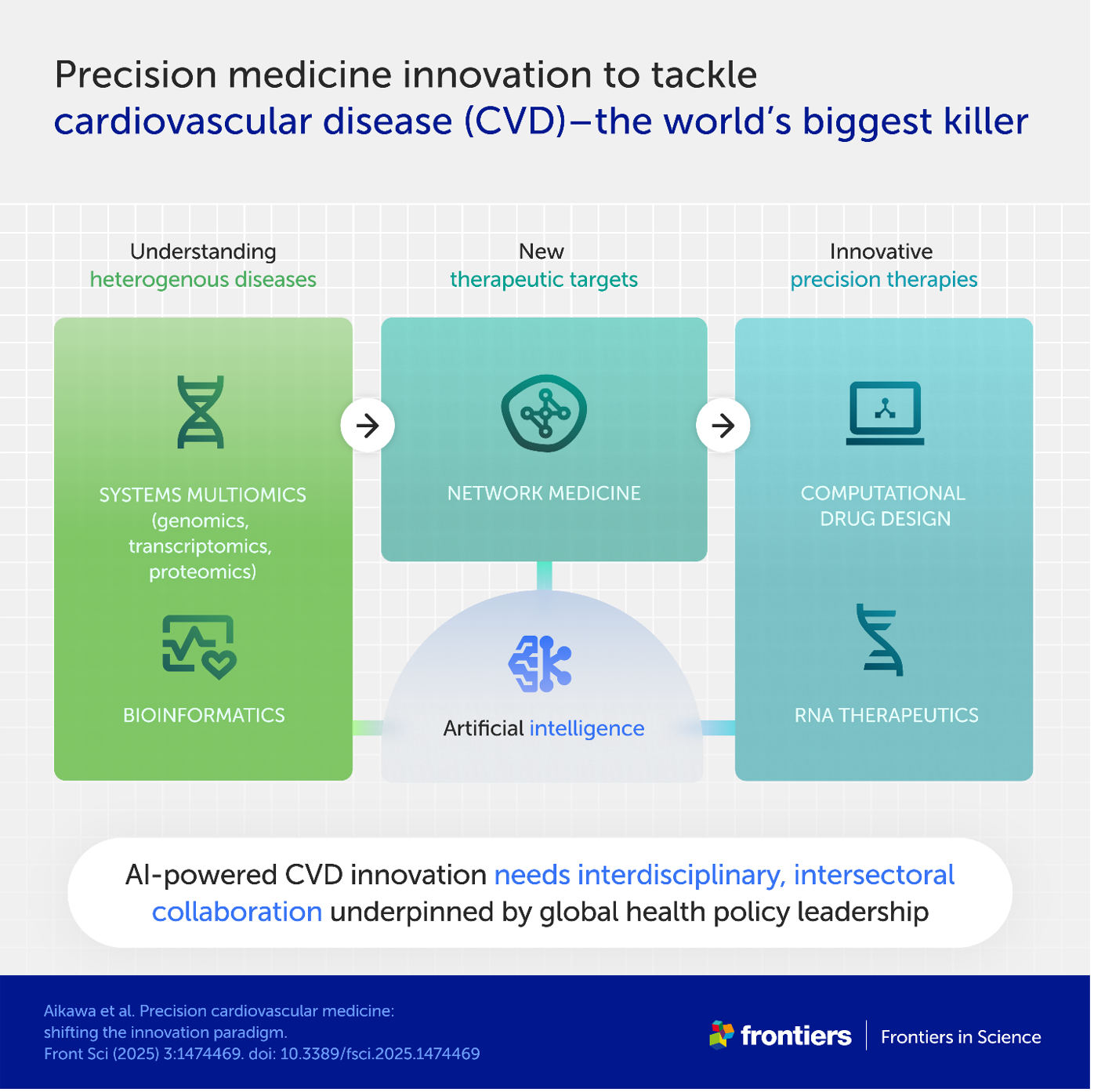
As outlined in this 2025 Frontiers in Science article, a precision approach to CVD requires innovation in three main areas:
1. Gaining a systems-based understanding of CVD
Cardiovascular diseases cannot be explained by a single biological pathway. Multiple processes – spanning inflammation, metabolism and cellular stress – interact in complex ways to drive disease. A systems medicine perspective views CVD as the result of disturbances across interconnected networks of genes, proteins and cells, rather than isolated defects in a single pathway.
“Omics” approaches are scientific techniques that provide a comprehensive way to investigate systems-level complexity. By capturing detailed molecular activity across tissues and linking it to disease traits, omics can reveal how biological factors interact to shape disease, and how these interactions differ between patients.
Omics studies demonstrate that cardiovascular disease involves far greater biological diversity than previously recognized, driven by multiple pathways and cell populations. Even a single cell type, such as macrophages in atherosclerotic plaques, can contain multiple subsets with distinct roles in disease development – including highly inflammatory cells that may promote arterial damage.
Integrating data from such studies is helping us define subtypes of disease and uncover molecular “signatures” that can help explain why patients with the same diagnosis may experience different outcomes or responses to treatment.
2. Identifying new therapeutic targets
Understanding molecular networks can reveal where intervention will be most effective, highlighting critical control points that determine how disease pathways interact. These control points are often genes or proteins not previously recognized as central to disease progression.
Mapping molecular connections helps drive the development of therapies that act on the root causes of cardiovascular disease rather than its symptoms.
By tracing the functions of these control points within broader biological networks, we can identify which mechanisms to target for the greatest therapeutic impact, and how multiple pathways might be modulated together for better outcomes.
3. Developing novel precision therapies
This innovation paradigm is already giving rise to a new generation of therapies tailored to the diverse biological mechanisms that define CVD.
Advances in computational modelling enable researchers to simulate how potential drugs interact with their targets before moving to laboratory or patient testing, improving both efficiency and safety.
Among the most promising developments are RNA-based therapeutics, which can be designed to silence or modify specific genetic messages – including those that produce cardiovascular disease-related proteins once thought to be “undruggable” due to their structure or cellular inaccessibility.
RNA therapies may be faster to develop than traditional drugs, and early studies have demonstrated their effectiveness. For example, in some patients, RNA-interference therapy has been shown to lower cholesterol and other cardiovascular risk factors more effectively than standard treatments.
Artificial intelligence (AI) accelerates each piece of this paradigm. By recognizing patterns in large biological and clinical datasets, AI can predict disease progression, cluster patients by underlying mechanisms and model how potential drugs will behave in the body.
AI can thus shorten development timelines and support the design of bespoke therapies matched to specific disease mechanisms.
Building an equitable global framework to tackle cardiovascular disease
The success of precision cardiovascular medicine depends on strong collaboration across sectors and borders – linking discovery, data infrastructure and patient care in a continuous global effort.
Shared data systems that connect molecular findings with clinical outcomes will be key to refining therapies as evidence grows. Partnerships among scientists, companies and healthcare systems can ensure that promising discoveries are translated efficiently into safe and effective treatments.
How the Forum helps leaders strengthen health systems through collaboration
An equitable transformation demands global health policy leadership and sustained investment. Many cardiovascular deaths occur in low- and middle-income countries, where access to diagnostics and advanced care remains limited.
Worldwide coordination and equitable funding are needed to strengthen infrastructure, train healthcare professionals and expand participation in research so that genetic and clinical data represent the world’s full diversity.
Building equity into innovation may allow precision medicine to finally turn the tide on CVD. With the right collaboration and leadership, precision cardiovascular medicine could become a model for how science can serve global health more effectively and fairly.
Don't miss any update on this topic
Create a free account and access your personalized content collection with our latest publications and analyses.
License and Republishing
World Economic Forum articles may be republished in accordance with the Creative Commons Attribution-NonCommercial-NoDerivatives 4.0 International Public License, and in accordance with our Terms of Use.
The views expressed in this article are those of the author alone and not the World Economic Forum.
Stay up to date:
Biotechnology


Forum Stories newsletter
Bringing you weekly curated insights and analysis on the global issues that matter.
More on Health and Healthcare SystemsSee all

Shyam Bishen
April 9, 2026


