Why clinician and patient trust is critical for digital transformation in healthcare systems globally

Global healthcare systems must embrace technology to enhance patient services and workforce satisfaction Image: Adobe Stock
- Global healthcare systems are under pressure to deliver more care more efficiently, making the best use of precious and expensive human resources.
- But a trust gap is emerging between healthcare professionals and the digital solutions intended to support them.
- Building trust in digital health is an ongoing global collaboration that requires transparency, shared standards and design with humans at the centre.
Global healthcare systems face urgent challenges. Demand for care is outstripping supply, a result of workforce shortages and the growing burden of chronic diseases among ageing populations. Healthcare workers are becoming burned out and operational costs are soaring. The sector is under growing pressure to deliver more care more efficiently, making the best use of precious and expensive human resources.
Governments and healthcare providers are increasing investment in digital transformation. Maturing technologies and stronger policy frameworks are creating a unique moment for change. A recent report from the BMJ Future Health Commission, an initiative formed by The BMJ and our company, the independent assurance and risk management provider DNV, reveals that 80% of European healthcare professionals believe that digital health technology has enabled better care delivery and three-quarters (76%) are optimistic about healthcare’s digital future.
While healthcare professionals clearly back digital transformation, the report’s findings also raise questions about efficiency and productivity gains. Less than half (47%) believe digital technology has eased administrative tasks and only 38% agree that it has reduced clinical workload.
What’s more, a trust gap is emerging between healthcare professionals and the digital solutions intended to support them; 41% of healthcare workers lack trust in the digital tools they use. Without trust, even the most advanced technologies will fail to scale, limiting their ability to deliver value to patients and healthcare systems. By working together across industry, policy and healthcare, we can bridge this gap and make digital technology a trusted part of the solution.
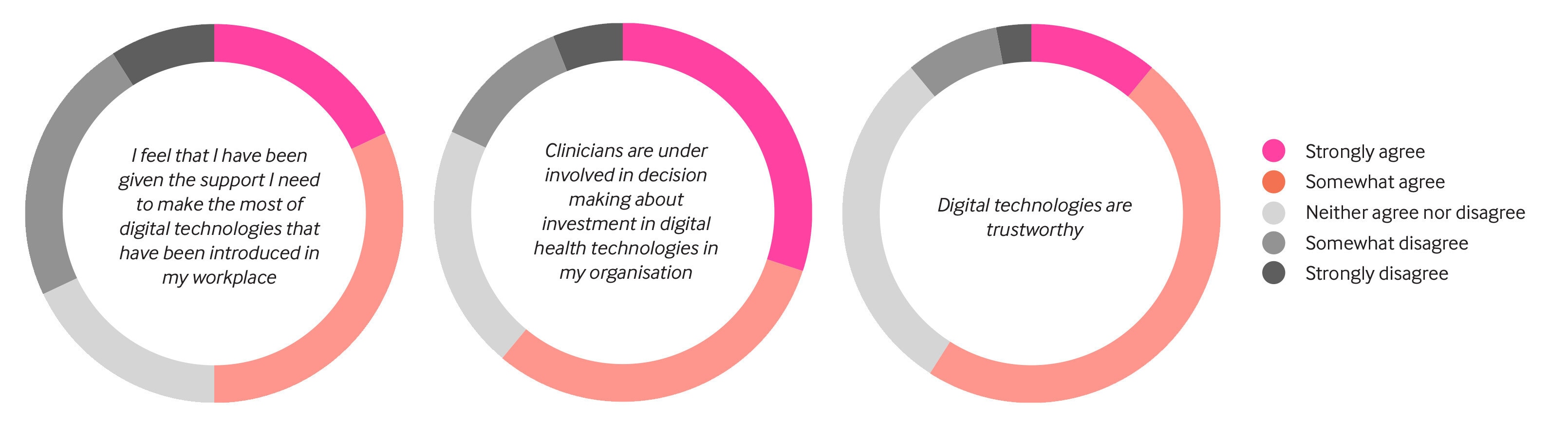
Bridging the gap: Building trust on two levels
For digital technology to realize its full potential in transforming healthcare, digital tools need to be adopted in the clinical setting. This will only happen when clinicians trust that these tools are reliable in high-stakes environments where decisions directly impact patient outcomes. When digital tools fail to meet expectations, trust erodes quickly, leading to clinician resistance, underutilization and, ultimately, failure of digital transformation.
For digital technologies to be adopted at scale and truly enable transformation in healthcare, trust needs to be established on two levels:
1. Foundational trust
Healthcare workers need assurances that the tools they use comply with data safety standards and maintain the critical function of safeguarding sensitive patient data. This form of foundational trust is earned through transparent standards and regulation. While digital technologies are developing at speed, regulation is by nature rigorous and time-consuming, often leading to a lag between the available technology and adequate regulations to govern it.
The regulatory environment in healthcare is catching up with the roll-out of regulations, such as the European Health Data Space (EHDS) and the AI Act, the implementation of which offers healthcare workers greater assurance that digital tools are safe and trustworthy.
2. Operational trust
While regulation legitimizes digital technologies, genuine trust is built when developers, providers and policymakers come together to ensure transparency in how these solutions operate. Operational trust is built when digital tools truly support clinicians’ daily workflows and improve patient outcomes. To create tools that deliver real value in the clinical setting, innovators depend on collaboration with and insights from clinicians on the pain points they need solved and where digital tools can have the greatest impact.
The value of such collaborations can be seen in projects such as MyPath, a digital patient pathway solution for cancer patients developed by DNV Imatis in partnership with clinicians at Oslo University Hospital. Through a close collaboration between innovators and clinicians, MyPath ensures patient-centred cancer care that leads to better outcomes for the patient and frees up time for the clinician.
Building trust across borders
Just as collaboration should stretch across stakeholders to ensure broad adoption, it should also stretch across borders. The pace of digital adoption is often slowed by the prevalence of localized solutions that lack interoperability and cross-border alignment. Without broader collaboration and scalable frameworks, many digital innovations remain confined to specific regions or institutions, limiting their potential to drive systemic change. When challenges cross borders, solutions must do the same.
DNV Imatis demonstrate the value of cross-border collaboration by bringing its alarm management system, developed based on the needs of nurses in Norwegian wards, to the UK. Its Silent Hospital project run with clinicians at the Royal Cornwall Hospital, has resulted in improved patient satisfaction and increased staff wellbeing and workflow efficiency.
Meanwhile, MBI Health, a UK-based company specializing in assuring patient data, saw that the 7.4 million people on waiting lists for treatment in the UK reflect a global challenge of waiting list backlogs. Having proven its value to providers in the UK by helping hospitals manage patient waiting lists, track patient pathways and ensure data accuracy, it is now expanding overseas, helping healthcare providers tackle waiting list backlogs, reducing delays in medical care and healthcare costs and improving health outcomes.
True transformation depends on deep collaboration
As healthcare systems globally face greater challenges than ever, there is an urgent need to accelerate digital adoption. For this to happen, foundational and operational trust must be earned and maintained in parallel. To enable this, there is a clear need for platforms where stakeholders across healthcare can come together to share experiences and collaborate to develop tools that can be adopted at speed and at scale.
Convenings, such as the annual DNV Digital Health Summit, provide meeting places for regional actors to come together, where providers and clinicians can voice their needs to innovators who, through these clinical insights, can develop tools that address critical pain points. On a global scale, multi-sectoral efforts, like the World Economic Forum Digital Healthcare Transformation (DHT) Initiative, the HealthAI community of practice and CHAI are driving knowledge exchange and informing the policies and best practices that will shape a healthy ecosystem for responsible innovation.
Building trust in digital health is not a one-time achievement. It's an ongoing global collaboration. It requires transparency, shared standards and design with humans at the centre to ensure that technology serves healthcare workers and patients alike. Only through such collective action can we realize the full potential of digital transformation in global healthcare.
Don't miss any update on this topic
Create a free account and access your personalized content collection with our latest publications and analyses.
License and Republishing
World Economic Forum articles may be republished in accordance with the Creative Commons Attribution-NonCommercial-NoDerivatives 4.0 International Public License, and in accordance with our Terms of Use.
The views expressed in this article are those of the author alone and not the World Economic Forum.
Stay up to date:
Artificial Intelligence-Facilitated Healthcare
Related topics:


Forum Stories newsletter
Bringing you weekly curated insights and analysis on the global issues that matter.
More on Health and Healthcare SystemsSee all

Matthew Oliver
March 24, 2026


