What AI’s role in strategic foresight tells us about the future of thinking

Using AI for strategic foresight: If machines can predict, simulate and speculate faster than humans, what’s left for the human futurist? Image: iStock/skynesher
- Artificial intelligence is increasingly being used by people in government, business and research to help them plan for the future.
- Recent research by the OECD and World Economic Forum shows three distinct levels of AI use in strategic foresight work.
- It also highlights some unease with using AI due to risks like bias and suggests how strategic foresight practitioners can use AI ethically.
Artificial intelligence (AI) is no longer a distant tool in the strategic foresight profession, it’s now embedded in the process of shaping how we imagine the future. Across governments, corporations and research institutions, AI is helping humans scan horizons, generate scenarios and interpret weak signals at speeds once unimaginable.
But this rapid transformation raises an unsettling question: If machines can predict, simulate and speculate faster than humans, what’s left for the human futurist?
In mid-2025, the Organisation for Economic Co-operation and Development (OECD) and the World Economic Forum surveyed 167 foresight experts across 55 countries, spanning public, private, academic and civil society institutions. Two-thirds of these practitioners already use AI in some aspect of their strategic foresight work.
The results show a field in transition. Foresight practitioners, once defined by their ability to navigate complexity through human judgement, are now testing how far AI can extend their reach. Yet almost all respondents agree on one point: AI supplements human insight, but it doesn’t replace it.
From assistant to architect
The data points to three distinct levels of maturity in how AI is being integrated into strategic foresight work.
Level 1: Analysis augmentation
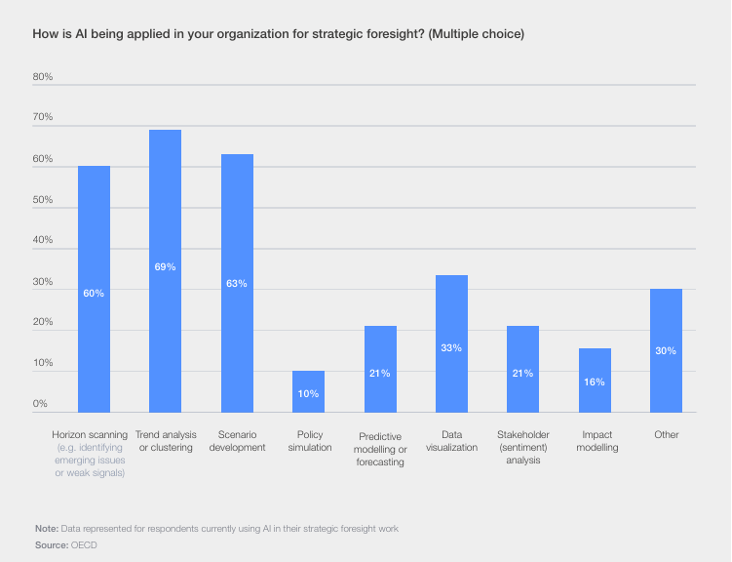
At this stage, where most foresight experts currently operate, AI is used to accelerate the early research phase by performing tasks such as synthesising data, conducting horizon scans and clustering signals. Between 60% and 69% of survey participants use AI in this way. They note that, at this level, AI acts as a digital research assistant that is good at gathering and summarizing, but incapable of true judgement.
Level 2: Creative sparring partner
While most work with AI is done at level 1, the research suggests practitioners should invest time in using AI as an idea generator and sparring partner that can stress-test human-generated content. At this level, AI tools can help to systematize and summarize signals, offer ideas for study structure, suggest scenarios based on uploaded data, help to compare collected signals with other factual data and help to speed up the search for relevant information.
Level 3: Integrated workflow
Even rarer, this level involves embedding AI throughout the entire foresight process. In these few frontier cases, foresight teams are building tailored tools and even deploying AI agents that continuously collect, cluster and analyse information streams.
Together, these three levels reveal a profession experimenting with new forms of cognition.
The AI productivity revolution
When asked about the benefits of AI, foresight experts are split. The most frequently cited advantage, named by 39% of respondents, is time efficiency. AI handles the repetitive, labour-intensive work of scanning and synthesis, freeing practitioners to focus on higher-order tasks like interpretation and narrative building.
Other benefits include data processing and analysis (17%), or uncovering hidden trends in vast datasets. Idea generation and creativity is cited as a benefit by 12%, who use it to produce first drafts or new perspectives. For another 10% of respondents, scenario development is a key benefit for generating and refining multiple possible futures. And finally, improved quality and scope (7%), and accessibility for non-experts (4%) mean AI is lowering barriers to entry in a field once limited to specialists.
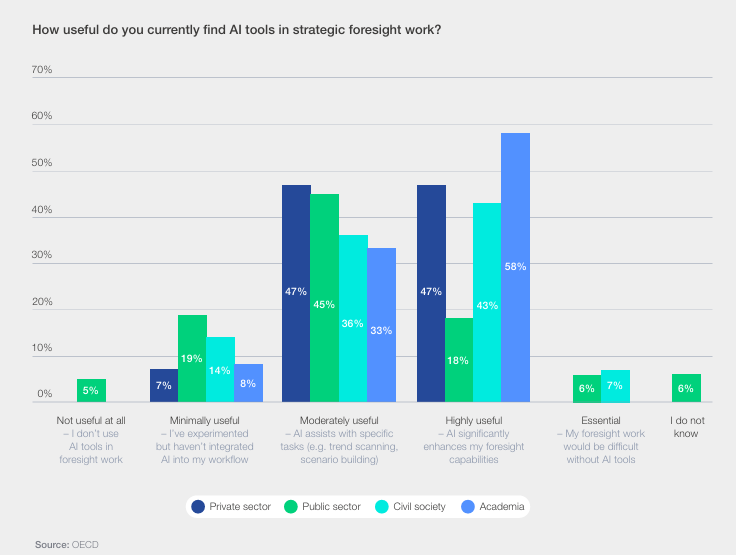
Overall, however, practitioners say AI accelerates their ability to conduct foresight. Of those from civil society organizations who have experience using AI, for example, 43% report that the technology is highly useful to their work, while 47% of survey participants from the private sector find it moderately useful.
The trouble with thinking machines
Yet the same survey also underscores profound unease with using AI because its advantages come with new risks.
The most prominent concern is output quality and trustworthiness. Many users note that AI-generated material can feel shallow or derivative – more remix than revelation – leaving them uncertain about what can be relied on and what requires reworking.
Bias is another major issue. Respondents point to the dominance of English-language and Western data sources, which can distort global perspectives and obscure weak signals emerging from other regions or cultural contexts.
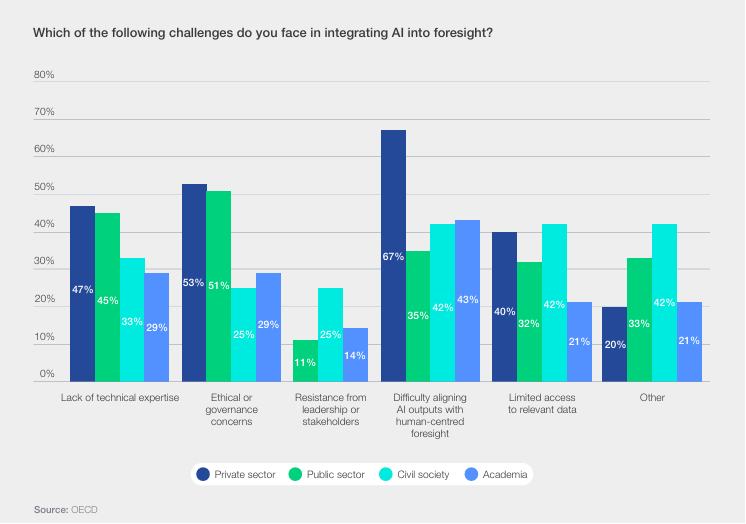
Ethical and governance gaps also weigh heavily. Many organizations still lack clear guidelines for responsible use and public sector teams in particular remain cautious due to data security and confidentiality constraints. Combined with the opacity of AI’s reasoning, this can turn foresight work into an audit exercise, where practitioners spend more time validating than imagining.
Even the technology’s strengths create new dependencies. As AI automates more foresight functions, practitioners risk losing touch with the very intuition and pattern recognition that define the discipline. Several warn of a creeping “deskilling effect” – the temptation to outsource judgement to algorithms trained on yesterday’s knowledge.
A turning point for strategic foresight
The OECD–World Economic Forum survey reveals a field standing on the edge of transformation. Practitioners now face several imperatives if they want to integrate AI ethically into strategic foresight practice. They must:
- Build AI literacy, especially in the public sector, where confidence in using AI lags industry
- Develop ethical frameworks to ensure transparency, accountability and data integrity
- Encourage experimentation such as small pilots and sandboxing to explore new AI-enabled methodologies
- Preserve human creativity to treat AI as a collaborator, not an oracle
As AI reshapes the strategic foresight process, it will also reshape what it means to “think ahead”. Machines can map the past and model probabilities, but the courage to imagine alternatives, to choose among futures, remains profoundly human.
The future of foresight is hybrid
Humans are never obsolete. AI may transform how we anticipate change, but foresight’s purpose remains the same: to help societies navigate uncertainty with wisdom, ethics and imagination.
The next frontier is not more automation, but smarter collaboration. This technology can analyse large volumes of data and support information gathering that, in turn, will allow strategic foresight practitioners to ask better questions about the future we truly want to create.
Don't miss any update on this topic
Create a free account and access your personalized content collection with our latest publications and analyses.
License and Republishing
World Economic Forum articles may be republished in accordance with the Creative Commons Attribution-NonCommercial-NoDerivatives 4.0 International Public License, and in accordance with our Terms of Use.
The views expressed in this article are those of the author alone and not the World Economic Forum.
Stay up to date:
Strategic Foresight
Related topics:


Forum Stories newsletter
Bringing you weekly curated insights and analysis on the global issues that matter.
More on Artificial IntelligenceSee all

Gayle Markovitz and Maxwell Hall
April 7, 2026


