How suppliers in heavy-emitting sectors are turning barriers into breakthroughs
There is corporate demand for low-carbon solutions to aid decarbonization, now we must turn to supply Image: REUTERS/Regis Duvignau
Daniel Boero Vargas
Lead, Industrial Decarbonization Innovation, Supply and Concrete, World Economic Forum- The First Movers Coalition (FMC) mobilizes corporate demand for low-carbon and near-zero solutions, but scaling supply continues to be constrained by barriers across different industrial sectors and regions.
- Across FMC materials and transport sectors, suppliers have highlighted a number of similar challenges across technological, market, financial and policy-related issues.
- Turning Challenge into Opportunity: Supplier Voices from Heavy-Emitting Sectors is a new FMC report that underscores that scaling low-carbon supply requires coordinated and sustained action across value chains.
As hard-to-abate industries seek to decarbonize, the First Movers Coalition (FMC) has primarily focused on mobilizing demand by using collective purchasing commitments from more than 100 major companies to send a strong market signal for low-carbon solutions.
However, since the FMC's launch in 2021, its work has made clear that demand-side ambition alone is not enough. Those commitments cannot be met without a sufficiently low-carbon supply at scale, at commercially viable prices and available in key regions.
To help close that gap, the FMC’s First Suppliers Hub is focusing on the supply side of industrial decarbonization at the FMC’s ambitious thresholds, while also providing a platform for low-carbon supply to meet demand.
The FMC’s new insight report, written in collaboration with Deloitte, Turning Challenge into Opportunity: Supplier Voices from Heavy-Emitting Sectors, draws on more than 30 interviews with executives from low-carbon suppliers across mobility (aviation, shipping and trucking) and materials (aluminium, carbon dioxide removal, cement and concrete and steel).
The paper distils nuanced discussion insights into clear sector snapshots and extrapolates shared cross-sectoral themes.
While it is vital to identify the critical, real challenges facing low-carbon suppliers, this process also reveals reasons for optimism and opportunity, further amplified when demand- and supply-side efforts work in tandem.
Common mobility and materials supply-side challenges
Suppliers describe how policy and finance pose shared cross-cutting challenges that shape their ability to scale.
The critical role of policy
Across sectors, suppliers stress that clear, consistent and durable policy is a key lever for converting decarbonization ambitions into investable demand. Yet, fragmentation and variability constrain scale.
In mobility, suppliers see policy as essential to create predictable demand signals for low‑carbon fuels and technologies but variable regional regulations and delayed global alignment hinder cross‑border scalability and complicate operations for multinational players.
In materials, inconsistent carbon pricing, shifting incentives and variable scope create uneven competitiveness and planning uncertainty, with aluminium, steel and cement developers navigating changing eligibility rules and standards.
The result often is hesitation on capital‑intensive projects and a slower pace of innovation. From the suppliers’ standpoint, the policy imperative is clear: translate and align internationally, standardize compliance and market signals and stabilize long‑term incentives to unlock scale across sectors.
Financing and risk allocation
Financing is a pivotal constraint – large upfront capital, long payback horizons, and layered risk (demand uncertainty, evolving policy and cross‑border complexities) raise the hurdle rate for investors and lenders.
Mobility suppliers face asset‑stranding concerns, technology and operational risks and difficulty securing capital without standardized, multi‑year offtake. At the same time, periods of currency swings and regulatory shifts further complicate global financing.
Materials suppliers confront similar demand risks, amplified by variable certification and policy frameworks; absent durable offtake, projects default to limited grants or philanthropic capital, stalling scale.
The following solution set or some combination of the following, offers promise: deploy standardized contracts, contracts‑for‑difference, pooled buyer syndicates and harmonized financing terms to share risk, stabilize revenue and unlock investable pipelines at a global scale.
These challenges form a shared backdrop against which more sector-specific challenges and opportunities play out.
Sector-specific dynamics
Within this shared landscape, each sector faces its own mix of constraints, opportunities and solution pathways.
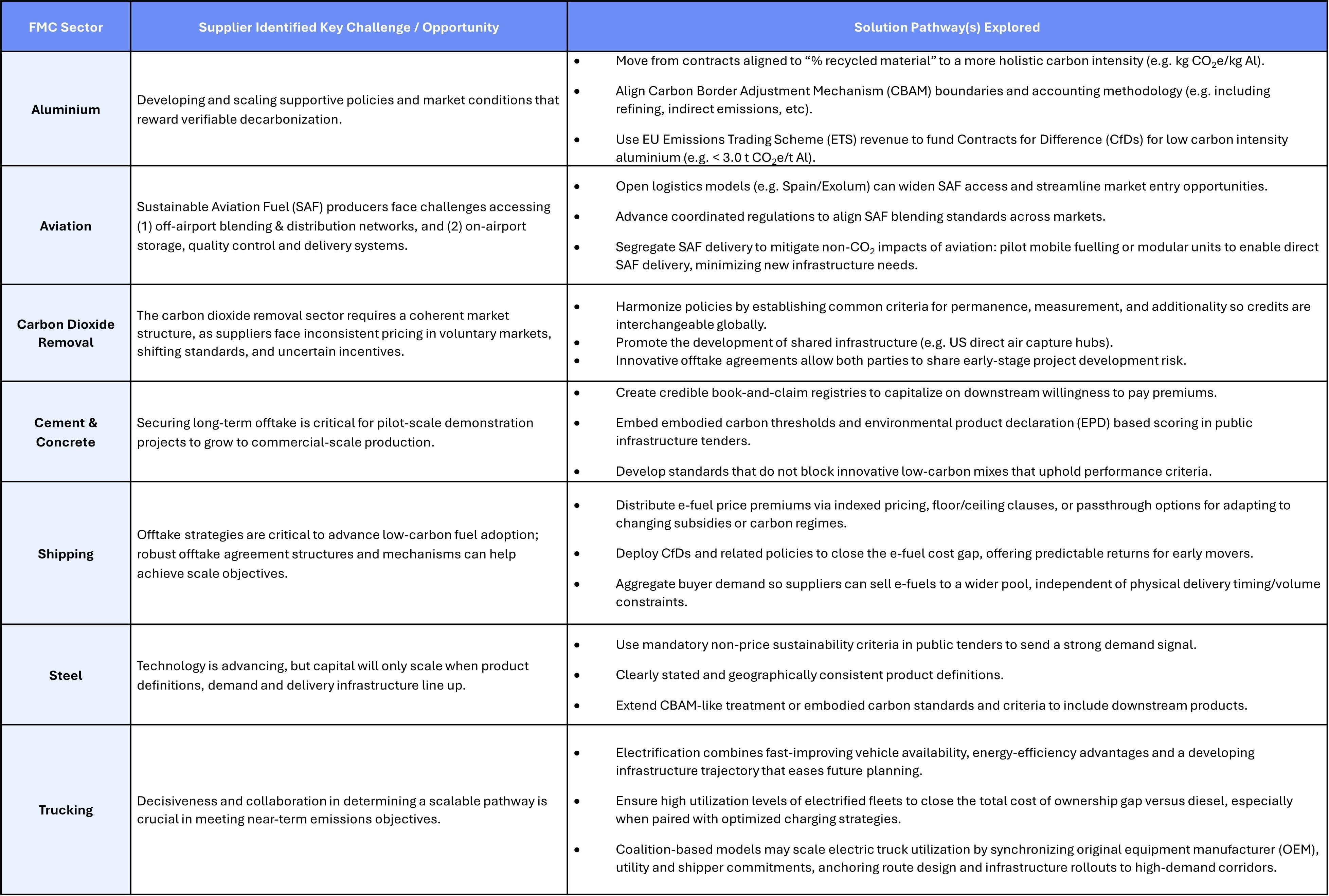
Looking ahead: From barriers to breakthroughs
Taken together, supplier voices from FMC sectors paint a picture that is both challenging and hopeful. The barriers are real but the landscape is not static.
Demand commitments are evolving, supplier project pipelines are expanding and collaboration helps align incentives and share risk.
Platforms such as the FMC’s First Suppliers Hub, with over 260 projects from over 150 suppliers, help connect supply with demand to increase the number of offtakes of deeply decarbonized goods and services across heavy-emitting industrial sectors.
The core message from suppliers is not that the transition is stalled but that it requires coordinated, sustained action across the value chain and across regions. Demand-side initiatives such as the FMC, leveraging supply-side visibility and engagement through the First Suppliers Hub, are well-positioned to help close the gap between ambition and implementation.
Turning Challenge into Opportunity: Supplier Voices from Heavy-Emitting Sectors offers deeper sector-specific insights and concrete recommendations for buyers, policymakers, financiers and suppliers alike.
Readers are encouraged to engage with the findings and with the FMC and First Suppliers Hub communities, to help move heavy-emitting sectors beyond pilots and toward scalable, commercially robust low-carbon solutions.
Don't miss any update on this topic
Create a free account and access your personalized content collection with our latest publications and analyses.
License and Republishing
World Economic Forum articles may be republished in accordance with the Creative Commons Attribution-NonCommercial-NoDerivatives 4.0 International Public License, and in accordance with our Terms of Use.
The views expressed in this article are those of the author alone and not the World Economic Forum.
Stay up to date:
Heavy Industry
Related topics:

Forum Stories newsletter
Bringing you weekly curated insights and analysis on the global issues that matter.
More on Industries in DepthSee all

Francisco Betti, Hernan J.F. Saenz, III and Karen Harris
March 14, 2026


