From poodles to pies: 8 leaders' analogies that stayed with us from Davos
Here's a selection of our favourite analogies from a week of interesting conversations in Davos. Image: World Economic Forum / ALAVEE
- Analogies are verbal tools, allowing the leaders that wield them to distill complex ideas into simple phrases.
- The World Economic Forum's 56th Annual Meeting in Davos, Switzerland, took place from 19-23 January 2026 - and more than a few analogies were shared by world leaders.
- Here's our selection of snappy one-liners that will help us better understand the challenges facing the world this year.
With the world's leading voices congregating in Davos for one week every year, it's no surprise we walk away with some new ideas and clever analogies.
Leaders love analogies - a comparison between one thing and another - because it's a shortcut to explaining a complex issue. They turn otherwise dry information into vivid stories that people can picture and feel.
Analogies, it is true, decide nothing, but they can make one feel more at home.
”When messages are more persuasive and memorable, that's when they're more likely to drive action - and leaders at Davos know that.
The undisputed queen of analogies at Davos 2026 was Kristalina Georgieva, Managing Director, International Monetary Fund, who compared issues to everything from poodles to accordions.
Here are our top picks from the World Economic Forum's 56th Annual Meeting.
Kristalina Georgieva on accordions and other things
On trade tensions the world experienced this year, Georgieva said: "We expected a big German Shepherd to bark. It turned out to be a cute little poodle."
All bark, no bite, it turns out.
Spring-cleaning was her analogy for excessive government regulation: "Every so often, as you do in your house, look at your regulations. What do you need? What is unnecessary? Get it out."
And on the potential for AI to further inequality: "The world as a whole is already experiencing the arrival of AI, but I do worry about the accordion of opportunities that are much more present in some places than in others."
Mark Carney on the dinner table
Many leaders of middle powers stressed unity and collaboration in these turbulent geopolitical times, with Canada's Prime Minister, Mark Carney, summarizing the challenge neatly:
The middle powers must act together because if we're not at the table, we're on the menu.
”Volodymyr Zelenskyy on well-seasoned salads
The Ukrainian President, Volodymyr Zelenskyy picked up the food theme. He gave a frank address to the Congress Hall about the need for a European "coalition of action" and through this, the "chance to be a great power together".
We should not accept that Europe is just a salad of small and middle powers seasoned with enemies of Europe.
”Zelenskyy reinforced this point by stating that "when united, we are truly invincible".
Brad Smith on multi-coloured quilts
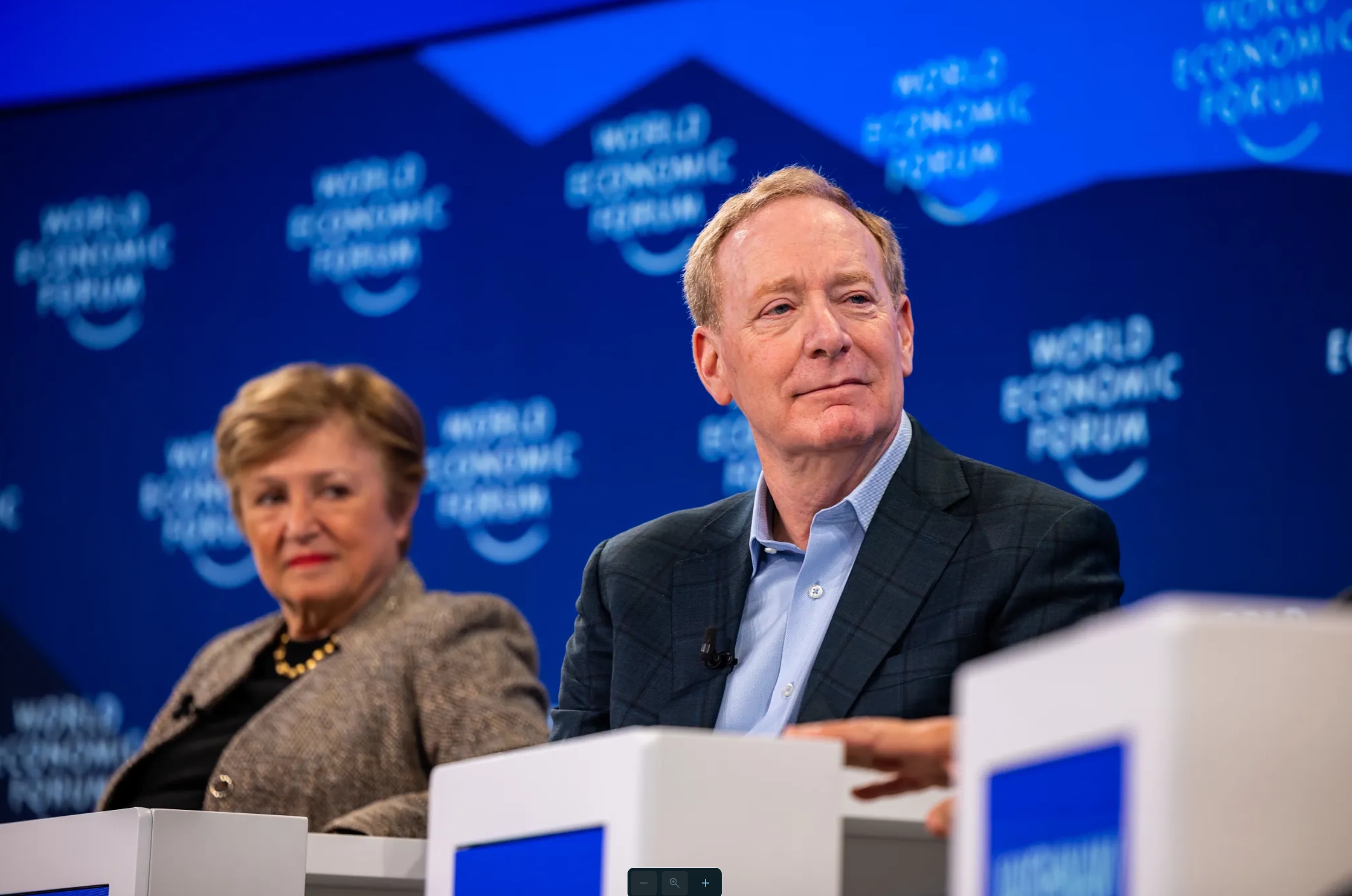
The world is a "quilt with different colours of fabrics" when it comes to creating data centres, said Brad Smith, Microsoft's Vice-Chair and President.
In the US, they're being blocked. Meanwhile in Europe, governments want to use taxpayers’ money to fund them. One key difference is that it’s incumbent on US companies that run data centres to assuage the concerns of local people about their energy and water supply - and explain who will benefit.
He Lifeng on ships and pies
Vice-Premier of the People's Republic of China, He Lifeng, delivered a Special Address on Tuesday morning. He cautioned against rising unilateralism and protectionism, urging countries to come together.
"Amidst the raging torrents of a global crisis, countries are not riding separately in some 190 small boats, but are rather in a giant ship on which our shared destiny hinges."
He's next analogy on economic development might have had something to do with it being just before lunchtime on Tuesday...
Making the pie bigger together is more important than fighting for the pie, and solving problems together is more effective than blaming each other.
”Whatever the inspiration, it's a message we can all understand.
License and Republishing
World Economic Forum articles may be republished in accordance with the Creative Commons Attribution-NonCommercial-NoDerivatives 4.0 International Public License, and in accordance with our Terms of Use.
The views expressed in this article are those of the author alone and not the World Economic Forum.

Forum Stories newsletter
Bringing you weekly curated insights and analysis on the global issues that matter.
More on LeadershipSee all

Murchana Roychoudhury
March 8, 2026


