How AI is reshaping global preparedness for infectious disease
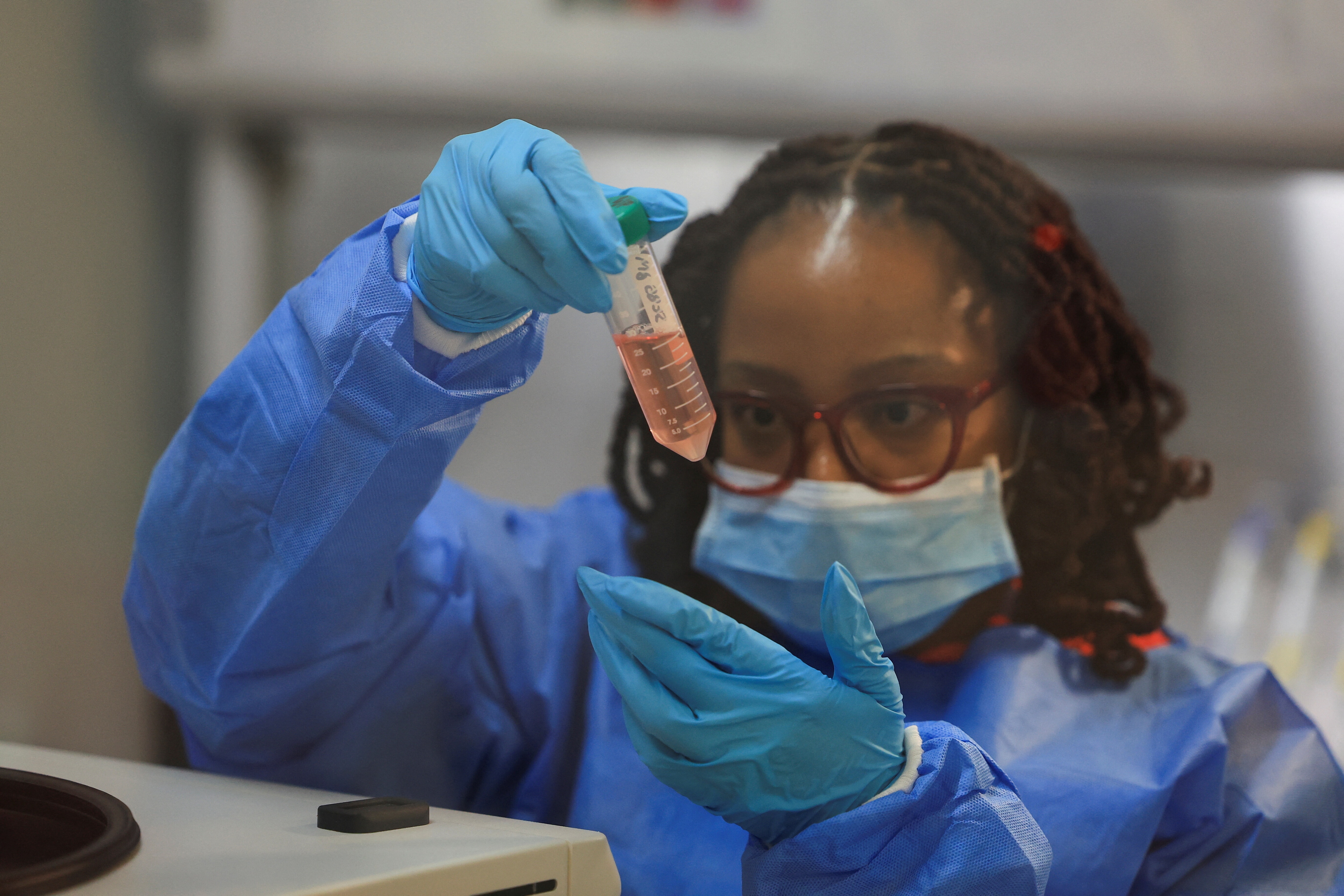
The World Economic Forum is supporting the development of two global digital platforms that use AI to transform infectious disease research and response. Image: REUTERS/Esa Alexander
- The ability to quickly identify, characterize and develop treatments for dangerous pathogens is critical to reducing social and economic harm.
- AI-enabled platforms can securely synthesize information from across sectors and geographies, transforming how the world anticipates and responds to emerging and shifting infectious diseases.
- To harness this powerful and timely opportunity, the World Economic Forum announced at its 2026 Annual Meeting two complementary global digital platforms to serve as global public goods: the Pandemic Preparedness Engine and the Global Pathogen Analysis Platform.
Staying ahead of rapidly evolving pathogens remains a central challenge for governments, industries and communities worldwide. The ability to quickly identify, characterize and respond to infectious disease threats is critical to reducing social and economic harm.
Beyond public health, infectious disease risk has also become a defining component of economic and national security. Outbreaks disrupt global trade, strain critical workforces, undermine investor confidence and create cascading impacts across sectors such as manufacturing, agriculture, logistics, travel and finance. Strengthening pathogen intelligence and the readiness of countermeasures is, therefore, foundational infrastructure for resilient economies and societies.
In this constant race against biological evolution, artificial intelligence is increasingly central to how the world anticipates and responds to disease threats. Importantly, AI is not a single tool but a spectrum of complementary approaches. Inference-driven and analytical methods, such as statistical modelling, epidemiological surveillance, and mechanistic simulations, remain essential for detecting signals, estimating risk, validating evidence, and supporting decision-making.
Generative artificial intelligence builds on this foundation by synthesizing complex evidence, exploring scenarios, generating hypotheses and speeding up design processes that would otherwise take months or years. Agentic artificial intelligence extends these capabilities further by enabling autonomous, goal-directed systems that can plan, act and coordinate multistep tasks with minimal supervision. It can be applied to integrating data, selecting tools, executing workflows and delivering insights in real time. Together, these approaches enable a more complete, responsive and resilient health security system.
To harness this opportunity, the World Economic Forum is supporting the development of two complementary global digital platforms designed as shared public-interest infrastructure: the Pandemic Preparedness Engine (PPX) and Global Pathogen Analysis Platform (GPAP). These platforms expand access to advanced analytical and generative capabilities while preserving appropriate governance, data sovereignty and safeguards.
The Pandemic Preparedness Engine (PPX)
PPX is the world’s first global, AI-factory-based platform designed to rapidly identify infectious disease risk and expedite the G7-endorsed 100 Days Mission to develop vaccines against viral threats within 100 days of identification. A World Economic Forum-hosted and incubated project, PPX is led by a Secretariat comprising the Coalition for Epidemic Preparedness and Innovations (CEPI), the University of Chicago and the European Vaccine Hub at the Sclavo Vaccine Association.

At its core, PPX is an end-to-end research and development platform that integrates data across the vaccine lifecycle – from genomic surveillance, epidemiological modelling, viral evolution, antigen design, clinical development and safety monitoring to regulatory submission. An agentic AI framework underpins this digital pipeline, enabling the estimation of outbreak dynamics, validation of preclinical and clinical evidence and robust hypothesis generation to support scientific and policy decisions.
The PPX platform uses this agentic AI architecture to integrate insights across disciplines, proposing vaccine designs, exploring alternative manufacturing pathways and compressing development timelines from months to days. As new data and research become available, they are continuously incorporated, allowing PPX to function as a dynamic scientific resource for both public and private sector users.
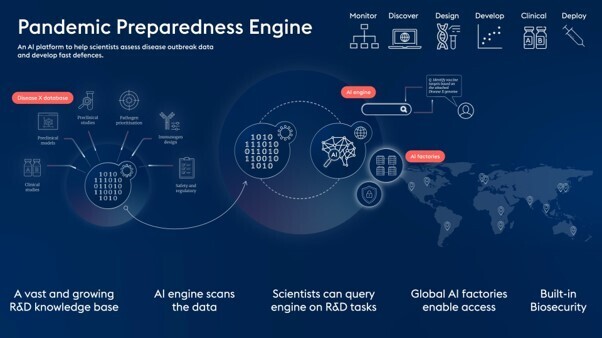
Equitable access, benefit-sharing, security and the responsible use of AI are foundational to PPX’s design. The platform will operate as a global digital commons, working with governments and research institutions to establish a federated network of international computing hubs or AI factories. This approach expands global access to state-of-the-art tools while maintaining strong data protection, national sovereignty and biosecurity-by-design safeguards.
PPX is designed to operate as part of a broader, integrated system for health security, working in close alignment with the Global Pathogen Analysis Platform.
Global Pathogen Analysis Platform
The Global Pathogen Analysis Platform (GPAP) is the world’s first globally accessible, AI-powered platform designed to turn pathogen data (from across human, animal, plant and environmental systems) into standardized, actionable intelligence at scale. GPAP closes a critical gap between the growing volume of genomic and surveillance data and the limited capacity to rapidly analyse, compare and interpret that data for decision-making, particularly in low and middle-income countries.
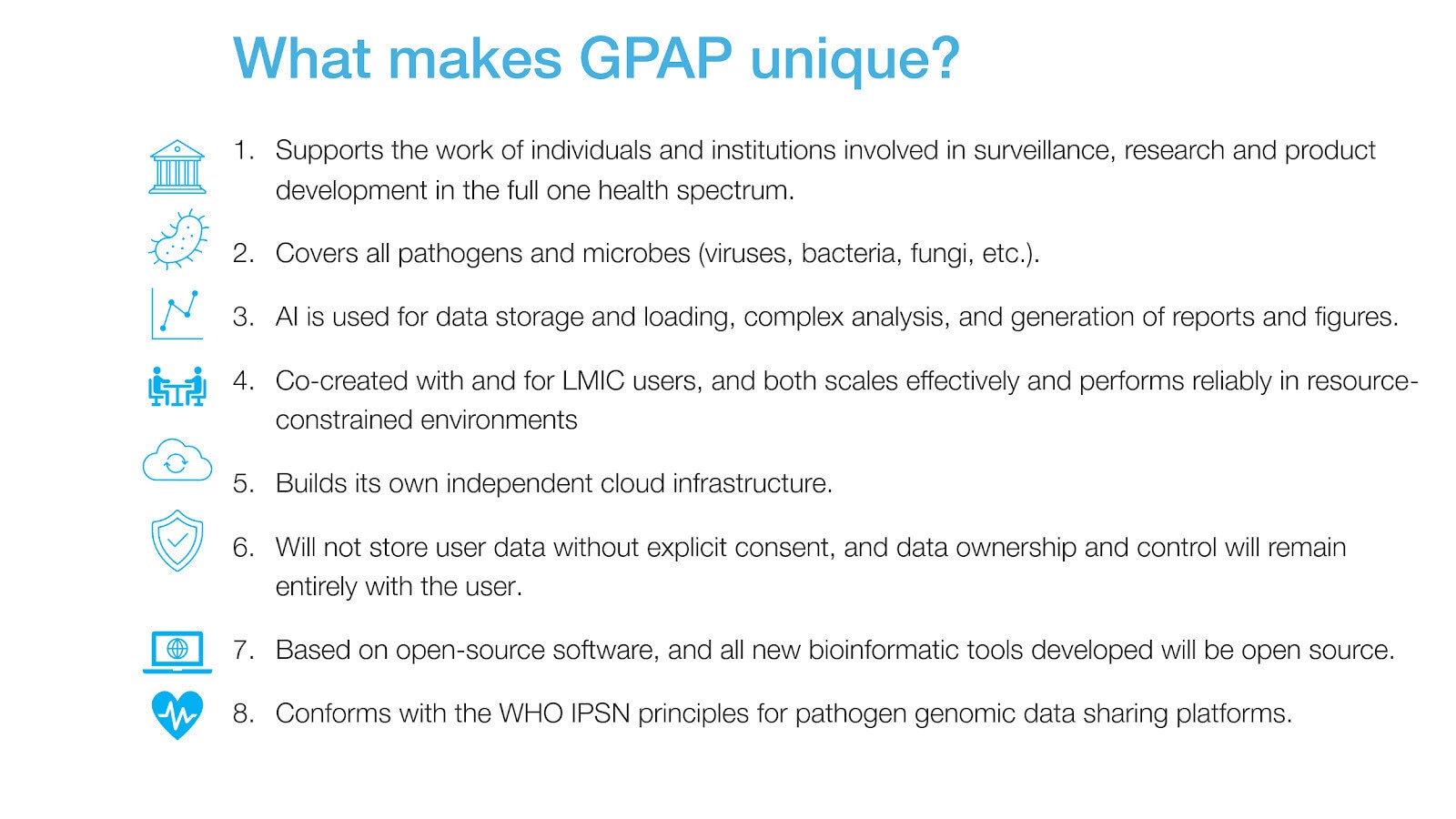
To achieve its goal, GPAP combines bioinformatics and AI to make infectious disease genome analysis widely accessible and to connect surveillance systems across sectors and countries, especially among low and middle-income countries.
Funded by the Novo Nordisk Foundation and established by the Technical University of Denmark in collaboration with the University of Copenhagen, the Statens Serum Institut and a global consortium convened with the World Economic Forum’s Health Security Initiative, GPAP combines advanced bioinformatics and analytical AI with a federated, user-controlled data model. It provides free access to state-of-the-art analytical tools, alongside optional secure services for data storage, sharing and collaboration. At the same time, it ensures that full ownership and control of data remain with users.
GPAP strengthens preparedness by enabling earlier detection of emerging pathogens and variants, faster comparison of signals across countries and sectors and the generation of timely, decision-ready insights. These capabilities rely on robust inference and analytical methods that support surveillance, estimation and validation across One Health domains.
In parallel, GPAP delivers day-to-day value for industries by enabling earlier risk detection, faster incident investigation and improved continuity planning. Sectors such as food and agriculture, biotechnology, diagnostics, manufacturing and logistics can use GPAP insights to reduce disruptions, protect workforces and safeguard supply chains against biological risks.
Linking detection to response
PPX and GPAP represent a new generation of AI-enabled global public infrastructure for research and development to combat emerging and future pathogen threats. Together, they form a complementary system: GPAP strengthens the world’s ability to detect, analyse and interpret pathogens through genomic intelligence and advanced analytics; while PPX transforms that intelligence into rapid vaccine research, development and manufacturing at scale, closing the gap between scientific insight and effective countermeasures.
By linking AI-enabled pathogen analysis with AI-enabled vaccine R&D, PPX and GPAP enable faster, more coordinated responses to biological threats before they escalate into global crises. They compress development timelines, reduce uncertainty and strengthen global resilience by ensuring that cutting-edge science translates quickly into real-world protection. This can help the world stay ahead of both known and unknown pathogen threats.
Get involved
Following the formal launch of PPX and GPAP at the World Economic Forum’s Annual Meeting in Davos this month, the Forum’s Health Security Initiative will support the design, coordination and strategic alignment of both platforms. Taking advantage of the Forum’s neutral convening role, this work will bring together governments, researchers and industry partners, while operational leadership remains with the respective host institutions.
We invite partners from technology and AI, pharmaceuticals, biotechnology, diagnostics, food and agriculture, supply chain and logistics, finance, reinsurance, travel and aviation, retail and other workforce-intensive industries to participate in the co-creation phases. By engaging early, partners can help shape a trusted, AI-enabled health security infrastructure that delivers shared protection, economic resilience and long-term value.
This article was contributed to by Lora du Moulin, Global Health and Security Lead at the World Economic Forum; Dr Polina Brangel, Research and Development Project Manager at CEPI; Dr Anna Chailyan, Senior Scientific Manager, PhD, at Novo Nordisk Foundation; Mats Olsen, Disease X - Senior Business Development Manager at CEPI; Dr Newton Wahome, Global AI Innovations Lead at CEPI; and Professor Henrik Wegener, Project Director, Global Pathogen Analysis Platform at the Technical University of Denmark.
Don't miss any update on this topic
Create a free account and access your personalized content collection with our latest publications and analyses.
License and Republishing
World Economic Forum articles may be republished in accordance with the Creative Commons Attribution-NonCommercial-NoDerivatives 4.0 International Public License, and in accordance with our Terms of Use.
The views expressed in this article are those of the author alone and not the World Economic Forum.
Stay up to date:
Pandemic Preparedness and Response


Forum Stories newsletter
Bringing you weekly curated insights and analysis on the global issues that matter.
More on Health and Healthcare SystemsSee all

International Women’s Day 2026: Leaders’ call to correct bias in women’s health research and funding
Dhwani Nagpal
March 8, 2026


